


24. 02.2022
Day 1.
The explosions were heard in Kyiv’s Troyeshchyna district many times, since 5.00 a.m. Until this day, I had never thought that this could happen. We pray… Russia attacked us. The war has begun. Again. I learned a new word: PVO (air defence, missile defence). It turns out that from 5-7a.m. I had been hearing our air defence repelling Russian missiles. Thank God, Dad and Grandma won’t hear it… They are in a better world.
25.02.2022
Day 2.
It is the war.
I would never, ever have imagined myself saying this, but: I am grateful that my dearest father passed in 2020, and he isn’t witnessing how his country of birth, Russia, is outrageously attacking the place he called motherland, Ukraine.
I would never, ever have imagined myself saying this, but: I am grateful that my beloved grandmother passed in December 2021. This loss is still so fresh and hurts. But she is in the other, better world now. She survived the Nazi occupation in Kyiv during WWII, and this war, again, may have killed her.
My mother, our cat and I are in Kyiv. Yesterday, which seems already a week ago, I took my documents, money, a few things, photos, and an external drive with all my work for the last twelve years, and came to my mom’s place. I’ve sent the manuscript of my book to my dear friend in Poland just in case. To preserve it. What if we die…?
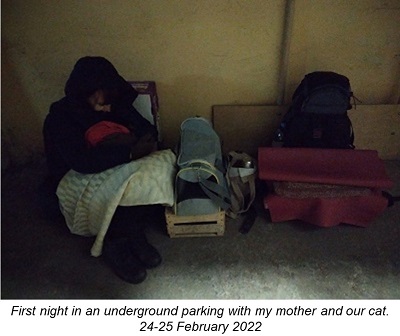
My mother, a cat we’ve inherited from my granny and I spent last night in an underground car parking nearby. We were frozen there. But safe. Many other people were there, with children and pets. At 3a.m., when another wave of Russian shelling got underway, we heard it, so close. Poznyaky area is not far from us. The poor cat was shaking. The dogs were screaming; kids crying. But! The men were so brave, keeping themselves calm and calming the women and kids. They stayed near the entrance to the parking, together, like a chain, ready to face anything, even without any weapons.
We went home at 7a.m. Tried to sleep, but didn’t succeed. I went to walk nearby, and it was such a contrasting experience to see that blue pre-spring sky, sun there, high and almost warm, listening to birds singing and air-alert alarms simultaneously. First green grass. Explosions somewhere to the North. Men staying near the district administration, calm and strict, saying that they would protect their home. From Russians. That was the first moment during those mad days when I felt tears in my eyes.
We will survive. I pray and hope for that.
I am overwhelmingly grateful for all those friends and colleagues writing me from all over the world, including those brave friends in Russia, who go out and protest against this war. My heart is melting because of the greatest support ever from Poland and Lithuania. Every person proposes to give us a shelter and host us, with our cat. That warms my heart. So good to know that you are there, you who care. Perhaps there will be that time again when we would be able, again, to talk about books we’ve read, and fieldwork we’ve conducted.
Now we stay in Kyiv. My mother doesn’t want to leave the city, categorically, and I am with her.
Thank you for being for us. For helping us. For your prayers and empathy.
I have always been convinced that Love will save every person, and the world. My life started because of love, I live for love and from love.
27.02.2022
Day 4.
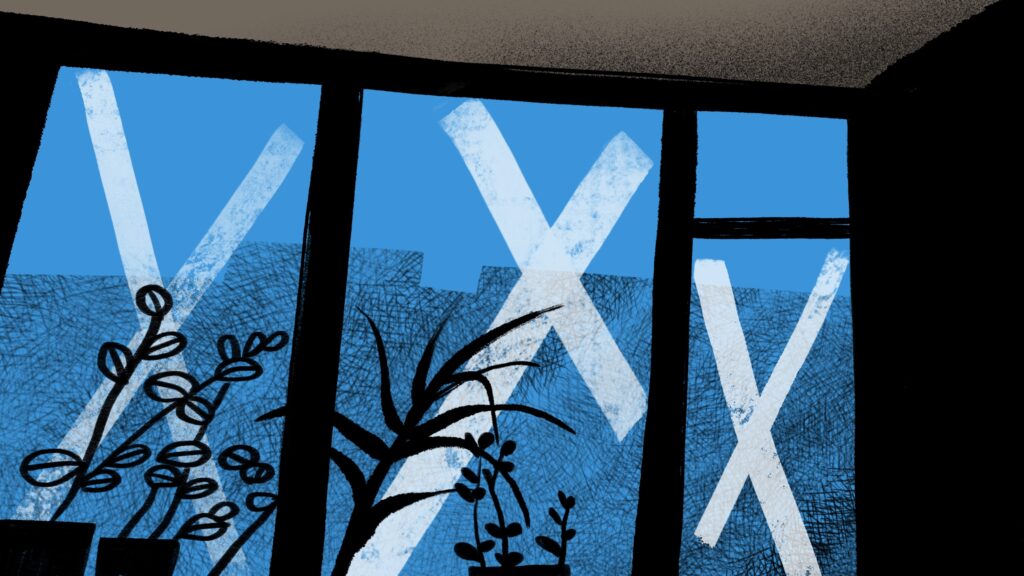
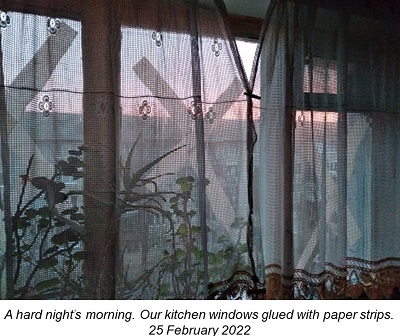
Every night there is shelling in Kyiv, it is under Russian siege, and we don’t sleep. Today, for the first time since the morning of the 24th of February, I was able to fall asleep for as much as four hours. The sounds of air-alarm sirens, the sounds of Russian shelling, the sounds of our air defence. We learn to distinguish shades of sounds: far or close. The windows glued with paper sticks and covered with cardboard, blankets and pillows. My grandmother had said that they did this during World War Two, when Kyiv was attacked by Nazis. Did we think we could use great-grandmother and grandmother’s survival strategies? At home, we have a supply of toilet paper, candles and cereals, which my grandmother made last fall. Because she survived the war as a child, she always saved certain foods just in case, for a black day. And here you go. My mother and I think about her and thank God that he took her in December so that she is not living through the war again. What would my great-grandfather say, who fought together with Russians against Nazis near Stalingrad, now that their tanks are in his city where his granddaughter and great granddaughter live? What a blessing that he died in the late 1990s and he didn’t see that shame.
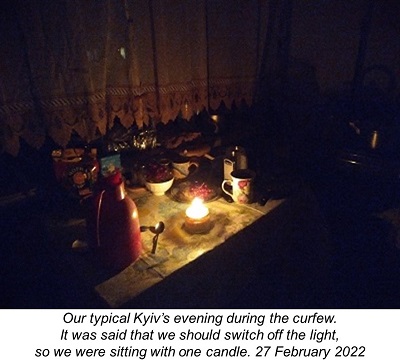
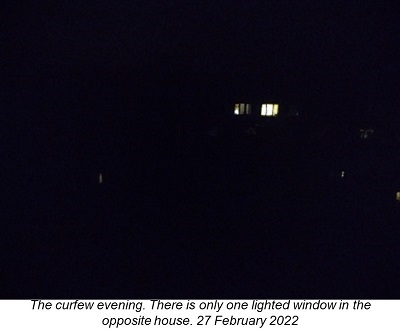
We check friends and colleagues, we read that Kharkiv, Mykolaiv, Chernihiv, Sumy, Odesa are under Russian siege. We pray. Here is my grandmother’s old prayer book, here are prayers written by her hand. I miss her tremendously, I cry. Here is the Psalter. I read Psalm 90 and my voice is shaky. Mom repeats after me “Amen, amen, amen.” At night we don’t turn on the lights. We sit with a candle. Only one window across the street has light. The whole building is black. The cat is afraid of loud noises and is shaking upon hearing air sirens or explosions. He is hiding or clinging to us. At night we cuddle together; the three of us are not so afraid to endure the night, when we sleep in one bed. The cat is sleeping between me and mom, and still shaking when she hears the sirens. Why did the Russian army come to fight with us, with women and cats? I can’t understand anything: why do they obey him, why do they follow the orders of someone who is sitting in a bunker far away, and who doesn’t care at all about them? Why do they come to us, to a foreign country, and kill? Are they really so pumped up with propaganda? What, can’t they think? What about their parents and families? After all, these are the lives of their fathers, brothers, sons, husbands, lost in a foreign country, on foreign land? And for what, for what? Once again I think how good it is that daddy is no longer with us, because for him, an ethnic Russian, it would be a double tragedy… May God give us the chance to survive. Each person is originally a light, a spark of divine love, because life is such a priceless, incredible gift. I am so grateful for the incarnation in the human body and for all that life has given me already. For emotions and feelings, for the beauty of nature that I can contemplate. Even now the birds are singing between the sounds of sirens and shelling. Why does the light in people turn into such an abyss of darkness? Why do monsters of greed, chauvinism, and war possess the mind and soul… And all this continues throughout history. I love the ancient Greek historian Thucydides and his History of the Peloponnesian Wars. It seems to me that his thoughts and conclusions are, in a certain sense, quite applicable today.
Please, God, help us survive this. May God grant us all the will to survive this war, to defend Ukraine, our home. And may God grant us here that we not be destroyed by the hatred within. God grant that light will be stronger than darkness in every sense.
28.02.2022
Day 5.
The fifth day of the Russian invasion ended for us in a strong explosion. It was the strongest explosion we’ve heard during these days. It was so close that my mother and I saw a kind of fireworks in the sky, and then everything became red for a second. The glass in the windows was shaken. And what was most horrifying: I felt like something pushed my body, into every part. Both inside and outside. We went quickly to the corridor. Our poor cat was terrified by this sound and its effect, so much that he disappeared immediately somewhere under the coach. He came out a long time after that. It had been a Russian rocket, sent from the territory of Belarus. It hit one of Kyiv’s neighbourhoods not so far from us. I can only imagine how it was felt there.
Thankfully, we are fine and safe. I think in their everyday lives, people tend to be so ungrateful for what they have. And we have so much. While we breathe, are able to see and smell, and listen. We lament and always want more. The growing consumerist culture has made humans so greedy, so wanting to possess. Another person, or more new clothes, or food, or jewellery, or houses and cars, islands, countries. This is endless.
The air-alert sirens are so loud now. My mother and I are sitting with one candle. We are checking in with friends, they are checking in with us.
In fact, we don’t need so much for happiness or to be grateful. Every war in the history of humanity springs from humans’ greed and desire to possess. Greek-Persian wars, the Peloponnesian wars, the campaigns the Roman empire conducted, The Crusader wars, the Hundred Years war, two World Wars… I name just a few. Humans kill other humans to possess. All these bloody, mad days I am reminding myself of John Lennon’s song “Imagine”. My dad, let his memory be blessed, loved it. “No need for greed or hunger, a brotherhood of men.” So true and so utopic in our world. On the other hand, shared pain and disaster make people united and kind again. We witnessed it during the recent pandemic. But why can’t we be kind in our everyday? To produce, live and share love with others. Humans, pets, nature. Utopia, I know. But still…
Another wave of air-alert alarms. I remember some stories my grandmother used to tell me. How she survived a great war as a child. My great grandmother remained in Kyiv with my little granny and her blind stepmother (she was Polish and was afraid to confess her Polishness even when she was old and blind, during the war…). My great grandmother also had an elder sister, who remained in Kyiv with her two kids. Only women with kids. Strong, but still tender and so beautiful. My mother told me that she wouldn’t leave Kyiv anyway: “Our family has been living here since the end of nineteenth century; I won’t go anywhere. Our family survived the Nazi occupation here; I won’t go anywhere. I will survive this Russian one as well.” My mother is a Russian-speaking Ukrainian with Polish, Jewish and Ukrainian roots. She is also an archaeologist, and very anxious about the fate of archaeological sites and collections during this war. She won’t go anywhere. And I am staying with her, with the cat we’ve inherited from my granny. I don’t know what can force me to leave them in my native Kyiv, and I don’t want to think about it.
Air-alert alarms again… Sirens are part of my world now.
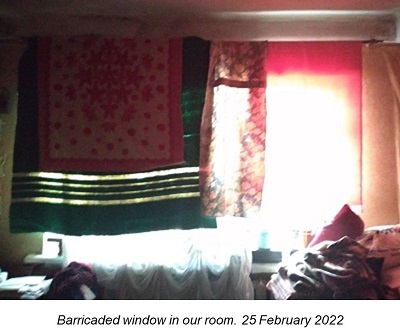
We haven’t switched on the light since Thursday. We are sitting in the dark, with a candle. Making supper by candle-light, using the phone somehow. We knew how to prepare our flat for the possible damage from the air attacks because of my grandmother’s stories about wartime in Kyiv in 1941-1943. We cover the windows with long paper lines, then put blankets on them. In the room where we sleep, the window is barricaded by pillows, books, clothes, all that. We sleep in the distant corner of the room, closer to the corridor, always ready. The cat always sleeps with us, choosing the safest place between us, under the blanket. He shakes every time we all hear explosions.
Is this the way “Russkyi mir” was supposed to look?
So many perished, damaged, forced to leave their home, killed… Russia wants to destroy us all.
02.03.2022
Day 7.
The seventh day. It was my first night to sleep six hours since the 24th of February. Strange, but we sort of “got used” to the sounds of alarm alerts, bombing, airplanes flying so close to the earth. Observing myself and trying to remain an anthropologist, even under such unthinkable conditions, I’ve noticed that I am not afraid of all these sounds, as I have been through the first four or five days. I start every morning thanking God that we are alive, checking in with my friends all over Ukraine, and answering their anxious concerns about how my mother and I are. I end every day praying for my country, my mother and my friends.
Today I managed to do some yoga for the first time (usually I practice yoga every day, even twenty minutes), and I couldn’t do the simplest things. My body seemed to be petrified and ached in every muscle and cell. I thought: “What a luxury that I have an opportunity and space to do yoga. What a luxury that my house is preserved. What a gift that I am alive.”
My country is being invaded for the seventh day. The Russian army, being outrageously obedient to its bloody generals and a dictator hiding in a bunker, is bombing the whole country. The Russian army is shooting and bombing my beautiful Kharkiv, the first capital of Soviet Ukraine (1919-1934), turning it to ashes. They bombard living areas, kill civilians, including children! They are ruining the historical centre of the city. The Russian army is fighting the history. They’ve attacked the island of Zmijiny, the famous archaeological site where the sanctuary of ancient Greek god Achilles was situated. They burn the fields of Khersonska and Mykolaivska oblast’s, where there is a rich cultural layer, where many archaeological sites re situated. Yesterday they bombed the television centre in my native Kyiv, and also the Babyn Yar Holocaust memorial, the place where Jews, Roma people, and members of the Ukrainian underground were exterminated by Nazis during WWII. Five civilians perished.
My female friends in Kyiv and Kharkiv, in Kherson and all of Kyiv’s suburbs are sitting in basements, parking structures, or old Soviet bomb shelters with their children. Some children are very young. Not every family can go out and run from the war. Those who managed to run are becoming refugees and cry from being separated from their families. A friend of mine from Kharkiv is now in the Czech Republic, but her sister, with her child, is in one of Kharkiv basements, seven days in a row. Her mother and brother are in Zaporizhska oblast’, and their little town is suffering, because of Russian soldiers who set fire to the town and robbed the supermarkets, stealing food and water. The “Great” Russian army – seriously? Are they still proud? Of bombing a children’s hospital in Kyiv for instance? Children have to be treated in bomb shelters, women are giving birth underground. Russians destroy my country and my people. Will the Western world still be fascinated with “Great” Russia?
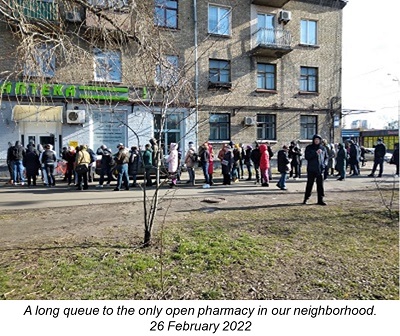
Yesterday my mom and I made a trip to the area in Kyiv where I live. Thankfully, it is the left bank. No need to cross the Dnieper river using one of the bridges. So, halfway on foot and then suddenly we’ve caught a ghostly bus, almost empty, with a silent driver, who took us to the area close to my place. Troieshchyna is an area with a population of some 550,000 residents, it is a huuuge district of Kyiv. And yesterday it met us with silence. My sixteen-storey building, with its many sections, was silent… No kids in the yard, no old women sitting on the benches, discussing politics and planting flowers. Only long queues to the one open pharmacy and the grocery.
My flat is full of my dad’s books and photos, and his archive. That was his place. Should I take Plato, or Aristotle? Or my Teddy bear? Or the earrings my mother gifted me when I graduated from university? I am taking my laptop. We are collecting all the food I had in the fridge, and all my supplies from the kitchen. I am turning off the water and electricity. When I will come back? How can I leave home? We were coming back, half on foot, half using the same ghost bus with the silent driver. There are check-points on all main roads, and near the administration buildings. Then we’re at home. Now we have food for ten to fourteen days. We are in a better situation than people in Mariupol or Kherson. My heart is bleeding for them.
The Russian dictator and his army want to destroy us all here.
But evil always loses. I see many resemblances with Tolkien’s world now. The evil will be destroyed, I know… But what unbearable price might we pay?….
Lord Have Mercy.
03.03.2022
Day 8.
Today I understood that I’ve got used somehow to the sounds of air-alert alarms, explosions, and our air-defence systems (PVO). Sometimes it seems to me that I can hear the sound of air-alert alarms even when there is silence all around. Evenings with a candle, in darkness, with a cat on mom’s knees or on mine.
And my mother saying all day long that I have to leave Kyiv. She started saying this to me after Russians bombed Kharkiv. After today’s bombing of Chernihiv, and all that the invaders did in Kyiv’s suburbs Irpin and Bucha, my mother has become desperately anxious about me. She won’t go anywhere anyway. She has reasons; her job, she is responsible, I get it. So, she wants me to go to Western Ukraine alone. I protest. Arguments all day long.
“Mom, we are both in this family, I don’t want to separate. I love you”
“I love you more, you have to go and save your life”.
Tears from both sides, arguing; arguments and counter-arguments. I’m already feeling guilty and bad. Mom is feeling overprotective and telling me: “Exactly, we are now two in this family. And you have to save your life, you are younger, you are the future”. Me, already feeling shame for the possibility of leaving her and a cat.
We went out today, bought some goods. The shops in our area are selling everything half-price. The trash bins are empty, and the streets are clean. So the communal services still work, doing their jobs, so essential in these circumstances. The volunteer spot has been opened in a gym. They organise products supply for vulnerable groups, among whom are retired people. They’ve asked people to bring any clothes they have for the Internally Displaced Persons [IDPs] from Kharkiv and Kherson who are temporarily in Kyiv. Many escaped without anything. My mother decides to bring my grandmother’s coats and some other warm clothes. We are coming back and bringing clothes to the volunteers. My granny passed recently, just in December 2021. She would have been happy to have her clothes warm someone. Again, I feel grateful she is in a better world now.
Emails from friends and colleagues literally from all over the world. Support and support again. Me being grateful and touched. Some translations done for the other volunteers who translate the news from Ukraine.
Air-alarm alerts, then explosions. For a long time.
Arguments with my mother: she wants me to leave, alone; I protest. The cat sleeps on my belly.
Let this night be quiet, and mercy for all of us.
05.03.2022
Day 9. Part I. Exodus enforced.
On Thursday night there were some strong explosions, several air-alarm alerts. Later we read the news that the Russian army shot and damaged the Zaporizhzhia Nuclear Power Station in Enerhodar, the largest nuclear power plant in Europe and among the ten largest in the world. If it exploded, it would be far worse than what occurred in Chornobyl in 1986. Chornobyl is one of the most traumatic memories for my mother. I was born on the 1st of June, 1985, so at the time of the Chornobyl disaster, I wasn’t even one full year old. My family didn’t know about the disaster for a week, until information from American Radio station (The Voice of America) was broadcast to Kyivans. My dad and granny had to make an enormous effort to get tickets on the plane to Mykolaiv, Southern Ukraine (three sleepless days in queues), where we went on the 6th of May. Mykolaiv now suffers from Russian bombing and tanks. My dad, and my mom with eleven-month me in her arms, took this trip together. Then my dad had to come back to Kyiv because of his job. But he returned to Mykolaiv in June, and then the whole summer and autumn we spent on archaeological expeditions that my dad worked in. We lived in a tent, and then in one village, then in the other. Then my mom lived with me in a village in Southern Ukraine until December 1985. I started taking my first steps at the archaeological site in Sothern Ukraine. Our family already has the experience of being forced to relocate from our native Kyiv. And that exact experience triggered my mother this time. She was horrified [at the thought] that if the Zaporizhzhia Nuclear Power Station in Enerhodar would explode because of Russian attacks on it, then it would be the end of everything. On Friday morning we quarrelled because I wanted us to go together or stay together. But my mother was relentless. She literally pushed me out of our home.
My mother’s colleague took me to the right bank of Kyiv, which was a big undertaking. There are many bridges across the Dnieper, but only one, the Northern bridge, was opened yesterday morning. Local territorial defence units (TO), organised as a grassroots response, were everywhere: all main crossroads, near tram lines, near the bridge, on the bridge. Cars were checked, but we weren’t. A traffic jam. We crossed the Dnieper. I saw the golden domes of Kyiv Pechersk Lavra on the horizon…
The closest underground metro station is Pochayna (formerly Petrivka), where the huge book trade market is located. A checkpoint again, and a member of TO asks me where I am going. Only one metro entrance works. I go down, and I am checked again, my documents are checked. The underground station is full of people. Many have arranged temporary housing here: mattresses, yoga mats, blankets, pillows, food supplies. Mostly women and children. Some people come and wait for the metro train to get to other areas in Kyiv. We wait for one and a half hours. The train doesn’t stop at central stations, they are closed and used only as bomb shelters. Finally, I get out at the “Olimpijska” station near the large stadium where Euro 2012 was held. It seems like a very past life, where I was not even present. The long column of adults with kids, some with dogs, all with the minimum of luggage, head to the railway station. I join them. I feel heartbroken.
Part II. The Central Railway Station.
It takes me twenty minutes to walk to the Central Railway Station. The square behind it is overcrowded, there is a lot of police there. The soldiers guard the building of the station outside and inside, trying to organise the sea of people, all desperate and anxious… There are a lot of volunteers inside, offering water and some dry-ration supplies, also trying to help people orient themselves somehow. There is a schedule of evacuation trains. No other trains, only those which evacuate people. I am overwhelmed by the cacophony of sounds. I am an introvert, and I feel very bad. But the worst was ahead of me. The trains come slower than in the schedule. They are overcrowded and therefore go very slowly. The evacuation train from Kyiv to L’viv is announced. And it is impossible to get there. People have been staying on the platform and near the entrance to the platform since sunset, just to get there. I don’t even try, because people are literally fighting, pushing each other. There are a lot of Roma people, poor, with many little children. People scream that they may steal what little they have. The elder Roma woman tries to calm the situation, screaming: “We just want to save our kids! We are from Khersonska oblast’. We are Gypsies, but we are also Ukrainians” (“My tsygany, ale my tezh Ukraintsi”). Finally, the crowds let them go to the train. I don’t even try. I call my mother and say: “I am not going anywhere, I am coming back home. I can cross the bridge on foot”. She starts crying. And that breaks me because my mother never cries. She is made of stone. The first time in my life I saw her crying was when my granny passed away in December 2021. This is the second time. The train to Kamjanets-Podilskyi is announced. It will arrive in the West in two hours. I go to the platform and see queues for every coach on this train. People have been standing since sunset. But at least I am able to go out onto the platform. It was impossible even to reach the platform when going for the train to L’viv. People go abroad, people flee to Poland and Slovakia. Without any hope, I stay in one of the smallest queues. At the end of the second hour of waiting, I am shaking from the cold and the stories I’ve heard in this queue. There are women with children and pregnant women from Northern, Eastern, Southern, and Central Ukraine.
Part III. The Evacuation Train.
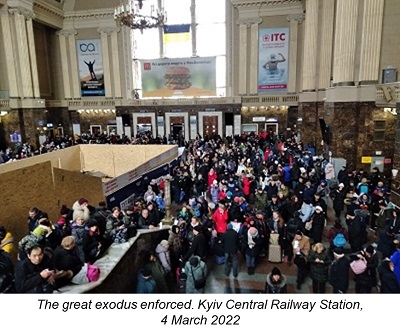
Finally, the woman in uniform, a conductor (providnytsia), opens the door of the coach. People in the queue start worrying. Obviously, we all won’t get there. There are men, accompanying their wives, children, and mothers. They start saying goodbye already. Women cry. There are two female conductors who organise the boarding to the coach. They are very kind, but strict. So first they let in pregnant women. The ascent to the coach is rather high; one should take stairs. For those women who already have later-term pregnancies, it is very hard. So the conductors organise men to take those women to the coach. After, the breastfeeding women with their babies are let in. Then women with toddlers. One little girl is sitting in her father’s arms, she embraces her dad’s neck and doesn’t want to leave him. When he transfers the child to the conductor, the girl burst into tears, screaming: “Daddy, da-a-a-addy, I won’t go without you”. The man stays firm, but his voice is trembling. He calms his daughter, saying that he will go and protect her and her mother, he has to. He says that bad guys came to Ukraine and are destroying us. He has to go and defend his home. His wife cries. The women in the queue start crying too. “Russians will pay for it. I cursed them all”, says a Russian-speaking woman from Sumy. Russian missiles destroyed her house in a suburb of Sumy. Next it is the turn of women with teenage children under eighteen. Then elderly people – men and women. There is an old man after a stroke in a wheelchair. The entrance to the coach is too narrow; the wheelchair must be folded. There is a woman with dementia. Then, at the last turn, the conductors allow single women without kids and elderly relatives to enter. I am among them. It is impossible to get very many things on the evacuation train. Only a small backpack. No clothes will fit there. No books. No mementos from home. All the seats on the train are occupied. We all stay. Literally, stay in the aisle between the seats. For eight and a half hours. We go from Kyiv under the sound of explosions. Russians bombed the area of Kyiv, visible from the railway station, Sofiivska Borshchagivka. There is no light allowed on the train; the windows are shaded. People are petrified. Children cry, women try to calm them. A few men were allowed to enter the train, those who were accompanying women with several children. There is a beautiful Azeri woman from Mariupol. She is with six (six!) kids, aged from two to ten. The eldest son, ten, is holding the youngest sister, who is two. This woman’s house was ruined by Russian bombing. She is sitting near the place where I got my chance to stay. She is crying, and her brother, who was allowed to accompany her, tries to calm her. Both are nearly my age. They were born in Ukraine; they are Azeri Ukrainians. Their parents came to Ukraine after the First Karabakh War in 1991 and settled there, hoping that their children’s lives would be different. Peaceful. “The Russians ruined everything,” says the Azeri man, holding his sister, the mother of six children. After three hours of constant sitting my back hurts, there is darkness in my eyes, and I feel almost like fainting. There is no air in the coach at all. There is a cacophony of every possible sound. I ask a woman sitting nearby with a teenage girl if she can let me sit for a while. She agrees. The woman is from Donetsk, and she is forced to become an IDP again. In 2014 she left her native Donetsk, and in 2022 she leaves Kyiv, her new home, with her daughter, again. She hates Russians and Russia, saying in Russian that they have destroyed everything. I hear this phrase many times. I stand up again. Women start offering their places to sit for the other women. Female solidarity grows, and I see how women are exchanging baby food and other supplies, warm encouragement, advice on how to organise breastfeeding in these unbearable circumstances, how to calm children, how to explain to them why Russia invaded Ukraine and ruined their everyday life. One woman with a toddler says loudly: “I am a psychologist, I can offer help now. Please, don’t be shy.” Some people come to her, although it is impossible to go through the aisle past the other people. The old man falls down. There is a scream: “Is there any doctor here?” One woman runs to the other coach and finds a gynaecologist, but still a doctor. She comes to our coach and does what she can with the restricted medicine she has. She says that the old man should get out at the nearest station because he is close to a heart attack. The nearest station is Vinnytsia. Our train comes to Vinnytsia following the sounds of air alerts. People in our coach are panicking. Then there is an explosion somewhere. Some of the people get out in Vinnytsia. There are medical staff with stretchers on the platform, waiting for the old man. Some people sit in Vinnytsia. They are from Kharkiv, desperate and stressed. Speaking in Russian, they curse Russia and its army for the atrocities they have committed in Kharkiv. There is also a woman with a little girl from Sums’ka oblast’. They have taken two days to get to Vinnytsia, where they had a small rest at the railway station, and are now going to Chernivtsi. The little girl is called Nadya (meaning “Hope” in Ukrainian). She is not crying, but she is very angry. She asks everyone: “Why did they do that? Why did they bomb my toys? Why did Russians bomb our house? I want them to give my house back and my toys back!” She pets the big German shepherd dog, lying among people’s legs on the floor in the aisle. The poor dog is from Chernihiv, as is his family. The apartment building they lived in was ruined by Russian missiles. They survived by hiding in a basement. I also pet the dog. His name is Oskar, and his eyes are full of pain. One of his paws is wounded, and there are spots of blood on a bandage. He is thirsty, but his family has not had any drinking containers with them. The whole coach starts looking for a container. One grandmother gives a little children’s bowl to Oskar, and says: “Please, have it. Hope, at least this may help you.” The dog loudly drinks the water. There are a lot of cats, guinea pigs, hamsters, parrots in boxes, bags. Some hold cats under their coat, closer to the chest. Some cats are frightened to death. A little boy from Bucha, Kyiv’s suburb, cries that he had to leave his fish in an aquarium at home. We were traveling to Chmelnitski for eight and a half hours, even though, usually, it takes only takes four and a half hours via train…
Part IV. Chmelnytskyi.
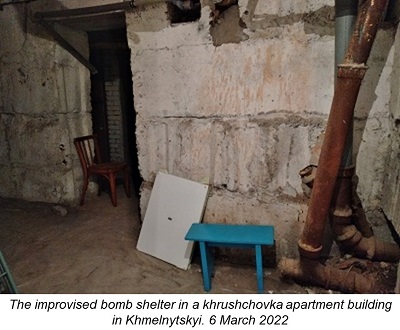
Here is the station, dark but full of people. IDPs. I am an IDP now as well. Who could ever have thought it? There are volunteers who meet people, help them to get out, give them food and water, hot drinks, help to get into the station building and find accommodation for a night or two. This grassroots organisation is incredibly powerful! My friends are waiting for me. They are the parents of my beloved university friend, who died when we were both only twenty-three years old. I have been in touch with his parents all these years, coming to see them once or twice per year. They treat me as if I were their own daughter. And now they host me. The night is so silent that I can’t sleep. I’ve got used to the sounds of explosions, bombing, our air-defence systems (PVO), air-alert alarms. This new silence is so fearsome. Like there is something waiting to happen. Finally, I fall asleep. My heart is broken. My mother is in Kyiv with a cat, I am in Khmelnytsky. We are separated. I did it because I love her, and I couldn’t stand her crying. There is a war. So many people suffer. Unbearable.
But deep in my heart, I know that this will come to an end. There is already a huge chasm, filled with blood, between Russia and us, between Russians and Ukrainians. I doubt it will ever be bridged. I don’t know how I will personally get through it, or when I may recover. But I will do what I can to save my country.
Today my legs are still swollen from hours of standing. I can barely go from my room to the kitchen, so I mostly lie in my bed. But tomorrow I hope to join women in a local school who weave camouflage nets for the front.
Thank you for all your great support and love.
8.03.2022
Day 12
Today marks two years since my dad died. I miss him so much.
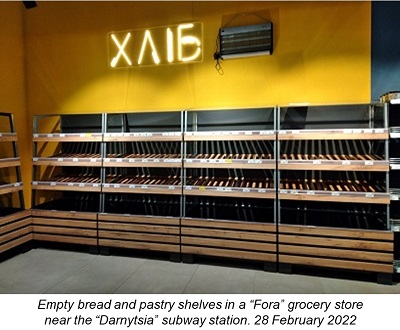
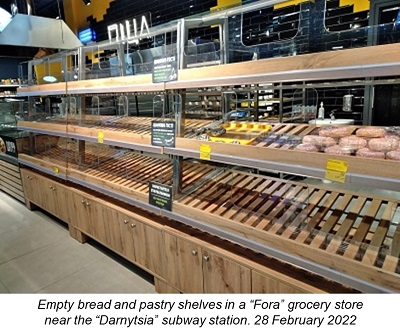
Today is my third day in Khmelnytskyi, which is approximately 350km from Kyiv. I couldn’t sleep my first night here because of the silence: no air alerts, no sounds of bombing, flying airplanes, air-defence systems (PVO). I was listening to that silence, and I had a sense that there were air alerts, but that nobody heard them, only me. On Saturday morning, my host family sliced a piece of bread for breakfast. They even had three types of bread. And I felt tears in my eyes. There had been no bread in our area of Kyiv since the 24th of February. I don’t eat bread in my everyday life as I try to keep fit. But in war, the experiences of all my ancestors, who went through WWI, the 1930s Stalinist repressions, famine, and WWII and its aftermaths, came alive in me. I would never have expected this of myself, but the absence of bread in the shops and in our kitchen made me feel anxious. So when I saw three types of bread for breakfast, I wanted to taste them all, my eyes moistened, and I was so unbearably thankful.
Over the last three days, there were a number of air-raid alerts in Khmelnytskyi. There were Russian attempts to bomb Starokostiantyniv airport, a military airbase forty-seven kilometres from Khmelnytskyi. My host family is very much afraid of the Russians. They hide in the bathroom every time and take me with them. Today we even had dinner in the bathroom. I don’t hide when I am alone at home. My mother and I were not hiding in Kyiv either. We got used to the air alerts and to the explosions, to the extent that it became prosaic, a casualty of everyday existence. Yesterday Russians bombed the airport in Vinnytsia, nearly one hundred kilometres from Khmelnytskyi. The air-alert alarms were heard almost all day long. We were outside with one of my friends when the air alerts started to wail. She was terrified and pushed me to go to the nearest basement under a Soviet apartment building. There were people there already, one woman with a little dachshund dog, another with a new-born baby. We were sitting there for almost an hour. One man, who shared the space with us, turned out to be from Kyiv, also from the left bank, like my mom and me. He was taking his family to relatives in Khmelnytskyi on the 28th of February, a journey that took them almost thirty hours because of the checkpoints everywhere. He had to free their parrot and let him fly out the window. They couldn’t take the bird with them. He tells me this, and I see tears in his eyes. “I am a man, I shouldn’t cry because of a parrot, it’s ridiculous,” he says. “But I wonder if our Yasha will be okay. It is still winter. Will he adjust? I hate this war…” After an hour of sitting in a basement without any fresh air, with many anxious, terrified, and angry people, I felt nausea and went outside. No way will I go to any basement under any circumstances. For me, all these air alerts in Khmelnytskyi mean almost silence, almost quietude. Life here is also different. More shops are opened; mostly for groceries. More pharmacies are opened, but there are no long queues for them. Here I was able to buy a hormonal cure for my thyroid gland, which I have to consume daily, and which had been absent in Kyiv’s pharmacies in our neighbourhood.
We’ve been reading the news anxiously. The Russian army is murdering civilians in Ukraine. Women have been raped by Russian soldiers in Hostomel. Russian soldiers are now committing the same crimes that the Red Army committed in Western Pomerania, Poland, and in Germany at the end of WWII. Some volunteers are being killed in Hostomel and other volunteers are shot on the road to Irpin, destroyed by Russians. The nineteenth-century Orthodox church in the village of Vjazivka in Zhytomyrska oblast’ is destroyed by Russians. The other church in the village of Bobryk, near Brovary in Kyivska oblast’, is ruined. One more Orthodox church in Malyn, Zhytomyrska oblast’ is destroyed as well. The Russian navy is bombarding Odesa from the sea. Russian artillery is shooting Mykolaiv, intentionally damaging residential areas. In Zaporizhska oblast’, Russian soldiers shot an automobile with two Ukrposhta workers who were trying to transfer letters and pensions to people. Russians shoot at Kyiv’s children’s hospital again and again, and children with cancer have to be treated in the underground shelter. Russians have bombed a large-scale bakery in Makariv, Kyivska oblast’, killing thirteen civilians. More than one thousand have already been perished. There are nearly 400 children among them.
Khmelnytskyi has become a transit spot for thousands of IDPs from Northern, Southern, and Eastern Ukraine. Khmelnytskyi is between Kyiv and the Central regions, and Western Ukraine. Last night, thirty-two evacuation trains came to Khmelnytskyi and went further to L’viv, Ternopil’, Kamjanets’-Podil’skyi. Some people decided to stay here for a short rest or wait for relatives and friends who could host them for a while, or just jumped from an evacuation coach into the unknown, hoping for their Lord’s mercy and other people’s kindness. I have visited Khmelnytskyi once or twice per year since 2008 after my university friend died from an accident. We were very close friends, and his parents, my current host family, became very dear to me. I know Khmelnytskyi quite well, and its railway station has always been nice, small, and almost empty, unlike the huge Central railway station in Kyiv. Today I witnessed hundreds of people sitting there, staying, lying, trying to have a short nap in between trains. Dozens of volunteers came in and out, helping the IDPs, bringing food and water supplies, clothes, blankets, heaters, toys for children. Dozens of people wanting to host IDPs, offering accommodation. Several doctors monitor people at the station, offering their help. Scores of local women are helping their sisters to overcome what they are going through because of war. Ukrainian women also fight in this war in their own way: not only through being in the army, not only cursing Russian soldiers, or giving them sunflower seeds to grow through their dead bodies on Ukrainian soil. I think that the most important fight we, as women, are engaged in here, is HEALING. We have the power to heal wounds: we support, we hug, we cook, we cradle our sisters’ children saying the most banal but most important phrases: “I am here for you. You can cry, it’s okay. It will end. Everything will be okay”. My friend’s mother and I baked little pies with mushrooms and potatoes and brought them to a railway station. A train from Kharkiv is expected soon. Perhaps, some Kharkiv residents may taste them. I have put a lot of love into my baking.
I didn’t cry in Kyiv. Not one single day. My body was so petrified that I couldn’t cry, despite the fact that I wanted to. Here I cry a little bit. Every day. First, when I saw three types of bread on a kitchen table. Second, when I saw an open café where people in the middle of the day were sitting and just drinking coffee. This is something that hasn’t been seen in Kyiv since the 24th of February. Third, when I came to the railway station today with my pies and saw all these incredible women hugging, encouraging, and helping the other women, who were forced to leave their home nest, to save their children. We will get through the war. Despite this unbearable trauma in its three dimensions: collective, communal, and individual.
My mother seems to feel better without me in Kyiv. No more tears from her, no more anxiety. She is concerned about her institution and its preservation. Our cat is also fine, thank you for asking. I miss them both tremendously. But I am glad that my mother is experiencing relief, knowing that for now, I am relatively far from the bombing and shooting.
12.03.2002
Day 17.
This war has grown in me so deeply that the pain it is causing will never leave me. The war is not “it”, it is “she”, because she is so alive, with all her cruelty and morbidity.
When we lose someone we truly and deeply love, the grief after their loss is always with us. It becomes softer and perhaps not so sharp as in the first months after the loss. However, it aches in the depths within us. I’ve had many losses, especially in the last two years. Dad and granny. I survived it, but I will always lack my beloved people in my life. The only thing that consoles me now is my faith, and my belief that they all are in a world full of light and divine love now. And if I am still here, then I am needed here. So, I just do what I can in these circumstances. For now, I am baking cookies and bread. And trying to write.
The war reveals the best and the worst in every person: the deepest love, empathy, and compassion, and the deepest evil with hatred. We are becoming capable of thinking, of doing, and of feeling everything we would have never imagined we would be able to experience. We are getting used to the circumstances and sounds which were unimaginable for us before. The sounds of bombing, of shelling, of explosions, of the air defence (PVO), and of air-alert alarms will always be a part of my experience, part of the wider range of feelings I went through in these (already?) seventeen days. Part of all the cruelty I’ve experienced with my country, cruelty from the Russian invaders. Part of all the kindness and the love I witnessed, felt, and was able to share with others in those cold days.
My host family is very much engaged in helping IDPs, who are coming constantly to Khmelnytskyi. With my host mother we bake bread, cookies and pies (different ones every day) and bring them to the railway station, where IPDs, mainly women and children, wait until they will be transferred on. Every night, Khmelnytskyi accepts between thirty and forty trains with Ukrainian citizens, running from northern, eastern and southern parts of the country. Some go on, some stay. There are so many volunteers here, mainly female, who take care of supplies. There is always food and water, warm blankets and pillows, toys for children, even carriages for babies. The humanitarian aid from Poland and Bulgaria arrived yesterday. Volunteers give us Polish flour and Bulgarian butter, and ask us to bake more sweet cookies, mostly for children. My host mother also takes some flour to her friend Tetyana, who is constantly baking pies for those who stay temporarily at the railway station. Tetyana has two sons. One of them is already eighteen, very young, patriotic, and willing to defend his country. Tetyana cries when she talks about him. In the nearest school many women gather every day and weave camouflage nets for the front. There is no place for us already, no free hands are needed. Women pray, cry and work, work, pray and cry. They are so beautiful.
The Mariupol tragedy is widely discussed here, between neighbours, in all the queues I’ve been, everywhere. People cry or curse. Or pray, even saying the words of Otche nash (the Lord’s Prayer) in the queue for a pharmacy. Nearly 1600 peaceful Mariupol residents were killed by Russian occupation military troops during the twelve-day-long blockade of the city. The maternity and children’s hospital was razed by bombing. A six-year-old girl died of dehydration. People are afraid that satana (the devil) may come to their peaceful town. Every day there are air-alert alarms. We are sitting in the bathroom or corridor mostly. My host family is afraid, but mostly for me. They treat me as if I were their own daughter. I don’t want to hide anymore, I am tired of it.
We all had hopes that the war would “end soon”, that it “won’t last long”, but it lasts. Our army is great, our volunteers incredible, our people brave, and our women marvellous. The sisterhood I have witnessed in these two weeks can save us all, despite the lack of sleep, anxiety and exhaustion. But now I can explicitly understand that the Russian government and its army desire to destroy all of us here. They all want to destroy Ukraine and Ukrainians, to ashes. As they ALWAYS wanted. They have the support of the obedient and silent majority (yes, people protest in Russia, but they are so few in comparison to the tens of millions who are loyal, obedient, or indifferent to the tyranny). Trying to reflect on the ongoing war, historians see many parallels with WWII and the Western European policy of appeasement of the aggressor. They were silent when Hitler was making an alliance with the Soviet Union (The Molotov–Ribbentrop Pact), when he enacted the Anschluss of Austria, and UK Prime Minister Neville Chamberlain greeted Hitler at the beginning of the Bad Godesberg meeting on the 24th of September, 1938, where Hitler demanded the annexation of Czech border areas. Then the Sudeten in Czechoslovakia, then Poland. And the West gave it to Hitler. And then Hitler came to Paris, et voilà. And then everyone woke up: “How this could have ever happened?” I can’t but agree with these historical parallels, but what comes to my mind more often, is the Slaughter of Baturyn.
The Slaughter of Baturyn or the Rape of Baturyn (Zakhoplennia Baturyna, Znyshchennia Baturyna) was a part of “punishing” military actions conducted by the Russian Imperial Army against the Ukrainian Hetman [Head of State] Ivan Mazepa and the Cossack state. In November 1708, the Russian army, headed by Alexander Menshikov, entered the town of Baturyn, defeated the garrison of the citadel, slaughtered the entire civilian population, and burned the city to the ground. Menschikov was merciless. He even gave orders to kill babies. The Russian army murdered between 6,000 and 7,500 civilian inhabitants. Many residents tried to hide in churches, and they were burned by Menshikov’s troops. According to a 2006-2009 archaeological excavation in Baturyn, the highest number of civilian casualties was recorded in the Church of the Life-giving Trinity, where the women and children were hiding. The Russian army has done pretty much the same in Mariupol. I feel heartbroken, devastated and helpless. But I can’t stop asking myself: how, on the whole Earth, they can live with this? How is it possible to have such a burden on their souls?
I don’t know why exactly my people have to go through these forty ordeals of our nation’s purgatory, and why my country was chosen to go through this. I am so tired that I even don’t hate Russians anymore. This state doesn’t exist for me anymore. Hatred breeds war. Now we need love, light, mutual understanding, mercy and compassion to stop this war. But how can we develop all these when they continue to murder and destroy? They don’t negotiate, they don’t need any negotiations, and they just kill us and kill us. Perhaps I am a bad Christian, and this is a huge burden for me and everything I believe in.
I know that the war will be over. I know that we will be, as a state, even stronger then we were before. I know that Love always wins in the end. And also I know that God works in mysterious ways, which we can’t understand. I still try to believe in the victory of good over evil, and do what I can to make it come closer.
13.03.2022
Day 18.
My host mother and I went to the railway station and brought our freshly-baked cookies. At the station, volunteers were waiting for a separate train of children from orphanages. I do not ask where are they from. I saw a man about my age, maybe a little older, who coordinated the volunteers and said that we still need to bring sweets and toys for children. Later, at home, I saw his video and realised that he was the mayor of Khmelnytskyi. I was glad that the mayor is such a young man, at the station, without security, cameras or PR, engaged in volunteering. At the exit from the station, a mother and a daughter were standing there. The girl said: “Mom, when will we go back to Kharkiv …?” The woman hugged her wearily, saying: “I do not know, but we will return home”. Then the girl asked: “Mom, and when will dad come to us?” The woman simply hugged her kid, and it was clear that she did not have the strength to answer. The girl had a toy in her hands, a plush hippopotamus. She hugged him and said to the toy, chanting, “We’ll be home soon.” I swallowed a lump in my throat. Volunteers approached them and seemed to ask something.
I also miss Kyiv. And I think that the last thing I did before the war was walk along the banks of the Desenka River, listening to the river’s sounds, embracing how the river was preparing for spring. I was standing under a big willow tree and squinting in the sun, soaking up my whole small and boundless world: the meadow, the cries of seagulls over the river, the first shoots of the first green grass, small stones and river shells … Then I went to the bazaar and bought my first spring flowers, pink tulips. I really like tulips. On the evening of the 23th of February, I sat in my kitchen drinking tea, made from thyme collected last summer in the same river meadow, and looking at the delicate tulip petals in a vase. This was the last photo I took before the war that woke me up the next morning. I know it will end. This has already happened in the history of mankind. Wars finish. And I will return home. A girl with a hippopotamus and her mother will return to their father and husband in Kharkiv. We will probably lose something. Hopefully, we won’t lose people. We will be different. But we definitely will be. We will rebuild our common Home, because we carry it in our hearts. Always. Just as I carry a small stone from the bank of the Desenka River near Troieshchyna in Kyiv.
18.03.2022
Day 23.
So many families who have lost everything, including each other, are already all over my country. I only see women and children passing through Khmelnytskyi. Yesterday the city accepted more than forty trains with internally displaced persons… More than forty trains per day. Many children have tags on their chests with full names and phone numbers so they don’t get lost. I remember in C. S. Lewis’s The Lion, the Witch and the Wardrobe, when the Pevensie kids were leaving London for the evacuation, they had tags on their chests. But Lewis wrote this book from the experience of the Second World War. And I proceed from the experience of the Third, which is unfolding in my home. I can’t write anymore, I’ve run out of words in every language I know. I would like to tell everyone: take care of yourself, try to hug each other, if possible. Say more often that you love those whom you love. So that you don’t regret later that you didn’t have time to say it. Ask “How are you…?” more often.
Day 26. 21.03.2022 – Day 29. 24.03.2022
In transition
I could have never imagined that the war would start. That was my thought, going back to the spring of 2014. I could have never imagined that the war would be prolonged, and that my native city of Kyiv would be bombed. We, all of us, in Ukraine, could never have imagined all the atrocities and the extent of the slaughter that Russians would perpetrate against us.
I am injured. I am injured deeply by every death, every scream of a woman giving birth in a bomb shelter, every orphaned child, every tear from every Ukrainian child. I am wounded by every checkpoint I saw, by every anti-tank hedgehog I met on my way, by every house razed, by every homeless and forcibly-displaced fellow-citizen. My heart is bleeding for all those who became trapped, killed, lost or forced to die because of hunger and dehydration in Chernihiv, Kharkiv, Okhtyrka, and Mariupol, those cities I visited, cities that were beautiful and so recently full of life.
When the war started I could never have thought that it would last long. I was waiting for every new day to hear the news that the war was coming to an end. For now I am speechless and have no words, no tears, no energy for anything. Russia’s “strategy” in war is all for nothing, only destruction, deaths, slaughter. No value for human life. How long will my country suffer these atrocities, just because a maniac with his army decided to “restore” the Soviet Union, which is impossible and mad?
I could never imagine myself making this unbearably hard choice to leave my country and become a refugee. But I had to make this choice. I am a refugee now. There were a lot of reasons for leaving. A way more to stay. Anyway, being in Khmelnytsky I was not at Home anymore. Yes, I was in Ukraine, and I was helpful, baking with my host mother, and taking it to the railway station, to bring some warmth and food to internally-displaced women and children. But Home is in Kyiv, near the Dnieper river, on the green islands, where I was used to taking long walks alone or with friends. And my friends are also dispersed now… Some of them have lost their homes. What is Home now for all of us? Something we remember? Indeed, WE ARE WHAT WE REMEMBER: events, words, touches, smells, colours, features of landscape. Something we got used to do in terms of our everyday routine? And what if our routine was smashed and ruined… Now I think, that I am my Home. The only material things from home I have are my father’s wrist-watch clock, my grandmother’s khustka shawl, my mother’s coat (and her blessing), a few family pictures I’ve managed to take… That’s all. All my books, letters, photo albums, clothes, hobbies, everything else is at my place in Kyiv. And my mother with our cat are in Kyiv. So I am the embodiment of my Home now.
My host family and I had our last breakfast (“before the war’s end!”), my host mother loaned me some of her clothes, and we went to the railway station. Together with other people-in-transition we were waiting for the next train heading west. There has not been a stable schedule since the start of the war. Only evacuation trains were announced, and new railway routes appeared. I was hoping to sit in some train from Eastern, Southern Ukraine or Kyiv to Western Ukraine.
Here comes the train Zaporizhzhia–L’viv. It is overloaded. The conductors allow only a few women with children, and some single women like me, to get in. There are people from Mariupol in my coach. There are many children with their terrified mothers. Some women are crying, the others are pale and petrified in their pain. I hear the fragments of broken sentences, told in broken female voices: “…aunt was buried near our house,” “…we let the dog go, we couldn’t feed him anymore,” “…we melted snow and made a fire to cook something,” “…we were sitting in a basement with kids for two weeks,” “…my son had no food for ten days, he is in pain,” “…Russians shoot all the cars with people inside…,” “…they write “children” (deti), and still they shoot all of them.” I am going through the train, listening, crying inside my soul, feeling helpless to change anything…
… All these women are sisters for me. Their pain is my pain too…
Finally, I find a place to sit near a family from Huliajpole, Zaporizhzhs’ka oblast’: an old couple in their mid-seventies, their forty-year-old daughter, and her six-year-old son. Their house was destroyed during bombing. They’ve managed to save their lives, hiding in the basement. The old lady is disabled, so she can’t move without anybody’s help. Her husband tells me that they have been married for fifty years already, hiding tears in his eyes. The old lady doesn’t understand the whole scale of what is going on, but she is scared to death. Her husband holds her hand and says softly: “I will never leave you, my little bird. We will always be together.” Their daughter goes to the train’s corridor and cries near the window. Her husband and brother are defending the country now. Her heart is bleeding for them, but also for the beloved dog Fantik, that they had to leave near their destroyed house… She prays for all them to survive.
Children from Mariupol are crying in the train. They are suffering from stomach pains after so many days of hunger and dehydration. And fear. Some of them are vomiting. We are arriving at L’viv, and there are already medical doctors on the platform, waiting for these children. L’viv’s railway station resembles a huge anthill, full of disoriented people, volunteers who are helping, policemen, medical doctors… There is a huge queue for the platforms, where trains depart for Poland. There are three directions: Przemyśl, Chełm, Kraków. I will be standing here for almost four hours. Finally, I am able to get on the train to Chełm. This is the third evacuation train in the last few weeks, overloaded by women with their children. A woman near me is a mother of three from Marganets, Dnipropetrovs’ka oblast’, not far from Enerhodar, Zaporizhzhska oblast’, where the nuclear power plant is endangered because of Russian shelling. She wants to go back. Her children left their aquarium with fish and are anxious about the fish.
Seven hours north-west, and here we are on the Polish side of border, as refugees. I have been in Poland many times. I have conducted fieldwork in Eastern Poland. I lived in Warsaw for almost two years. And I would never have thought that history would make me come back to my beautiful sister-land Poland as a refugee. I returned to Warsaw, my cosy and quiet city, where I once left a piece of my heart, as a displaced person. I still hear the air-alert sirens here, in all this quietness… They are so deeply within me.
I am not a hero, I am just a woman. I can’t save lives as doctors do, I can’t fight as men do. I have even burnt out because of baking and volunteering. The final step in my decision to go was the need to see a doctor and get pills for my thyroid. There is a lack of this treatment in Ukraine, almost impossible to get. I need to consume it daily. But still, I feel guilty that I left. As perhaps many of us do. No “easy” or “good” choices in these circumstances.
I believe that this war will come to an end one day. We will bring all our broken pieces together and come home to those whom we love. We will try to restore our lives and come back to everything we loved. But I know forever that we will never be the same.
We are our Homes now. This is something new to learn.
P.S.
Jeżeli porcelana to wyłącznie taka
Stanisław Barańczak
Której nie żal pod butem tragarza lub gąsienicą czołgu,
Jeżeli fotel, to niezbyt wygodny, tak aby
Nie było przykro podnieść się i odejść;
Jeżeli odzież, to tyle, ile można unieść w walizce,
Jeżeli książki, to te, które można unieść w pamięci,
Jeżeli plany, to takie, by można o nich zapomnieć
gdy nadejdzie czas następnej przeprowadzki
na inna ulicę, kontynent, etap dziejowy lub świat
Kto ci powiedział, że wolno się przyzwyczajać?
Kto ci powiedział, że cokolwiek jest na zawsze?
Czy nikt ci nie powiedział, że nie będziesz nigdy
w świecie czuł się jak u siebie w domu?
24.03.2022. The month of war.
I do lack words. There has been a month of war.
“Since they thought it foolish to acknowledge God, He abandoned them to their foolish thinking and let them do things that should never be done.” Romans 1:28
I have always thought that Life is in everything. It is, it just is. And it’s enough for us just to be meaningfully alive, rejoicing at such a gift with which the Lord has blessed us… Is it enough now?
Prepared for the website “Ukraina Moderna“. Published for the first time. Any reproduction of the text (in whole or in part) is possible only with the consent of the Author and the editors of the “Ukraine Moderna” website. The publication uses illustrations provided by the Author.