


“…on the twenty-third of February at eleven o’clock in the evening, I finally packed an emergency bag”
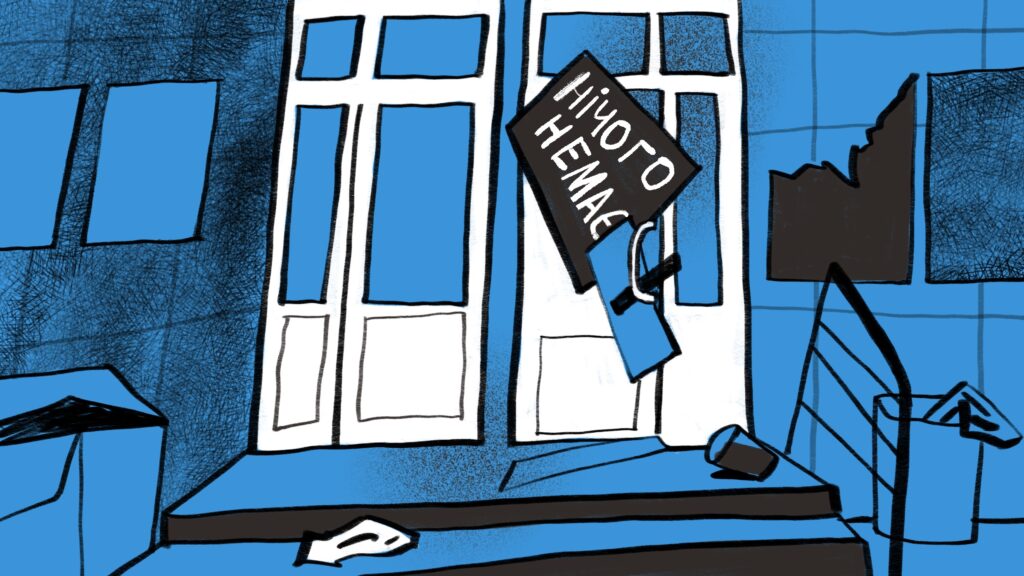
‒ As far as I know, you have been professionally engaged in ethnology for over twenty years, and in almost all regions of Ukraine, you have recorded evidence relating to World War Two. Could you have ever imagined that the everyday life of wartime – from your respondents’ horrifying stories – could become a reality for modern Ukraine?
On the 23rd of February, I could not have imagined it [smiles ironically]. On the evening before the war, I visited Mykola [a colleague and friend, Deputy Director for General and Economic Affairs of the State Research Centre for the Protection of Cultural Heritage from Technological Disasters in Kyiv – S. M.]. We had a long discussion about Biden’s predictions concerning the possible outbreak of war, but we never came to an agreement about it. But on the 23rd of February, at 11p.m., I packed an emergency suitcase. It included two pairs of socks, two pairs of pants [laughs], a sleeping shirt, a change of shirt, a sweater, sports pants, slippers, documents, money, medications, and a small ration of lard. But I did not believe, until the last moment, that war would break out.
Even with my historical background, and my ability to analyse and compare facts, I still could not imagine that in the twenty-first century, in the civilised world – despite all the savagery of Russia – such a war could break out. Other, current wars seemed very far away from us. And, frankly, when I hear now that some states are not very active in [helping] solve our problems, I realise that our war is as distant for them as other wars were for us. If you look at the rhetoric of Russia since 2014, you can draw historical parallels and see that the war was inevitable. It was just hard to believe that all this could lead to such a full-scale war. Let me recall, for example, the same Sudetenland when the Germans issued ultimatums to the Czech Republic; the scenario seems very similar. But a war in the twenty-first century, on such a scale and with such inhuman atrocities, still defies the imagination.
‒ The Russian-Ukrainian war has been going on since 2014, but it came to the homes of most Ukrainians in 2022. How much has the war affected your life over these eight years?
For me, the war in Donbas seemed to be quite far away. At the outbreak of the war in eastern Ukraine, I did not heard explosions or shots. Also, I had no friends who died at the frontline. Of course, there are a lot of guys I know who went to war in 2014, but fortunately, there were no casualties among them. At that time, I did not feel the pain of loss, and I was not traumatised by personal experience. The war was far away then, but when it came close, I had completely different feelings, and I realised what war was.
“I just heard explosions. Not like the explosions I had heard before”
‒ Were you in Kyiv on the 24th of February?
Yes, I was in Kyiv. On the 24th of February, it was a Thursday, and I was supposed to go to my work.
‒ How did you find out about the outbreak of war?
In Kyiv, I live in the Nova Darnytsia neighbourhood, and I just heard explosions. Not the kind of explosions I had heard before. The windows shook, although the explosion seemed to be distant. I think it was the moment when Boryspil airport was bombed. It was somewhere around 5a.m.; I immediately looked at my phone and realised that it had all started. I had been woken up because the windows were shaking. Then it was only news, news, news…
“We thought that the big city would have big problems, the small city would have small problems. That is why we decided to go to Vorzel”
Around six o’clock, I called Mykola. He was already in the grocery, running to buy something. We decided not to go to work, but we didn’t stay at home either. We went to Vorzel the same day [1].
‒ Why did you go to Vorzel?
We had two options: either stay in Kyiv or go somewhere else. We thought that big city would have big problems, and the small city would have small problems. That is why we decided to go to Vorzel. Mykola has an apartment there, and I have one too, although it is not fully equipped. Mykola had a water supply, a kitchen, and rooms – though not renovated – but a sofa and a cot bed. So, we decided to go to Vorzel. We thought it would be easier in a small town. To be honest, I had no idea that it could be occupied. For some reason, I was full of optimism. We went by train from Darnytsia. We also took the food that we had in our fridges at the time with us: meat from the freezer, lard, some cereals, butter, and tinned fish. I had an emergency suitcase. Back then, the trains were still running normally. For some reason, I didn’t want to go home to my native village [Meleni village, Korosten district, Zhytomyr region – S.M.], because I hoped that the war wouldn’t last long. In addition, Vorzel is a modern suburb with Internet; I thought I might have to work online. I took flash drives with me, and Mykola had a computer; he also had Internet access at home.
“I perceived that first day in Vorzel as a game. I had a feeling that we were just going to play and then come back home”
When we arrived in Vorzel, my heart felt sore for some reason. There was a pharmacy in the yard. Not all pharmacies were open, but this one still was. I bought pills to calm my heart.
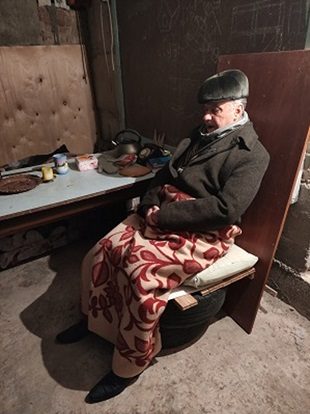
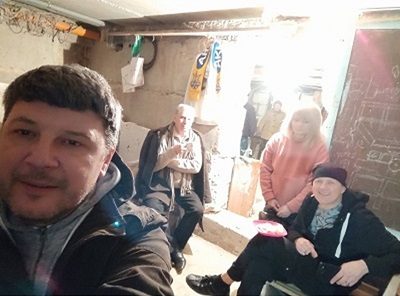
Mykola had a neighbour, Olya, probably a little younger than us [under 45 years old – S. M.], originally from Donets’k. In 2014, she and her family had already experienced similar moments [after the evacuation from Donets’k, Olya, and her family had bought an apartment in Vorzel – S.M.]. So, she was very determined in encouraging us to equip the basement. Back then, I had my doubts and thought: “What’s the point of all this?” But she was very persistent, so we decided to help her. As a result, the basement was set up. We had beds with mattresses, pillows, blankets, a table, a kettle, bottled water, and something like a toilet. But it all seemed superfluous to me at that time.
‒ Was it the basement of a multi-storey building?
Yes, it was a basement of a multi-storey building. It was very cold there, it was impossible to sit for a long time, very uncomfortable. I thought of that first day in Vorzel as a game, even though I could hear explosions from Gostomel all the time. I helped with everything, but I didn’t really feel the need. In the evening, Olya cooked potatoes, and we ate them in the basement for the first time. I had a feeling that we were just going to play and then come back home.
‒ Did people bring the food to their apartments or to a common larder?
At first, everyone was on their own… We spent our first night in that storage room. For me, there was a certain romanticism in all this. We would periodically go down to the basement and occasionally go outside. There was a military man with us, a border guard, who was taking care of all the arrangements. His wife worked, I think, at the airfield in Hostomel. So, they sort of took care of us. We heard explosions all night long, and we even tried to calculate something: a shot, a flash, a fall. We were counting the time and distance. We stayed like that, I don’t know for how long, but not until morning. I was terribly cold. We had some blankets, but it was still uncomfortable. We had blankets, mattresses, and a kettle. We could make tea. And on that first night, we even warmed ourselves with tea.
‒ How did you set up your life in the basement? How much time did you have to spend there?
We went down to the basement several times. On the 25th of February, Olya and her husband left for the village of Petrushky, and the border guard went to Kyiv. The old man, Pavlovych, and his wife were still there. So they went down to the basement, and we went several times. When it was really loud, we would go down; we didn’t go there often. Sometimes we came up and just stood near the shelter so that if it got scary, we could quickly hide. If you look at our basement from the point of view of protection, I don’t know how safe it could have been. I think if it had collapsed, it would have been even worse. When the power went out, we went in with a flashlight, sat there while the shelling was active, and then returned home. We ate some food from that basement in May or even later.
‒ So, you spent most of your time in Mykola’s apartment?
Yes, yes.
“There was just not enough bread”
‒ Have you ever used your professional knowledge of historically-rooted survival strategies? Perhaps some of the things you had recorded during your fieldwork?
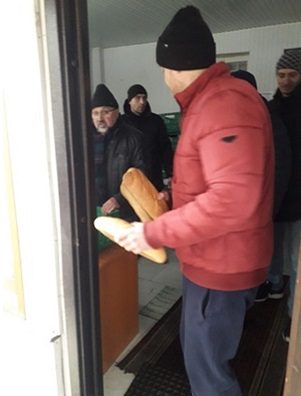
Let me put it this way. While everything was more or less normal, we somehow didn’t pay much attention to it. We just didn’t have enough bread. There was none, and the village council organised the baking of bread. There was a bakery near the house where Mykola lived. Young men under the age of thirty committed themselves to baking. Women from the house also joined them. They cleaned the place, brought flour and yeast, and baked bread. The next day, the village council distributed the bread. But this, however, happened only once, on one of the first days. The next day we also planned to bake bread, but there was no electricity that day. The guys came to bake bread, but it was so cold in the room that the bread just didn’t work.
“Those who can, come and milk the cows”
When local people distributed bread, they also distributed milk. There is something like a farm in Vorzel. One day, when the power went out, a message appeared in Vorzel’s online groups: “Those who can, come and milk the cows.”
‒ You didn’t go to milk the cows?
No, I didn’t go [laughs], I just helped to distribute milk. I wanted to be involved. Mykola and I often hung around the village council and helped as much as we could.
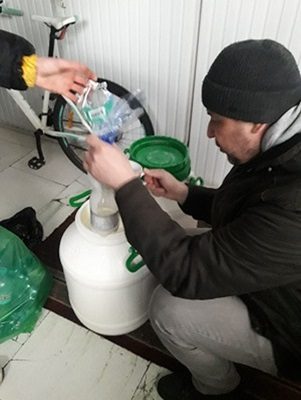
And then there was no light. In the first days, there was light, then it disappeared, and along with the light, there was no water, but there was gas.[2] When the high-voltage line was shelled, the repairmen said they would not come to repair anything. No services were working at all. Only the maternity hospital was open, there was some kind of medicine there. But we didn’t go there, we didn’t need to.
‒ How many people stayed in Vorzel in those days?
There were a lot of people: women, men, children, old and young people. Everyone was there. And smart people like us came to Vorzel from Kyiv [laughs].
“I don’t know how much I could have used my fieldwork experience, but I certainly used my personal experience in cooking and organising rural life”
When the power went out, we started unloading the fridge. We consumed what we needed to eat first. For example, dumplings and frozen vegetables. We stewed the mushrooms. We fried the fish and the meat. We tried to eat everything [laughs] – both ours and the neighbours’ – so that nothing would be lost. [The neighbours asked them to look after their two cats and left them the keys to their apartment, while they left, first to the village of Petrushky in Bucha district, and then to Odesa region. They still haven’t returned to Vorzel – S. M.] We cooked everything we could. What could be salted was salted. We made meatballs out of some of the meat, while the rest was simply fried in a frying pan. Then there was no gas. First, there was a power cut, and on the morning of the 8th of March, the gas went out. That is, I only experienced two days without gas. Before that, there was gas all the time, and we cooked with gas.
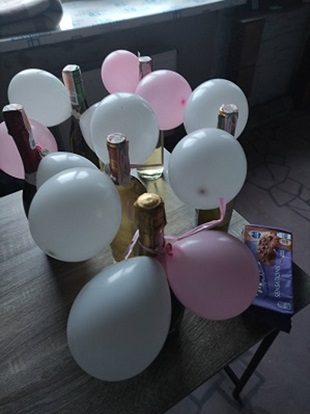
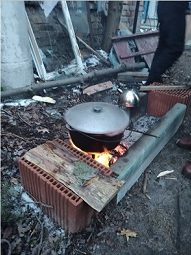
When the gas supply was cut off, the men made a homemade stove. They took sidewalk curbs, laid them parallel to each other, and inserted bricks perpendicularly along the entire length. It was like a gutter, about ten metres long. And they cooked on it. At first, everyone cooked for themselves. But on the second day, people began to cook together. They took one pot and poured water into it so that the water was boiled all the time. Anyone who wanted to take it would just come up and take it, and then they would add it again. They began to help each other. And on the 8th of March, men were making small presents for women. They were gifting them champagne, wine, or whatever they had in stock [laughs].
So one day we woke up in the morning and there was no gas. The first things that come to my mind about those days: you have to make a fire, boil water for tea, coffee, whatever. And then cook something. I said to Mykola: “Go get some pine wood.” And he responded: “What pine wood?” I said: “These urban folks! They know nothing about life!” [laughs]. And then I said: “We have some chicken, bring it, we’ll stew it.”, especially since my neighbour had already cooked her meal, and she had a fire left. We tried to keep that fire going. Mykola brought a five-litre cauldron full of sliced chicken. I said: “How do you imagine we’re supposed to stew all this?” It didn’t boil. I had to take a frying pan and cook it in parts.
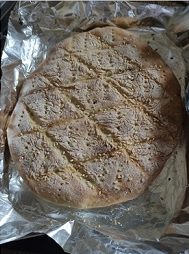
I don’t know how much I could have used my fieldwork experience, but I certainly used my personal experience in cooking and organising rural life. When there was no bread, I remember baking a cake with baking soda and kefir. The cake was like bread. When I wanted pancakes, I made pancakes. They were like pancakes instead of bread.
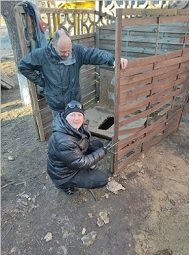
There was one more important moment in our everyday life. There was no water, and we had to use the toilet somehow. So, we made a toilet outside. We just dug a hole, put two boards down, fenced it in, and that was it. It looked like a village toilet but without a roof. But there was one big miscalculation when, a little later, a kitchen was organised not far from that toilet. I don’t know where those wise men were looking. I began to resent the fact that it was inconvenient to go to the toilet near the kitchen. And they said to me: “Close your eyes and do what you need to do.” I had to get up earlier and use the toilet, while there were not so many people in the kitchen [laughs].
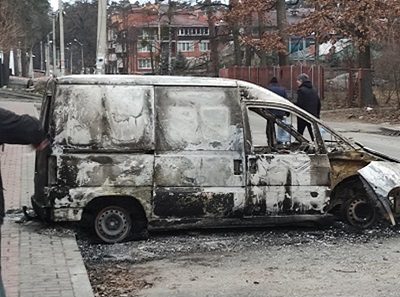
We also went for water, because there was no water either. At first, we collected it in different containers so that we could at least have water for the toilet and for personal hygiene. While the gas was on, we heated water and washed ourselves. When we needed water for cooking, we went to the well. The well had a handle, and you had to unscrew the bucket. We took it in all the bottles we could find. We had to walk about two kilometres each way, to the well and back. It was scary. Before crossing the street, you would look left and right, and if there was nothing, and only then, you would run quickly. Once it happened that we were walking down the street, and these bastards were approaching, I think, on a tank. I remember we had to move quickly.
“One of my ‘looting’ achievements was French buns. A whole box of French buns”
There was looting. There was a rumour that a “Fora” grocery contained a lot of food in the basement. On the 9th of March, 2022, we heard that there was a green corridor, and we could leave, but we didn’t know if we would be able to leave, so we went to “Fora”. There were a lot of dumplings and milk in the basement. But we didn’t take any of that. We took a block of fish, but I don’t know what kind. I think it was mackerel. One of my “looting achievements” was French buns. A whole box of French buns. When Mykola would later mention that we had no bread during the occupation, I always denied it: “But we had a box of French buns” [laughs]. For some reason, people did not want to take those French buns. They looked at the already-opened box and did not take the buns.
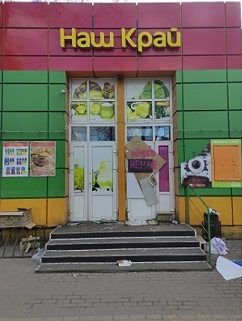
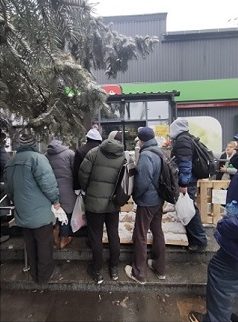
The owner of the “Vatsak” grocery also started giving food to people, mostly cakes. I asked: “Do you have any cookies?” and he said: “No cookies, but you can have as many cakes and pastries as you want.” One of the shops had butter, eggs, a lot of frozen fruit, and chicken fillets, but no flour. We took two five-kilogramme packets of chicken. It was still cold in March, so we could keep it without a fridge. Some links of lard were twisted together. I salted it and put it in jars. When we returned to Vorzel in May 2022 after the occupation, the jars were no longer there. When Mykola left, he left his apartment keys with his neighbours, so those who stayed there must have eaten all the food.
“Either fall and crawl or stand and don’t move”
‒ Was Vorzel completely occupied?
Yes, Vorzel was completely occupied, but the Ukrainian flag was not taken down, the flag hung all the time [3]. There was no occupation administration there. I think Vorzel was a transit point. At first, Russians were moving along the Warsaw Way [4]. And when they were defeated there, they started driving through the town and then, before reaching Bucha, they turned to Irpin. The street they were moving on was all destroyed.
‒ How were Russian military vehicles marked?
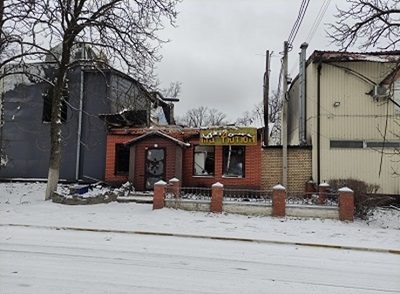
There were no Ukrainian vehicles there. I don’t remember the letter “Z” on the enemy’s vehicles. I think there were some triangles. Maybe I’m wrong. Maybe I have this picture in my head from the news. I saw the vehicles driving down the street, quite fast. There was a situation when the vehicles were moving, and on both sides of them, there were people with assault rifles and other weapons that were placed on the shoulder. I don’t know exactly what they were called. As far as I understand, everyone had their radius of control, their angle. Some held their weapons at one angle, others at another. Everyone controlled their own area. I looked out the window and thought: “What can I do? I’m standing under the wall. Either fall and crawl or stand and don’t move.” If they had shot, the taped-over windows would hardly have saved me.
They did not enter our yard. One day they drove up to the first block of the apartment building, where in peacetime there had been a children’s club, and where during the occupation mothers and children were hiding. There were large, warm rooms there. People said that the Russians came to that entrance, and one of our people came out to them and said: “Why did you come here? We have children here; we have old people here. What are you looking for here?” And they apparently put down two rations, turned around, and left.
“Why didn’t I find arguments to convince him to leave?”
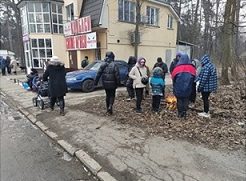
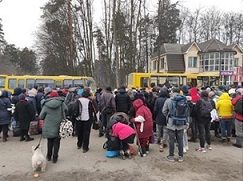
There were a lot of children in our house, but not many old people. Mostly young people. On the 9th of March, 2022, there was an opportunity to leave, buses were organised, as well as a green corridor for people to leave in their own transport. Many people left then. At first, we had to wait a long time. They said they didn’t know when the buses would be there. Some women started organising columns of thirty people at once. But when the buses arrived, no one was staying in those columns. We decided to go home for lunch. Then I got the impression that Mykola had hoped that we would not leave. He didn’t want to leave, because he was responsible for cats and grandmothers. But I still decided to go, albeit with a strong sense of guilt. I realised that if something happened to him, I would blame myself for the rest of my life. I still blame myself for not being convincing enough at the time. Why didn’t I find arguments to convince him to leave? But Mykola stayed in Vorzel [crying].
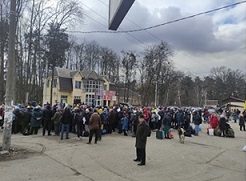
‒ How did you find out about the evacuation?
There was no electricity by that time. On one of the first days, there was the mobile tower that was damaged during the shelling. After that, there was no Internet at all, and no electricity, but there was a generator. I don’t know where local people got the fuel for it, but it was possible to charge the phone from that generator. I knew that on the top floor, I could call using the Kyivstar network. SMS messages came late, and we came up with the idea of writing the time the message was sent. For example: “11.00a.m. I’m fine”. And then, for example: “13.28 Everything is fine for now”. So that it was clear when you were fine, at lunch or in the evening. I tried to call my mother every day. Do you know how I got used to reassuring my mother that I was fine? I would say: “Mum, today I slept without trousers” [laughs]. It meant that everything was fine, that it was safer. Because in the early days, everyone slept in their trousers, in warm clothes, so that in case of an emergency they could immediately run into the bomb shelter.
In those days, many people tried to contact me to tell me about the green corridor. A lot of people left through this corridor. People who had their own transport were the first to leave. When we came for lunch, there were many fewer people in the house. And then there were even fewer again. The rest of us left Vorzel by bus. There were also additional routes. Mykola later said that there were twenty-five people left from the six blocks of the five-storey building. Before that, there had been a lot of people, even a couple with a two-year-old baby.
To be honest, I had no idea how this evacuation would go. People came with huge suitcases, cats, and dogs. When the buses arrived, it was said that they could not take their belongings. So, people left their suitcases and boarded the buses without them. Later, it turned out that those suitcases were loaded onto the last buses with free seats, but I’m not sure that all the owners were able to get the suitcases back, because in Bilohorodka, where we were initially brought, we were immediately transferred to other buses to Kyiv.
Our bus passed enemy vehicles, but I personally did not see any Russians because I was standing among other people. Our soldiers were already waiting for us beyond Mykhailivka-Rubezhivka. In Bilohorodka, there was a document check, although, in my opinion, it was a formality. They checked only men. They did not touch older men. They looked at my passport and residence and asked me who I was with, where I had been, and where I was going. It was clear from my appearance that I was not Russian, but still, this check looked very official. In Bilohorodka, there was a huge volunteer centre where people prepared lunches, tea, and sandwiches with sausage and cheese. “Here you go!” – an attentive woman said, serving food to the bus with trays. Toilets were also available. In general, the organisation was good.
“…We had no idea that it could be even worse”
‒ Didn’t Mykola come to say goodbye to you?
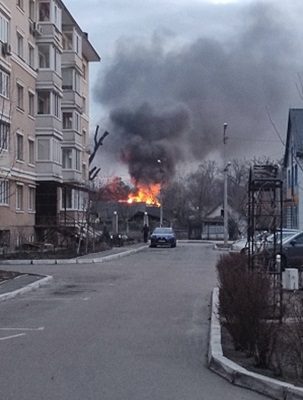
No, he didn’t. He said he had to get some water. I think it was just an excuse. He didn’t want any unnecessary emotions. By the way, I didn’t ask him about it later. The “official” version was that he had to go for water and take care of the household cats and the old women. The “official” version of my departure was to save food supplies. I reassured myself that if I stayed, we would need twice as much food to survive. But… We didn’t know about the events [atrocities] in Bucha then because of the lack of news, for example. We had shelling, fires, smoke. But we had no idea that it could be even worse.
‒ What were you most afraid of?
Uncertainty. I kept trying to use my historical knowledge of the war. I thought: “I have three days’ supply of underwear, and in three days two things can happen: either we will be captured, or in three days we will defeat them.” For some reason, I had those three days in reserve. And then it went like this: one day passed and I thought that Germany captured Denmark in one day, then Belgium in two or three days. And it just kept going on and on. I realised that Russia had great power, even very great power, and anything could happen. What does one hundred and fifty thousand deaths mean to them now, if almost forty million people died in World War Two? It was also scary when we heard constant explosions. Once we heard a whistle very close. And I remembered something from one of the films: “Don’t be afraid, because if it whistles, it’s already flown over! For sure it won’t hit you.” [laughs]
“My professional quirkiness was also manifested here: the toilet was photographed, a piece of bread was photographed, lunch was photographed”
‒ Is it possible to use historical experience and historical knowledge in modern conditions?
Historical experience is one thing, and knowledge about the war is another. For example, I had no experience, but I had knowledge about the war. I think that experience can be used. I mean, not only mine, because I didn’t have any personal experience during the war, but I heard something [from old people], and I can use this experience. For example, according to Mykola, when only a few people were left in Vorzel, the food, including meat and fish, began to deteriorate, and women began to make stews over the fire. Not on gas, but on the fire, they preserved food and put it in jars. I don’t think they were doing this daily before then, and I don’t even think everyone knew how to do it. It was somebody’s else’s previous experience. Someone probably had some skills, and they used them.
‒ Did you make any recordings during the occupation?
No, I did not make any recordings; I only took photographs. My professional quirkiness also manifested here: the toilet was photographed, a piece of bread was photographed, lunch was photographed. I didn’t take pictures of people. Before we left, I didn’t even think that phones could be checked, so I didn’t delete anything. We were not checked. We were just travelling. But it was scary, too. But Mykola was seriously checked – he left a week after me. Interestingly, there was complete silence on the buses at the enemy posts. And later, when they saw our soldiers, the children all got excited and started waving happily.
“Ukrzaliznytsia carries bread (palyanytsi)”
‒ What did you learn being under occupation?
I met new people. Previously, I had known almost no one there, but after the occupation, I knew more people in the building where we lived. I set up the bomb shelter together with the others. To distract ourselves and keep busy, we organised a duty rotation in the house. We even had our own password – “Ukrzaliznytsia”. Russians would not [be able to] pronounce such a difficult word for their jaws [laughs]. We even joked that “Ukrzaliznytsia carries bread (palyanytsi)”. The team had its leaders, although some of them only wanted to lead, but had no ability to do so. It was a period of very interesting communication and new experiences in a completely unfamiliar team and very extreme conditions. Today it is a team with its own history.
During our meals together, we allowed ourselves a glass of alcohol. Every first toast was always “To Victory!” If this toast could influence anything, we would have won long ago [laughs]. Since the occupation, we have met many of our temporary team members. Our password is still valid.
“When months or even years pass, there will be a lot of people who will start mythologising and exaggerating all this…”
‒ What modern sources of information do you consider to be the most truthful in the context of the informational war?
I think that if we are talking about oral history, then if it is recorded as soon as possible, it will be the most truthful. It has not yet been influenced by the media. Before certain clichés appear, it will be the most truthful. We need fresh, living testimonies. When months or even years pass, there will be a lot of people who will start mythologising and exaggerating all this, and perhaps even putting themselves in the context of these events. Therefore, it seems to me that at the initial stage it may be uncontaminated oral historical evidence. I think it could even be journalistic interviews, not necessarily purely research, not necessarily ethnographic, as long as it remains unbiased.
From a scientific point of view, we should try to record everything at once. Perhaps we should record it now, and then it would be good to interview the same people in a year or two so that we have comparative data. I assume that over time, the view of the same events will change. Something will be forgotten, something will be added, something will be mythologised or “folklorised”.
‒ Based on what you have said, to what extent can the testimonies that ethnographers recorded many years after the war be considered true and objective?
Our discipline is generally rather subjective. Therefore, it is difficult to reflect on this issue. The stories of our respondents may combine their own experience with the experience of their parents or, for example, neighbours. Sometimes they may emphasise this, and sometimes they may not. In addition, the testimonies of our interlocutors could be influenced by Soviet [Russian] propaganda. It seems to me that with skilful interviewing and the right methodology of oral history recording, experts can interpret all this correctly.
‒ How do you perceive the oral testimonies of people who create the “whitewashed” image of the occupiers?
If a hundred people passed by and one gave a piece of bread, that would be one person out of a hundred. When I heard the story about the rations left by the occupiers near the shelter with the children in Vorzel, I immediately thought that I would never take what they left. But people did. The low frequency of such cases makes it possible to understand that these are only isolated stories. During my surveys about the Second World War during my fieldwork, I also used to record testimonies about the help of Germans, about caring policemen, and Soviet partisans’ atrocities. But there were few such testimonies.
“Historians are humans too… everything depends on the integrity and professionalism of the researcher”
‒ Do you think that the view of events produced by a historian who was a participant or witness, and an outsider historian would differ?
To a certain extent, emotions play a role here. But it seems to me that it is possible to dissociate oneself from emotion. If the emotion is deep, if the wound is deep, then it is probably harder. Everyone is human. Historians are also people. They can hide something, conceal something, or foreground something else. This must also be considered. Much depends on the integrity and professionalism of the researcher. And in ethnography, it is possible to overlook a single fact or to ignore a fact on purpose. Here we are talking about the integrity of the researcher. I think that we can talk about a certain objectivity of historical presentation only if we use a variety of sources: the media, documents, eyewitness accounts, and even testimonies of enemies.
“…two disciplines should be taught at school: military training and history. Military training, to be able to shoot; and history, to know who to shoot at”
‒ Can a contemporary historian influence communications policy through the research, an informational space which continues to be exploited by Russia?
I remember how in the first months of the war I came across an interesting and important idea online. It sounded something like this: two disciplines should be taught at school: military training and history. Military training, to be able to shoot; and history, to know who to shoot at. It sounds a bit harsh, but it is relevant for our time. Long before the full-scale invasion, I tried to provide the most objective information in my communication with students. Today, my methodology has changed somewhat. I know what to emphasise and what to ignore. I don’t know whether students’ frank patriotic stance today can be called the result of propaganda, but I can confidently say that it has emerged, based on my many years of teaching experience. This is no longer a game of patriotism. “Glory to Ukraine!” from the lips of students today are not just words. In addition, modern students have begun to perceive the meaning of many historical phenomena in a new way. For example, when we study totalitarian regimes, they draw parallels with Russia and Belarus. In other words, they perceive this concept through their personal involvement in the modern epoch. They see it in real-life examples, facing specific situations. I tell them that their current experience is very important, although very sad.
The interview was conducted by Svitlana Makhovska.
The publication uses photographs from the private archives of Oleksandr Vasyanovych and Mykola Hrinchuk.
This publication is also available in Ukrainian.
Links and Notes
[1] Vorzel, Bucha district, Kyiv region, is located near the Antonov airport (Gostomel), which was attacked by Russian troops on the first day of the war (24.02.2022) and was apparently on the list of strategically-important objectives at the opening stage of Russia’s planned seizure of Kyiv.
[2] Electricity, heat, and water were cut off in Vorzel on the 2nd of March, 2022, and gas was cut off on the 8th of March, 2022.
[3] In early March 2022, Russian military vehicles drove through the streets. This is how Vorzel residents learned about the occupation of the village.
[4] The Warsaw Highway connects Kyiv via Korosten, Sarny, and Kovel with the western border of Ukraine (Yahodyn checkpoint). This road was one of the important arteries in the Russian offensive on Bucha, Irpin, and further on to Kyiv.