



‒ Iryna, please tell me what Mariupol was like before the full-scale invasion. How do you remember the city?
Mariupol is the city where my entire family and I were born: my husband, sister, children, and grandchildren. My husband is Greek, one of those Greeks who came from Crimea historically [smiles]. His mother, Varvara, is a pure-blooded Greek. Our large Greek family loved Mariupol very much. This wonderful city was founded at the end of the eighteenth century by the Crimean Greeks and named after Maria, the Mother of God. It survived the Russo-Turkish War and the Second World War, and the historical centre was preserved. From 2015, the city had been constantly changing for the better. During that period, I worked in Greece, where I was giving lectures in Thessaloniki. One evening, while walking through the city, I thought: “How beautiful it is here, the light is everywhere. When will it be the same in Mariupol?” And after about a year, Mariupol did turn into a city that could be enjoyed: with colourful courtyards, playgrounds, and cafes.
But already in the winter of 2022, many journalists began to come to us. They constantly emphasised [with reference to the BBC] that soon Mariupol would be destroyed, and that the Russian Federation had placed many military units around [the city]. However, no one wanted to believe it, and we tried not to think about it. When a Christmas tree, which had been placed on St. Nicholas Day in front of the Drama Theater [1], was broken by a strong wind, I thought that this was not a very good sign. I felt like something bad was about to happen. And I was not mistaken. The winter of 2022 changed everything: the air became filled with anxiety, and people became increasingly cautious every day.
My son went on a business trip to Europe at the end of January. Before leaving, he said: “Mom, be careful because you have two grandchildren staying with you.” Our family had just bought an apartment at the time, and the children were extremely happy. Thoughts about a possible Russian offensive were stressful though. In February, the mayor of Mariupol began to appear on television with soundbites about the “Azov” regiment, which “if anything happens” would protect us and he spoke about the three lines of defense of the city. Like others, I wanted to believe him. A little later, Rinat Akhmetov [2] arrived and reassured the Azovstal workers: “Don’t worry, we have serious protection here.” People reacted differently to such messages, but until the end, no one believed an invasion [was possible].
“… negative stories about the Azov soldiers were made up, and the image of 2014, of course, spoiled their reputation”
‒ Iryna, the “Azov” regiment played a very important role in the Russian-Ukrainian war and became a heroic military formation, around which many myths were formed. As an insider, please tell me what was the attitude of the people of Mariupol towards Azov?
In 2014, the image of Azov residents was sharply negative. After the release of Shyrokyne [a village in the Mariupol district of the Donetsk region. – S.M.] information was spread that they had organised mass thefts and looting there. Shyrokyne was a very prosperous village at that time, and its residents suffered a lot then.
However, after 2014, the image of the Azov soldiers changed. I saw how they were training, how they played sports every morning. I even looked at the physical traits of these people – strong, handsome representatives of different parts of Ukraine. My grandson went to the sports section, which operated under the auspices of “Azov”. I felt sincere admiration and respect for the Azov soldiers. Then various rumours about the violence of the Azov people began to spread again, so many treated them with caution. I personally have not encountered such cases. I’m not sure that the situations people talked about were real. There are many medical doctors in my environment, so if there were cases of violence, people would have sought help, and I would have heard about it from acquaintances and friends. Therefore, I assume that these negative stories about the Azov soldiers were invented, but the image of 2014, of course, spoiled their reputation.
When the shelling of Mariupol began, some locals started talking about the fact that the Azov soldiers were to blame. Some believed that Azov was carrying out the bombing, others believed that Russia was bombing us. I think that some of Mariupol’s residents have still not changed their beliefs about the Azov soldiers.
“A basement on the Left Bank, near Azovstal, became a shelter for us…”
‒ Where were you at the time of Russia’s full-scale invasion of Ukraine?
On the 24th of February, my son called and said: “Mom, pack your things quickly, I have arranged a bomb shelter for you.” Our shelter was a basement under a café on the Left Bank, near Azovstal. My husband has been disabled for years; he uses a wheelchair. Therefore, the idea of going into a basement somewhat “amused” him. “Nothing like that will happen, everything will be fine. Don’t worry! Don’t panic!”, he said at that time. But my son asked us to protect the children and his wife Olha, my daughter-in-law, so I did not dare ignore his request.
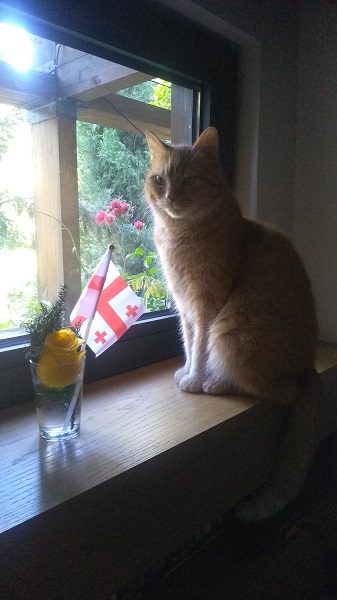
So, my husband stayed in the apartment with our cat, Marcel [3]. He did not want to go anywhere. Then I also said: “Marcel, I’ll leave you food for two days.” I turned off the electricity and brought my husband everything he needed [including] food for some time. We took documents, water, a flashlight, a phone, bank cards, and my wallet when we left home on the 24th of February. Three hours after my daughter-in-law, her children and I left, an enemy shell completely destroyed my son’s family apartment in a nine-storey building. There was also nothing left of the neighbouring apartments, but I learned about this only later.
As it turned out, nobody had prepared this bomb shelter. People brought sofas and mattresses to our basement. There was still electricity at first, but later the light disappeared, and the horror began. We had phones, but we had no use for them because we couldn’t charge them anywhere. There was money, but why would you need it, if you couldn’t buy anything? People engaged in mass looting: they robbed pharmacies, shops – everything they could take.
At night we slept a little more. But soon the sound of explosions began to approach, and after a week there was no way to get out of the basement. There were Azov soldiers in the neighbouring houses who protected us. The Russians, on the other hand, shelled residential areas on purpose in order to understand where our military could fire back from. Having found out the coordinates, they bombed the areas where the “Azov” regiment was concentrated. Two weeks later, the Russians launched massive attacks. We could no longer go out.
On the eve of the full-scale invasion, I had a dream that I was walking through a festive Mariupol until I suddenly found myself in a dark basement. I didn’t know where to go for a long time, until I saw myself in a bright city, among palm trees, as if I were in paradise. After each series of shelling, I thought: “Well, this time I didn’t go to heaven” [smiles]. But it wasn’t funny at all when you are sitting in the basement, not alone, but with children.
“At that time people ran out of their homes with nothing, just to save their lives”
‒ If it was not possible to leave the bomb shelter, how did you live, how did you meet your daily needs?
Somehow, we did leave the basement, to get water. In the first days, volunteers brought us water, and then we realised that that was all – no one would bring us anything else. My husband and the cat stayed in the apartment all this time. I didn’t know anything about them at that time. A week passed, and the situation did not change. At that time, our faith in the international community influencing the course of events failed.
We were very happy when it rained because it was an opportunity to collect rainwater for our various needs. Before active hostilities in Mariupol, there were many birds, pigeons. With the start of the shelling, the white and grey pigeons disappeared, and only black ones remained. They were not going anywhere. The sparrows also immediately flew away. A huge number of animals fled from the bombing sites. We fed cats and dogs whenever possible. It was very difficult to look into their eyes.
The policemen, by the way, remained until the city’s last throes. They were armed, so they took part in military operations. They also helped people to get to the hospital until it was bombed.
One day we went upstairs and saw the neighbour’s children in the yard with their mother cooking some kind of porridge in a cauldron on the fire. Suddenly there was an explosion. I look there and see only the porridge remaining; there are no more people, there is no one to eat. We once again understood that it was very dangerous to leave the basement.
Ten days later, a woman gave birth to a child in the basement. It was necessary to find at least some food for the baby. In a few days, the mother and child were taken away by volunteers. We still don’t know where she was taken, but at that moment we were glad that they were evacuated.
‒ And who helped that woman to give birth in the basement?
Another women had experience of childbirth and some idea of what to do and how. Some rags were found, as the pregnant woman had run to the basement empty-handed. People were running out of their homes with empty hands, just to save their lives. Many lost literally everything.
Once we went out to fetch water, and a woman in her eighties came towards us with a fishing reel in her hands. “I traded it,” she told us, “for a pack of cigarettes”. A hunting store had been bombed in the city, and some people had grabbed their fishing gear. “My husband will be eighty years old in a few days, and I want to give him this spinning reel so that we can go fishing in the summer. We will still win. We have such a wonderful Ukrainian army, we will win!” she continued; we were somewhat charged with her optimism at that time.
“We spent forty-six days in the basement”
‒ How long did you have to stay in the bomb shelter?
We spent forty-six days in the basement. For thirty days there was no opportunity to wash our hands at all, there was simply nothing. Water was used for more important needs.
My grandchildren Anyuta and Yurchyk were my light in the basement. Yurii had a birthday on the 25th of March. In addition, it is the Independence Day of Greece, and Greek blood flows in the veins of my grandchildren. In the pre-war period, we celebrated all birthdays with fun and delicious food. Yurchyk celebrated his fifteenth birthday like an adult. He calmly reacted both to the explosions and to the greetings of everyone present in the basement. And he became childishly happy, just for a moment, when I gave him a chocolate bar.
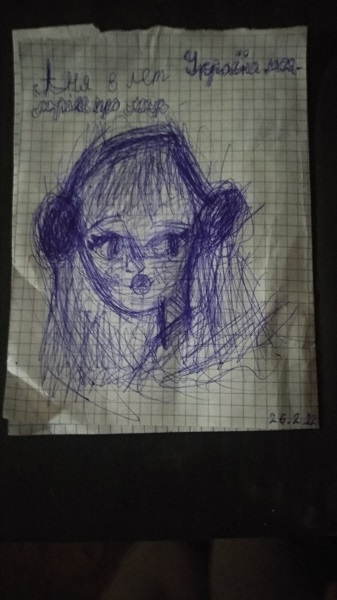
Anyuta was drawing and reading a lot. During the bombings, she shouted insanely: “I want to live! I want to live! Airplanes, fly to your Russia!” She kept repeating this phrase as a command. One day she lost a milk tooth. I began to tell her that this was a good sign. So, there will be good news soon. The soldiers from “Azov”, who were protecting us on the second floor of our building, informed us that Ukraine would soon join the European Union. This news calmed Anyuta a little, although she did not fully understand what the European Union was. She became interested in whether the Tooth Fairies bring gifts to the children of the European Union, as the Ukrainian Tooth Fairies do.
‒ How many people were in the basement?
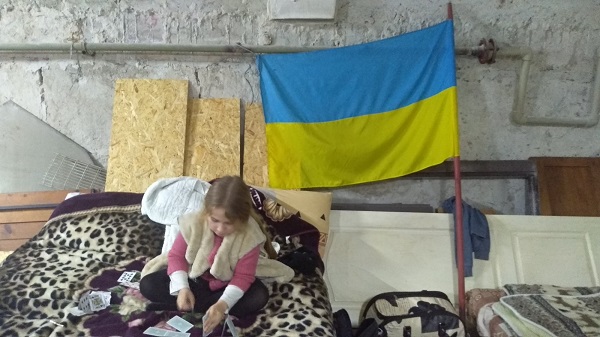
At first, there were twenty-five people. Then some began to leave, and later there were twenty of us, and then seventeen. Some of these people were waiting for the Russians. When Russian tanks appeared nearby, one of the men ran out to meet them shouting: “Hurray! Ours!” The Russians immediately shot him. The other man stayed with us, and he blamed the Ukrainian army and the Azov regiment for everything: “What are they defending!? It would be better to give up!” There was a lot of talk about the fact that they were the reason for all the shelling and destruction. But in our basement, there was a Ukrainian flag and the majority of people were patriotic.
Later, a military man from the so-called Donetsk People’s Republic (DPR) [4] jumped into our hiding place. He was sent to service from Donetsk. He ran to us with a rescue request. In his hands, the man was holding a magazine from a machine gun, because all other parts of the weapon had been ordered by the Russian command to be acquired in battle. The Azov soldiers, on the other hand, were very well-armed. Aid was regularly brought to them, and they even fed our children, helping us.
‒ Did you know what was happening around you while you were in the basement?
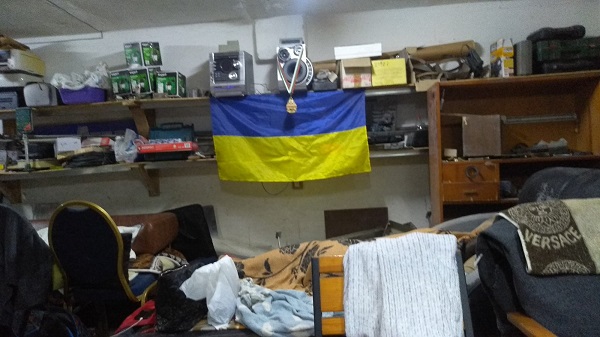
For a very long time, there were battles for Morskyi Boulevard, where we were. On one side stood the Kadyrivians, Chechens, on the other side, our Azov soldiers. They exchanged fire with each other for forty days. As a result, almost all the houses were destroyed. Then the Russians parked a car with a gramophone near the avenue, which played “S chego nachinaetsia rodina…”/ “From which the Motherland starts” [a Soviet-era song]. Later, they began to announce the possibility of evacuation through the loudspeaker. Some people believed them, especially families with children. Once I saw a mother with a child who, despite the shelling, was hurrying to the so-called evacuation site. When I tried to stop her, she replied: “My children haven’t eaten for three days, I don’t care anymore.” Whether they managed to evacuate or not is unknown.
“The most frightening thing was the child’s question: When are we going to eat?”
‒ How did you organise your life in the basement?
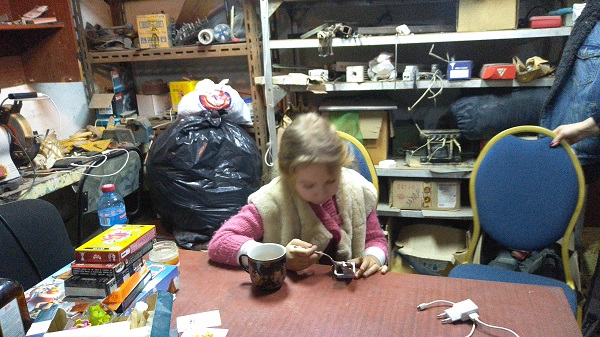
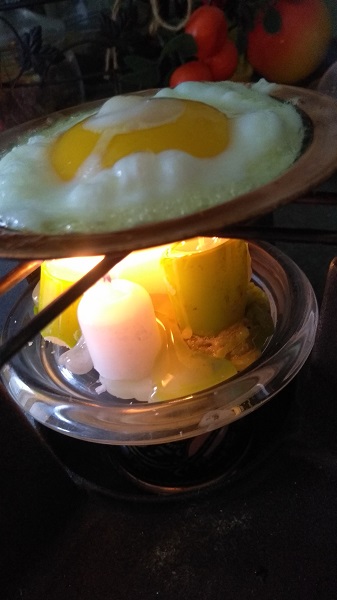
We fed everyone together. The men brought disposable plates from some supermarket, and we spread food on each one: stew, a piece of crouton or scrambled eggs cooked on candles, etc. This was our daily norm, but by the evening the children were already asking for food. The most frightening was the child’s question: “When will we eat?” It is difficult to explain to children why they have to endure hunger. At first, we divided the food among the children, after which the leftovers were distributed to the adults. For example, in order to satisfy my needs at least a little, I chewed fruit tea bags. I tore open the bag and ate this tea. In forty-six days, I lost more than ten kilograms. When people tell me now: “I don’t eat anything, and my metabolism doesn’t allow me to lose weight,” I don’t believe it anymore [smiles].
With respect to hygiene needs, in addition to the main room [where we stayed], there was another destroyed room in our basement where we put a pail. Despite the danger, we took this pail outside each time. The fact that I am a professor did not affect my ability to pitch in [in the basement] in any way. I could cook something delicious for everyone while there was still some food left, and it was greatly appreciated. In addition, I often told my roommates various interesting facts about the history of Ukraine, which they listened to with pleasure. My daughter-in-law speaks English well, so she taught the children in the basement. Two weeks later, they were already talking. At school, most of them could not make progress in learning a foreign language for a long time, but in a basement, it was possible to see progress in a few weeks. It’s just that in the bomb shelter, everyone had an irresistible desire to distract themselves from the events around them and fully devote themselves to different tasks.
‒ How many children were there in the basement?
There were twelve children, aged nine to sixteen. You know what was most interesting? While we were in the basement, no one got sick. No-one had the opportunity for full hygiene and disinfection, but at the same time, no-one got sick. It was not possible to wash our hands, but the body was obviously very determined to survive.
‒ How did you calm the children in the basement?
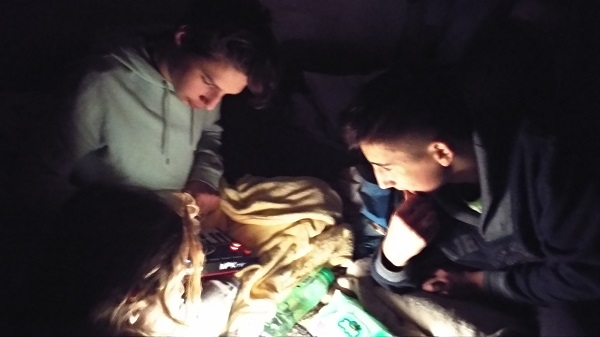
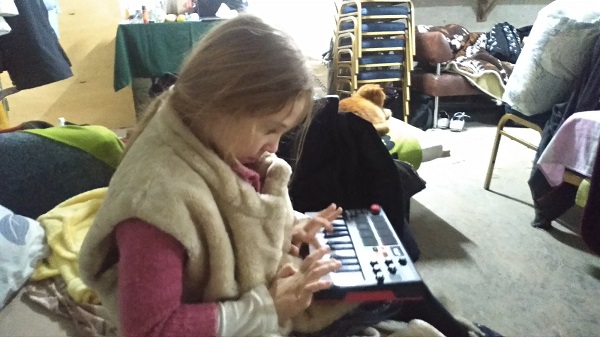
The children first played board games that we had brought with us. It was almost impossible to play active games, engaging bodies, especially because of the constant shelling. It was very cold, the temperature sometimes dropped to -10˚С. It was crucial to keep warm, so all the children of necessity stayed close to their parents. My Anyuta [granddaughter. – S. M.] took a small electric piano with her to the storage room and constantly played Leontovich’s Shchedryk, adding a little optimism and supporting everyone mentally and spiritually. We had seven animals, but two cats did not survive these hardships. The owners, of course, took food for their pets from home, but later they had to look for food for them in stores, exposing themselves to danger. The pets felt everything very much and they often showed us through their behaviour that we should prepare for shelling.
“When the Kadirovtsy [Chechen] police surrounded every house in our neighborhood, one of the men said that the flags must be removed urgently”
‒ How did you find out about events occurring around you?
At first, the Azov soldiers were telling us. Then they said that they were no longer bringing weapons to these areas, and they were forced to retreat. When the Kadirovtsy [Chechens] surrounded every house in our area, one of the men said that the flags must be urgently removed. There was information that in the basements where the Kadyrov soldiers saw Ukrainian symbols, they immediately shot everyone. That’s why we were forced to hide everything.
We waited until the end for the Ukrainian army, we hoped for a response from the international community, and we woke up every morning with hope. Once there was information about a supposed “green corridor” in Mariupol, but there was no such corridor, as it turned out later. Some dared to go to Berdyansk, and from there advance farther. Many people were shot on the way. There was no help.
There was a lot of unconfirmed information everywhere, which disoriented people profoundly. In addition, on the eve of the invasion, the authorities did not prepare people for possible scenarios at all. We still do not have answers as to why the residents of Mariupol were not saved, or why they were not evacuated.
‒ Under what circumstances were you able to leave the bomb shelter?
As soon as the Azov soldiers left, a shell flew into our house and hit the basement. It was then that we realised that very soon there would be nothing left of our shelter. The Kadyrov people “cleaned” everything so as not to leave even a hint of resistance. One morning we realised that our house was already under Russian control, although the neighboring one was still controlled by the Ukrainians. I then decided to go to the military with a request to take us away from the combat zone in Mariupol. My most important task was to save the children. What would happen to me was of little concern to me. I wanted to protect the children. During explosions [from shelling], I constantly tried to cover them with my own body. When I went to look for the soldiers, the fear receded, because I had to save the children.
Forty-six days in the basement affected my appearance significantly. After leaving the basement, I started shouting: “We have children here! Help!” And suddenly a Russian soldier waved at me from the window of another basement. I saw the young face of a military man – a blue-eyed, handsome boy with a blush on his cheeks. I asked him: “What are you doing here?” He responded: “We were sent for training, and we ended up here.” It was clear that the boy was not at all ready for what he saw in Mariupol. “Does your mother know where you are now?” ‒ “No, she doesn’t know!” Then I asked: “Is your commander somewhere nearby, someone from the senior staff, so I can talk to him?” As far as I understood, there was a military man who had led the capture of the city. This boy turned to him with the words: “Comrade commander, some grandmother has come to you, there.” [smiles] And then, despite the explosions and the complexity of the situation, I exclaimed in surprise: “What?! Am I a grandmother!?” [laughs]. When they call me grandma, a different system of coordinates turned on for me.
I looked at that “commander” and he seemed to be normal, unlike the types of so-called DPR citizens, who looked like drunkards and drug addicts. Therefore, I dared to say: “Save us, we have children in the basement.” He agreed but warned: “Don’t come out yet, because we have a command to destroy everything that moves. I must inform [his commanding officer – J.B.] by walkie-talkie that you will be leaving.” I returned to the basement, told everyone to gather all our things, as we would be taken out. When we went upstairs, the children started crying; everything around us was destroyed. The shelling stopped a little because that “commander” had given a warning about our evacuation. There were armoured personnel carriers near Hospital No. 4, they put us in them to take us out of Mariupol.
The biggest difficulty for many of us was the lack of any information. At that time, we were not even sure that Kyiv had not yet been captured. There was no information. So, we got into armoured personnel carriers and left. In that part of Mariupol, where Kadyrov soldiers already felt like they were the owners, even Victory Avenue was signed as “Kadyrov Avenue”. They stopped us at the checkpoint with the DPR soldiers and did not want to let us through. They stripped the men and began to check them. The Russian “commander” told them that he was accompanying us. But the one who stood at the post still did not want to give permission. A conflict arose between them. As far as I understood, the Russians and the soldiers of the DPR were hostile towards each other. Then our escort got the certificate. Apparently, he was of senior rank, because we were immediately allowed to move. On the outskirts of the city, we had to be transferred to another transport. At that time, it was possible to leave only through Russia, it was impossible to get to Ukraine. Near the transfer point, I asked this “commander”: “Why did you come here? You said that you had to “save” us, but it turns out that you destroyed our city.” On the one hand, he really saved us, but on the other – I couldn’t help but ask him about it. He answered: “I am a military man; I have orders.” I asked: “And how are you going to live on after this, hug your children…?!” I felt the need to say this. I received only silence in response.
Everyone who was with me in the basement decided to leave the city. I decided to stay because I didn’t know what was going on with my husband and my cat.
“As soon as the Kadyrov soldiers met a grandmother or a child, they immediately took out candy to show how good they were, unlike the Azov soldiers”
‒ How did you survive in the city alone?
Having stayed in the city, I did not know whether our house had survived, or whether my husband was alive, but I was more relieved that my daughter-in-law and children had gone to a safer place. At least, at that time I really wanted to believe that everything would be fine with them. In the end, it did happen that way. Having overcome a long and difficult road, they ended up in Norway, which is very friendly to Ukrainians. This country has created good conditions for our refugees.
When I reached my house, I saw that our part of the building had survived. I quickly jumped in and opened my apartment door with my key, but my husband was not there. I found my cat Marcel downstairs. He immediately jumped into my arms. I couldn’t imagine how he had survived that horror. When I went with the children to the basement, I, however, had left the refrigerator open. And like a real Ukrainian cat, he had obviously found a piece of lard [salo] there, weighing about a kilogram. I saw the remains of this lard on my bed. I guess he had been eating a little bit of it every day. He had found a hiding place for himself in the closet among the things, where it was probably safer.
Having found the cat, I still didn’t know anything about my husband, yet I had to survive somehow. So I went to one of the distribution points for humanitarian aid, we had places where Chechens distributed such aid. I began to communicate with the Chechens in a rather cheeky way, as I understood that they had instructions to demonstrate their benevolence towards the local population and their desire to help. Every soldier had candies in his pockets. They had received an order to create a more benevolent environment; they addressed the children with the words: “Don’t cry, children, everything will be fine!” The poor children, of course, blossomed when they saw the sweets. As soon as the Kadyriv soldiers met an old woman or a child, they immediately took out candies to show how good they were, unlike the Azov soldiers.
I looked for the end of the queue for a long time – to get something in the queue, you had to have a ticket – after which I approached the long-bearded Kadyriv soldier and asked if there was someone in charge. I was allowed to approach their commanding officer. “Commander, I have a question,” I said. “I’ve been coming for three days, and I can’t even find out where humanitarian aid is given out here. You have made a complete mess here.” I specifically provoked him to react. But he smiled and said: “It’s because you are in such a mood.” I responded: “And what kind of mood could I be in when you mock people!?” He took me to the so-called “minister of Chechnya”, who took me to storage and gave me a box of food, to the great joy of my neighbours, with whom we were soon cooking food together in the yard on a bonfire.
‒ Did you manage to find your husband?
Later, I knew that my husband had survived and was in a village nearby. When the Kadyrov soldiers had seized the territory where our house was located, the firing stopped. So my husband was able to leave the city to go to his parents. At first, he tried to find out where we were staying with the children, but the Russians did not let him go there because of the serious fighting, even though the distance between us was only one kilometre.
Later, together with the cat and my husband, we managed to reach the territory of the so-called DPR. When we crossed the posts, the picture was very expressive: on one side, a cat, on the other, a man in a wheelchair, and many bags. You can make a film about it, a tragicomedy. We found ourselves with our relatives, who had a pro-Ukrainian position. There, all the men were taken to the front, providing them with only one machine gun magazine [among several conscripts]; in fact, they were taken as “cannon fodder”. That is why our relative hid her husband when the Russians came.
Men were forcibly brought there from Mariupol and deployed at the school. Documents were taken from them. I was talking to one of those men, who said that he went to Mariupol to get water when suddenly a car drove up and took him away. Relatives did not know anything about these people. Their fate today remains unknown. These guys were sent into battle in front of the Kadyrovs as a human shield so that they would absorb the impact of the shelling. We are talking about the village of Kozatske [a village in the Novoazovsky district of the Donetsk region. – S. M.], which is on the territory of the so-called DPR. Actually, we made our first stop there after leaving Mariupol.
“When I was in the DPR, I came to the opinion that it is not “Homo Sapiens” who live there, but “Homo DPR”
‒ How did you fare subsequently?
In the first days of life in the basement, before the electricity went down, I received an email from a colleague who already knew that we were being bombed. I managed to answer that the situation was very difficult. Many people actually wrote to me then. I was able to take my laptop to Kozatsk. It was very important for me, because as an ethnographer I had a lot of information there, including my field data and field notes, which I had been collecting for many years. In Kozatsky, I received communications from my colleagues inviting us to the island of Crete. I had no idea how it could be done.
‒ How did you carry a laptop through the posts? As a historian, you must have understood what the consequences could be if the Russians found out about your profession and found relevant data.
I encrypted everything related to Ukraine and my work as much as possible to make it difficult to find. However, the Russians did not inspect us very carefully at the posts, due to the sheer number of people. The only thing that attracted attention at the post were the details of my husband’s wheelchair. We had to buy a pass through the DPR. I handed over the money, whereupon I was invited to meet with some “boss”, and everything was settled. I also had to pay volunteers. They, of course, took us out, and I am grateful for that. My sister was at the other end of Mariupol at that time. Volunteers also took them to evacuate, but they asked my sister for a thousand dollars and a car. That is, under the guise of volunteering, the Russians simply earned money. Although others did sincerely try to help.
My Ukrainian colleagues also helped me a lot. In particular, dr. hab. Serhiy Petrovych Segeda [Ukrainian anthropologist, professor. – S.M.] organised a fundraiser as soon as I got in touch. Surprisingly, it was possible to do this among some researchers from the Russian Academy of Sciences. My husband and I had to get to Rostov, from there to Georgia, and then to Greece, to the island of Crete. Colleagues from Russia called me, apologising and thanking me for accepting their help. They said they did not support the actions of their country. I asked for the names of those who helped me to thank them publicly, for example, on Facebook, but they were categorically against it. They had already been warned about the possible consequences. I saw how quickly their messages disappeared on Telegram. It was clear that the correspondence was being monitored. Therefore, I was asked not to disclose this assistance anywhere.
Russian volunteers invited us to their house, where we lived there for three days. They did not tell us their views; they said it was their job to help people. Every day they took someone out of Mariupol. We did not communicate with them on political topics. A colleague who once worked at the Mariupol State University helped me a lot in Rostov. To take the cat abroad, we needed to get him all the vaccinations. This colleague helped to solve this issue for free. All the Russians who helped us at that time said that they were ashamed of their country, but they could not talk about it, because they would immediately lose their jobs or get into dangerous situations. I realised that they were governed by fear and a philosophy of ‘thralldom’. Here one can condemn, another cannot condemn. It seems to me that it is difficult to change something because Russians have such an upbringing. It is the same as forcing a woman from a certain culture to remove her hijab. Russians seem to have it all at the genetic level. When I was in the DPR, I came to the idea that it is not “Homo sapiens” who live there, but “Homo DPR” [smiles]. They have a completely different system of neural connections. It is impossible to talk to them, let alone convince them of something. They constantly talk in clichés. In general, they look like normal people, but when it comes to politics, their aggression becomes more active. They are completely unable to analyse and compare facts.
We were very warmly treated in Georgia. Georgians sincerely support Ukrainians. We lived in the centre of Tbilisi for about a month and a half. Mostly mothers with children lived with us in the hotel. The hotel owner himself offered lots of help. However, the government in Georgia is pro-Russian. Today, the Georgian opposition is led exclusively by women.
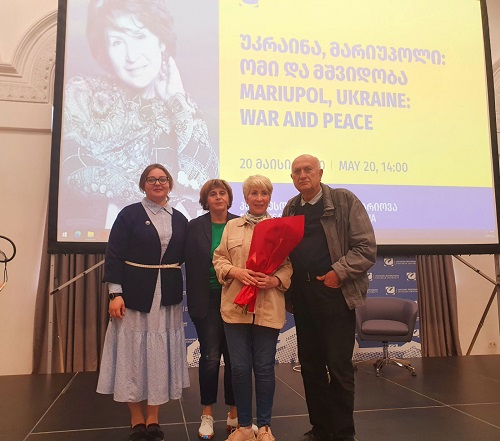
After Georgia, my husband and I ended up in Greece. We were in a dream: from the destroyed Mariupol, after constant shelling, we came to the blessed Greek island of Crete. Of course, we were met by our guardian angels – the life-affirming Dzelina Harlaftis, the director of the Institute of Mediterranean Studies, and the charming researcher of this institute, Hanna Sydorenko, thanks to whom we inhaled the heavenly aroma of Crete.
‒ What is Greece’s attitude to the war in Ukraine?
We are here only thanks to the initiative of my colleagues. They offered me a job at a research institute. I am currently working on the non-fiction book Mariupol in Time and Space. It will be published in Greek. There is no social help in Greece for Ukrainian refugees. My husband is disabled, so we have to decide what to do next. Greeks are very friendly, cheerful, and balanced. They work a lot, get tired, but do not have much aggression. Some people brought us food, others brought different things. However, the Communist Party has a lot of influence in Greece, and Russia invests a lot of resources in it.
“Everyone tries to forget what was in the basement”
‒ Iryna, you and your family have experienced extremely traumatic events, please tell me how you are coping with it, what gives you the strength to move on?
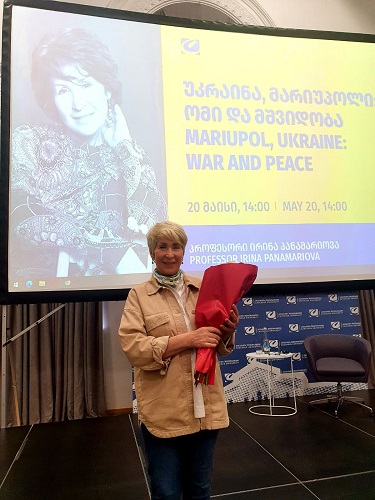
Everyone is trying to forget what was in the basement. When I recall those events today, I try to retell them more softly, taking care of the mental health of the listener or reader. We try not to talk about it with the children because they quickly adjusted to the positive things in a new country. Marcel has also moved away from those traumatic events a little. He gained weight and has adapted to new conditions [5].
‒ What fate do you think awaits Mariupol?
I have no doubts that Mariupol will soon become one of the most powerful centres of Ukraine. It was once the Greek capital of Ukraine, and I believe that it will soon become Ukrainian again. I am also convinced that it will be rebuilt quickly. Those who became collaborators will be forced to leave. We will have to work with others. My students are very determined to return, and so are my children and grandchildren.
One of my medical students wrote that they did not leave the hospital until April [2022 – S.M.]. Surgeries were performed from morning to evening without painkillers, and students even had to sleep at the workplace.
Patients with limb injuries were mainly taken to the hospital. Even though he was only in his fourth year of studies, he quickly became a practicing surgeon. A close friend of our family was injured and was left lying motionless in a nine-storey building, where his daughter from Kyiv looked for him. She even reached Pushilin [6] and was able to get her father out. Now he is in Kyiv. Some did incredible things for the sake of their pets, others for the sake of loved ones. Mariupol is very diverse. Therefore, I am convinced that this city will recover very quickly. Mariupol’s Greeks are pro-Ukrainian. Therefore, the ethnic component will also significantly influence this process.
‒ What would you advise historians and ethnologists to do today to prevent repeated Russian speculations on historical facts?
Our problem is that we often study the past more, and we need to study the present – “here” and “now”. Every day you need to incorporate a variety of layers – from culinary tastes to the anthropology of the city. It is important to have a common conceptual research agenda and a cohesive community.
‒ Thank you very much for the conversation.
An interview was conducted by Svitlana Makhovska
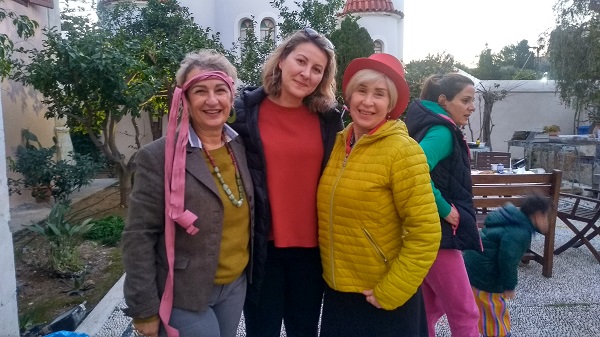
The publication uses photos from the personal archive of Iryna Ponomaryova and open sources.
This publication is also available in Ukrainian.
Links and Notes
[1] The basements of the Donetsk Drama Theatre in Mariupol were used as a bomb shelter during the blockade of the city since Russia’s full-scale invasion of Ukraine. According to various sources, between five hundred and twelve hundred civilians were hiding there. On 16 March 2022, the Russians conducted an air strike on the Drama Theatre building. The exact number of victims has not yet been established.
[2] Rinat Akhmetov is a Ukrainian oligarch, businessman, entrepreneur, banker, economist and politician. In 2000, he founded SCM (System Capital Management). The Azovstal and Ilyich Iron and Steel Plants in Mariupol were the backbone of Akhmetov’s steel business.
[3] The story of Marcel the cat was partially described by Dr. Hab., Professor Serhiy Seheda on his Facebook page. For more information, see: https://m.facebook.com/story.php?story_fbid=pfbid02cN94gLsv6nGiEpENELu68nv5eZrs9WnnYVAbcmgqR96bjnKyvNddaQfnh3trpH73l&id=100069600436396; https://m.facebook.com/story.php?story_fbid=pfbid02kTR62Scb9SJcVnEcxhctJiw3je8J7tXh5CxUYqXTZhDh6MZTYpysBSxp9H9MRNZHl&id=100069600436396
[4] A resident of the Donetsk People’s Republic (DPR), an unrecognised quasi-state in eastern Ukraine created by Russian-backed separatists. From 2014 to 2022, the DPR existed as a self-proclaimed state in the occupied part of the Donetsk region, after which it was annexed by Russia.
[5] While the interview was being prepared for publication, Marcel the cat unfortunately passed.
[6] Self-proclaimed temporary “leader” of the “Donetsk People’s Republic”.