

“Friends, finish feasting, it’s time to go to the training grounds and prepare for the war”
‒ Yevhen, as the founder of the Department of History of Kherson State University, its first dean, and soneone who initiated the creation of several leading journals and edited volumes in Ukraine [1], you have an accomplished professional biography. Could you briefly mention the main milestones of your professional activity?
During my professional career, I have held many positions. After graduating from the Department of History and postgraduate studies at Kharkiv State University, for twelve years [1994–2006 – S.M.] I was the head of Chair of Ukrainian History at Kherson State University. Having founded the Department of History at the university, I was its dean for nine years [1995–2004 – S.M.]. From 2004 to 2007, I did my Ph.D. studies, defending my doctoral thesis “The Place of the Krakow Historical School in Polish Historiography from the Second Half of the Nineteenth to the Beginning of the Twenty-first Century” [specialty 07.00.06 – historiography, source studies and special historical disciplines. – S. M.].

November 2021
Since April 2013, I have been an honorary professor at the Jan Dlugosh Academy in Częstochowa, Poland. In 2016, I became a vice-president of the Academy of Social Sciences of Ukraine. From 2018–2019 I was a full-time professor at the Institute of International Relations and Political Science of the East European State Higher School in Przemyśl, Poland, and from September 2018 to today I have been a member of the faculty of the Department of World History and International Relations of Bohdan Khmelnytsky Cherkasy National University. This is to describe my academic life in short. Although it is very difficult to speak briefly about professional activity, which is not only a job but also a vocation [smiles].
‒ I know that you have been actively helping the Ukrainian Armed Forces since 2014. What did you manage to do during this time? What kind of experience was it for you?

2022
Yes, I have been immersed in the war effort [volunteering, fundraising – J.B.] since 2014. Ever since the Russian invasion of Donbas and the beginning of the annexation of Crimea, I have been helping the military in every possible way. Last year [2021. – S.M.] I was at the training grounds three times: once at the shooting range and twice for parachute jumps. Since 2014, I have taken care [this relates to volunteer assistance. – S.M.] of two particular special units.
With the beginning of the full-scale Russian invasion of Ukraine, I continued to actively raise funds to help the military, whom I have every right to call my brothers for these last nine years. I was very worried about the guys from one of the special forces that I visited last summer [2021. – S. M.]. They were hit by missiles in the first minutes of the war. A couple of days later, I received a message from Colonel S. with the following content: “Our barracks were bombed. We’re fine, we’re holding on. The car you handed over fulfilled its mission.” He also attached a photo of a Toyota without windows.
‒ When and how did the war come to your home?

2022
I wrote on my Facebook about the fact that a full-scale invasion awaited Ukraine back in November of last year [2021. – S. M.]. Moreover, I even published a video of myself shooting a Kalashnikov at a training ground with the caption: “Friends, stop feasting, it’s time to go to the training grounds and prepare for the war.”
‒ Did you have any information from the military or were these your predictions as a historian?
I did not have information from military circles, but I saw many analogies with the last century, in particular with the 1920s. Russia has been our existential enemy, and we will not get away from that. It has always wanted to destroy us. Even starting from such liberals as Belinsky, Gorky, and up to now. Therefore, the war was not a surprise for me. Moreover, I am convinced that it should already have started in the summer, sometime in June 2021. I think that Biden meeting with Putin in Geneva in June in fact slightly delayed this invasion. When Putin concluded that Biden might have been leading him along, not willing to “divide the world” [as in 1939 under the Molotov-Ribbentrop Pact] along Stalin-Hitler lines, it became apparent that a full-scale invasion of Ukraine was inevitable.


2019

December 24th, 2021.
For a long time, our family even argued about the date of the invasion. My eldest daughter was convinced that the war would begin on January 1st, because the New Year’s Eve celebration, when everyone is drunk, could have been be a very convenient time. So she left with her children for the Baltic states in early December last year [2021 – S.M.]. During our discussions, I insisted that the war would begin on the 22nd of February 2022, especially given Putin’s love of various symbolic dates, the so-called magic of numbers. I was waiting for the 22nd of February, then the 23rd of February, the day of the Russian army [Defender of the Fatherland Day – J.B.]. But nothing happened. From four o’clock on the 24th of February, I again began monitoring the news. And soon there was information about the bombing of Kyiv, Ivano-Frankivsk, and Mykolaiv; I remember Kulbakino being bombed at the time.
“…this dead silence portended something”
‒ Were you in Kherson on the 24th of February?
Yes, I was in Kherson. When I returned from the Baltic states on the 9th of February, I still had time to take my eldest granddaughter to the ice rink at the “Fabrika”, the largest shopping and entertainment centre in southern Ukraine. I have four granddaughters, two daughters, and a wife. And the only men are me, my cat, and my sons-in-law [laughs]. At the time, I felt as if that walk to the “Fabrika” would be the last one, and in fact, soon after the orcs [pejorative term used by children to refer to Russian soldiers and subsequently adopted popularly– J.B.] burned it down.
Before the war, I went to my dacha, which is located on the left bank of the Dnipro River. There was a forest nearby where the military was stationed. I could always hear them clearly; they were either shooting or starting a tank ,and I can distinguish the sound of a tank engine from other vehicles. But this time there was complete silence. I noticed it then, as if this dead silence portended something. Three days before the invasion, I returned to Kherson.
My granddaughter had just been born at the end of December. At the beginning of the full-scale war, she was not even two months old, so it was difficult to take her on a long journey, for example, to western Ukraine, a thousand kilometres away.
Having had an experience of war from 2014, I was seriously preparing for the greater war, including buying gasoline and diesel. I didn’t buy any food, though, because I didn’t think Kherson would surrender so quickly; I still hoped that our men would defend the Kherson region.
As a family, we agreed that I would move the children from the apartment to my eldest daughter’s house, which was still under construction. My wife, as I expected, insisted that she had to go to work, so I took her there as well. There were no lines at the ATMs in the city centre, unlike in the suburbs, where our apartment is located. There was already a rush at the shops, at pharmacies, and at ATMs.
‒ Was it the 24th of February?
Yes, I went downtown with my son-in-law to see what was going on. There were many men between their twenties and forties in front of the city council demanding weapons, but no one gave them any. At least we didn’t see any citizen self-defence units being formed. We noticed a police car on the main street. A siren wailed from time to time. In the afternoon of that day, the orcs were already on the left bank in front of Antonivskyi Bridge, where the fighting had started.
It turned out that the tanks had not been refuelled, so it seemed that no one was preparing for the fighting. Our leadership, though, claims that they knew about the date of the invasion.
“I couldn’t even imagine that Kherson would surrender so quickly”
‒ Do you think the military leadership was not preparing for the war?
I could not even imagine that Kherson would surrender so quickly. Back in 2014, I remember realising that there were very few defence facilities in the Crimean direction [southern Ukraine, steppe zone – J.B.]. There were not any more of them [added] even later. In addition, I saw that Melitopol was exposed. Mariupol was tightly protected only from one side, the actual side of the Russian Federation, and the rear was completely exposed. I’m not even talking about Berdiansk; due to the city’s geography, it would have been very difficult to organise its defence, and therefore it would have been subject to serious destruction [had it not surrendered – J.B.].
At the time, I was convinced that at least on the isthmus from Crimea towards Kherson, some kind of reliable defence network would be built. It seemed to me that the “bayraktars” [Unmanned Aerial Vehicles] purchased during the tenure of the previous president [Petro Poroshenko – S.M.] would at least fulfil an observation mission. But in fact, none of this was done, so the orcs simply went along the key highways to Nova Kakhovka and Kherson. There was even a story online by one of the Russian soldiers that he fell asleep in Armyansk when their convoy was leaving and woke up in Nova Kakhovka.
‒ How much time did you spend under occupation?
I stayed under occupation until the 14th of April, 2022. Russians entered Kherson on the night of February 28th to March 1st. They were apparently afraid to enter the city because they thought that our troops were waiting for them with NLAWs and Javelins [hand-held rocket launchers – J.B.]. But I did not see our troops in the city. Only some suspicious young men with smartphones in their hands, wandering around at the crossroads.
On the night of March 1st, Russians entered Kherson, shelling the city with Grad rockets. Many people were killed. A man and a woman who were driving in a “Zhiguli” car on Perekopska Street were shot. The enemy hit school No. 24 and the balconies of some nine-storey buildings. The son-in-law of one of the principals of a private school was literally blown to pieces. At the same time, the Fabrika, which I mentioned earlier, was also destroyed. In the morning, my son-in-law and I stopped by the Silpo store, which was still operating in the Fabrika, but by the end of the day it had completely burned down. A fighter jet launched a missile over my house at about 6p.m.. I thought the city council, which was shining with Christmas lights, [had been attacked] but it turned out that the central market had been targeted.
In Kherson chat rooms, there were many messages and videos about Russian soldiers looting stores (Europort, ATB, Silpo), and local looters helping them. First, they stole food, and the next day they went to retail outlets and showrooms with new cars, phones, laptops, scooters, computers, and the like. Pharmacies were robbed. Activists tried to catch the local looters. The punishment for them was to tie them to a tree with duct tape and write “thief” on their naked buttocks with a black felt-tip pen. On March 1st, in the evening, explosions and machine-gun fire could still be heard in the city. Unfortunately, due to a betrayal, in Buzkovyi Hai, on Naftovykiv Street, orcs shot several dozen Ukrainian patriots from armoured vehicles. Our Orthodox priest, who dared to bury the dead there a couple of days later, was tortured by Russian soldiers.
‒ Have you seen the occupiers? Can you create a collective image of the occupiers? Age, ethnicity, what did they look like in general?
You see, they were so poorly dressed up that, to be honest, it was very difficult to understand who they were. They looked like vagrants.
‒ Was the enemy equipment marked in any way?
“Z”, “Z”. Everything had a “Z”. Even civilian vehicles were marked with the letter “Z”. All equipment was labelled. First of all, they turned off Ukrainian television and radio and then turned on Russian radio and television channels. In the “Regional State Company” they turned off all the equipment and replaced it.
“My daughter lost her breast milk due to stress, and it was a problem to feed our two-month-old granddaughter”
‒ How did you act at that time? What were the biggest challenges you faced?
We didn’t buy a lot of food, only for a couple of days, because again, I didn’t believe that Kherson would be captured so quickly. I was aware that it would be harder to buy gasoline and diesel, so I created more serious fuel reserves. In addition, I called Colonel S. and asked him to bring “Hryhorovych’s machine gun” [as the military jokingly calls the weapon assigned to “machine gunner” Yevhen Hryhorovych Sinkevych – S.M.], because I had received eight years of training at the training ground with all types of small arms. Food in Kherson was not easy to get, because what we could find was mostly rotten and not very suitable for eating.

2014
My eldest granddaughter’s temperature jumped to forty degrees due to stress, which lasted for two days. Stress caused my daughter to lose her breast milk, and it was a problem to feed our two-month-old granddaughter. We managed to buy the last jar of baby food at ATB for nine hundred hryvnias. Prices for everything skyrocketed in those days. Later, my son-in-law found a pharmacy that hadn’t been robbed completely, and there he bought another jar of baby food at a steep price. Later, volunteers helped us a little with the formula; they just shared it with us, for free. But the baby food was not very good, we had to give her laxatives. The child was suffering. It was a complete nightmare. The orcs banned the organised delivery of humanitarian aid to the city.

2015
Local businessmen, in my opinion, behaved with great dignity. Realising that the warehouses would be looted, they started distributing flour to people, baking bread, and giving it away for free as well. In the early days, this was very helpful for people in the absence of food. The surviving “ATB” groceries had only Fanta, Coca-Cola, and some non-essential goods.
The biggest problem for me and people of my age was medications. People who were dependent on insulin, for example, could not get it at all. The volunteers, of course, tried their best to help. However, it was impossible to reach everyone and deliver insulin to each person on time. For the last month, I have been taking my pills every other day, even though they should be taken daily.

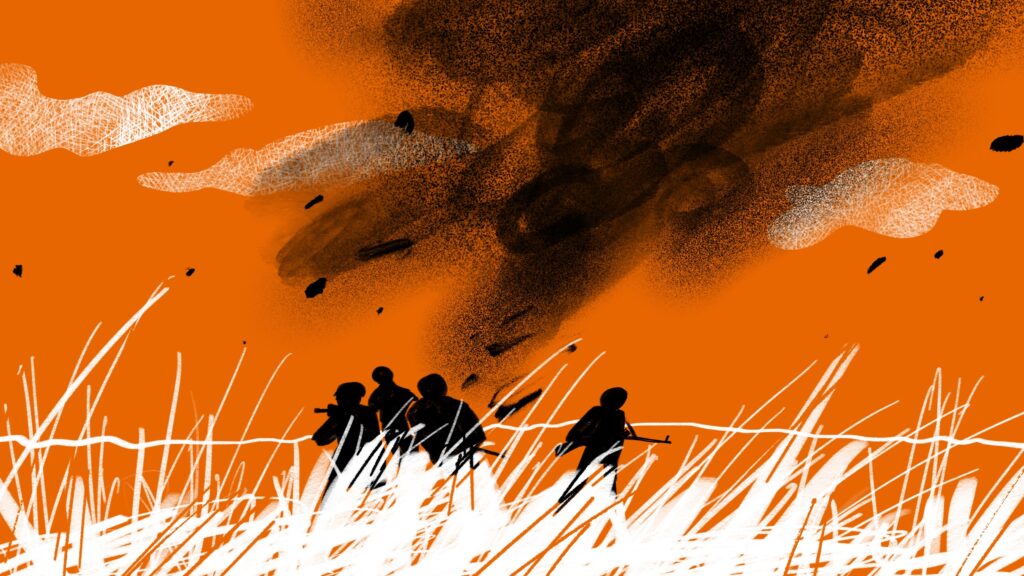
Training of a Ukrainian special forces unit in the reeds on the river.
2015
One day, my son-in-law and I went out to buy cat food, because our cat eats only specific food, so we had to solve this issue somehow. I stood in a long line for half a day. We returned home through small streets because the orcs were afraid to drive on those roads. They were probably afraid that someone would throw a Molotov cocktail from the bushes or something. So they usually moved in small armoured groups along the central streets.
‒ What survival strategies did people use in these conditions?
An internal network of information exchange was created in Kherson: where the enemy was, where the checkpoints were, where you could buy the things you needed, or food, or where you could exchange something. In this regard, the people of Kherson were very united.
There was also a lot of mutual assistance between local people. I remember baking bread and sharing it with others, and they shared fish with us. Back then, many people were fishing in the Dnipro to survive.
About two weeks later, the Russians allowed villagers from the left bank to bring food and sell it. One day I wanted some cheese pancakes (syrnyky), so I spent three days buying cheese. The orcs banned the delivery of feed to one of the largest poultry farms in Europe, Chornobaivska, and an epidemic among the chickens began.
Until the Rosgvardia and the FSB entered the city, Russian soldiers did not particularly harass the residents; they even tried to spread so-called humanitarian aid to create an image [of benevolence for broadcast on] Russian television. But they were met with categorical opposition. So this image was arranged by bringing buses with “grandmothers” from Crimea.
‒ What was your situation with the electricity and water supplies?
There were no problems with gas, water or electricity. Everything was working, everything was functioning. The only trouble was the experience of constant explosions, which caused power surges. I even had a TV set burn out because of this. Moreover, during the occupation, garbage was taken out only once a week.
‒ Do you know any examples of collaboration with the occupational forces?
There weren’t many collaborators, although I was concerned about it. The principal of the school where my daughters and granddaughter studied was an eighty-year-old woman who had a heart attack. She had become a principal under the Communists. One time, she would not allow my daughter to study in Ukrainian, arguing that “we will not open a class for fourteen khokhols [pejorative Russian name for Ukrainians].” Realising that they were under occupation, some school principals burned all the documentation, but our school did not, so the collaborators simply took [these files] away. It is clear that the personal files of the children included the addresses of their parents. Therefore, everyone was told to come and enrol their children in Russian classes that would teach them according to Russian programmes. They threatened to “come to the apartments of those who ignored them”.
“The feeling that your city became a stranger to you was probably the worst feeling of all”
‒ You are a professional historian and are also an active volunteer. For Russians, this is sufficient reason to consider you an “ideological enemy”. Did you try to protect yourself in any way during the occupation?
After the Russians came to Kherson, I completely deleted my Facebook because I realised that having it was dangerous. I wore a mask, although no one was wearing them at that time, as Covid had calmed down a bit by then. I realised that there were cameras that could easily identify me. I pulled a cap over my forehead and took only a push-button phone because it did not have any information or social networks. And I moved only through narrow streets to avoid being seen… You had to survive through it. The feeling that your city had become a stranger to you was probably the worst feeling of all.
One day I wanted to share a photo of administrative buildings with our flags by email. I went to the city centre sometime after 5p.m. There were no vehicles or people. Everything was empty. I took a photo on my smartphone and decided to leave when three armed orcs rushed at me. It was good that they did not shoot me in the back. I hope that maybe someone still has those photos because, in anticipation of “guests” who might come uninvited, I had to delete everything [from his phone -J.B.].
The feeling of being in a foreign, hostile city was very strong. People outside the occupied territories often put us in danger. For example, they could send a message saying, “Glory to Ukraine! Glory to the heroes!” And at that moment, if you were walking through the occupied city with your smartphone and Russians checked you then, or if the message came through with a sound, you were dead! And people in the free territory did not understand this. They were heroes in the deep rear, and for us, this “heroism” could be a matter of life and death.
After the invasion had just begun, I was writing several letters a day to various people, to authorities in Ukraine and abroad, including Poland. I gave an interview about the situation in occupied Kherson to a correspondent of a German newspaper. Some of my posts, I was told, even reached Japan, where they were published by the Japanese. As you can imagine, it was dangerous to write under my own name, so I took a pseudonym. I transferred funds to the soldiers to replace the water pump in the armoured vehicle, as well as to treat a man from Kherson who had been shot in the leg by orcs during the protests.
Once I almost revealed myself; I called a village mayor I knew, but he was already under the control of Russian torturers. He was tortured with electricity for three weeks at a recreation centre and had his ribs broken. Ukrainian patriots in that village also suffered from the orcs. One of them was mercilessly tortured for removing road signs, and was later taken to Crimea and sentenced to twenty years in prison. At my godfather’s house, the orcs demolished the gate with an armoured personnel carrier and settled into his house, and my neighbour E. was mercilessly beaten to confess where his son, an “ATO soldier,” was hiding. Then I realised that my number was tagged, so I had to pull out my SIM card. It became clear that Russians could pay a visit at any moment. My family was under threat. So the question of leaving the city arose. The orcs never provided any green corridors. Therefore, the citizens decided to leave at their own risk. Not everyone’s journey ended successfully. My relatives left through Bilozerka, Stanislav, and through the village of Oleksandrivka, which was already destroyed at that time. They covered the sixty kilometres to Mykolaiv in eight hours. My son-in-law, daughter, wife, and two granddaughters went along. They spent the night in Mykolaiv and then got to Odesa. This happened in March.
At that time, I was mostly worried about my family because I thought that they could be taken hostage because of me. And what they would do to them after would be unknown. Because of all these worries, I lost fifteen kilogrammes in a month and a half.
“I had to decide what to do with the compromising data because there was a high probability that I might be ‘visited’ soon”
‒ Did you manage to avoid a horrifying meeting with the occupiers? Did anyone else you know suffer from their visits?
I witnessed arrests beginning. I always speak Ukrainian as a matter of principle, but one of my friends and I agreed: if she is revealed, she will switch to Russian in her conversations with me or in her messages and vice versa. This will be a sign that there are problems.
First of all, the Russians took prisoners from the detention centre and began to fill it with ATO fighters. Our guys were tortured mercilessly. Screaming, physical violence. After interrogations, some were found in the Dnipro River, some were found dead in a forest plantation, and some simply disappeared without a trace. Volunteers and journalists were also caught. My former student R. is a journalist. She was taken to the orcs’ “basements” for a month.
‒ Did they also abuse women, and interrogate them?
Yes, they did. R. shared information that there were eight women in a three-person cell in prison. That is, only three were allowed to lie down, while the rest slept on the bare floor. They did not receive any female pads or any other hygiene products. The food was miserable. Women were not tortured or beaten there, they were psychologically exhausted. No medical care was provided. R. wrote that one woman died after a month in their cell.
‒ Was there any sexual violence against women?

2022. (“Beasts!”)
You see, not every woman would want to talk about it. And men don’t talk about it either, because sexual violence has been often committed against men to break their will.
After sending my family to a safe place, I started thinking about where to hide, because I thought that sooner or later they would find me here. I remembered a graduate student. But before I could call him, I received a message: “Can I come to you?” His mother came to see me, frightened by the experience of an acquaintance of hers, an SBU [Security Service of Ukraine] officer, who had been kept “in the basement” by the occupiers. She asked me to hide her son at my place because he was a former ATO soldier, and was therefore in serious danger. The orcs had lists of addresses. Of course I agreed.
‒ Did you have to hide Ukrainian symbols during the occupation?
Yes, I had to do this. When my family left, I started to think more clearly. I had to decide what to do with the things compromising me because there was a high probability that I might be “visited” soon. I had a lot of awards, and certificates for helping the military, signed by various generals [2]. I also had medals and orders from my volunteer trips to Crimea and the Mariupol area, including a medallion [3]. I hid all this in a safe place. I also put two flags in the same place: one was a regular flag of Ukraine, and the other had signatures from the military.

December 24th, 2021
I hope that when I return, I will film the entire process of dismantling this secret place. But most of all I was worried about my laptop, where I had photos from training grounds, shooting ranges, photos with the military, etc. There were also many texts of my publications in various networks, for example, articles with titles like these: “Why do Russians need Lenin’s mausoleum?” or “When does a lizard lose its tail?” The “lizard” is Ukraine, and the “tail” is Donbas. Do you know that a lizard’s tail grows back after a while? [smiles].
‒ Yes, I do.
I had many other posts, so I had to hide the laptop very securely, which I did [4].
‒ Did you keep a diary during the occupation?
I was writing every day, starting from the 24th of February to the 13th of March. These were mostly fragments of emotions, experiences, thoughts, reflections, and exchanges with those to whom I had the opportunity to write.
“…listening to my daughter’s pleading, I decided to leave”
‒ Did you finally decide to leave the city?
I knew at that time that my mother was dying. The 13th of April was her birthday, she was turning eighty-four. I called my mother in the morning, and at 8p.m., listening to my daughter’s entreaties, I decided to leave.
I realised that if I left alone, they would kill me. I had a new car and a diesel engine. So, I took two women I knew, left some food for the ATO soldier – I planted potatoes near the house, which also helped him later – took a cat, a guinea pig, an electric baby mobile, a diaper-changing mat, diapers – everything that my children could not take. At 6a.m. on the 14th of April, we left Kherson for the north, in the direction of Beryslav-Kakhovka.
On the way, we saw burned cars, a completely burnt-down two-storey gatehouse near the railroad crossing, and the destroyed “Fabrika”. I put on the clothes I wear at the dacha: inconspicuous, grey, old, darned. I left the originals of all my documents at home because, if the Russians knew I was a historian and a professor, they would hardly let me leave. My fellow travellers wiped my smartphone completely [of dangerous information]. They deleted all the photos relating to the army, the war, Ukrainian flags, etc. They deleted applications: Diya, WhatsApp, and Instagram – I had deleted Telegram earlier, on the recommendation of our military – so that nothing could be traced or discovered about me.
When I approached the checkpoint, I rolled down the windows completely, turned on the hazard lights, and slowly moved in, waiting to meet the inspector face-to-face. And at that moment, it was important whether he liked you or not. We passed the first checkpoint calmly. The second checkpoint was manned by burly men in their thirties and forties, probably from the National Guard. We also successfully passed this post. But the car that was following me was stopped, and the whole convoy [behind him] stopped.
There were a lot of damaged vehicles on the road, including civilian vehicles. In the next village of Dariivka, the line was moving slowly, and there were many military vehicles around. So, we reached the post across the Ingulets River, from where the road to Snihurivka was impassable. I had a minor conflict with the Russian military there, but it was soon over. I was convinced that as soon our army took Snihurivka, they would immediately liberate Kherson.
We drove off-road so that the car would quickly turn from white to dirty, clay, and would no longer attract attention. Then we met a checkpoint with young guys, clearly Russian conscripts. They asked some of the people leaving whether they had vodka or cigarettes – I had heard in Kherson that there were cases where they were demanding “currency” for travel. Then there was a checkpoint with Buryats. They would demand only cigarettes from people leaving. In Snihurivka, there was another line. Along the roadside there were several burnt BMPs [infantry fighting vehicles], I don’t know whose, and our mangled military KrAZ [trucks]. A power line with broken wires lay in the fields; craters, and signs with the words “Mines!, Mines!, Mines!,” were everywhere.
The Russians bulldozed the road, about three metres deep and three metres wide, and threw on stones and concrete blocks. The procedure was the same at all checkpoints. White pieces of fabric had to hang on the car mirrors. At the next checkpoint, documents were checked by an FSB officer. We had a story that we were going to Koblevo to baptise my granddaughter. To confirm this, my daughter in Romania sent a photo with my grandchildren and an invitation to the christening from her smartphone. The soldier read the name in my passport and was hesitating. To be honest, I had shivers down my spine. But, thank God, it was all right. The soldier asked me to get out of the car and open the trunk. After a cursory inspection of its contents, he allowed me to move on.
But we didn’t know where to go. We reached a crossroads. I had never been to that place before, I had only passed by on a train. I knew only one thing: to get to Mykolaiv, I had to keep to the left side and cross the tracks. Suddenly I saw a car with local licence plates coming from the left. I stopped, rolled down my window, and started waving for them to slow down as well. When the Lanos drove up, I saw the letter “Z” painted in white on the door. The window went down and there were three Caucasians in the car.

April 15th, 2022
“What do you want?”, they asked. I responded in Russian, “Hello, guys. Should I go here, to your place, or straight ahead?” “Don’t go here, go straight,” I thanked them and left. Thank God, they didn’t pay [any real] attention to me.
Eventually, after two roadblocks, including one with drunken Chechens – Kadyrov soldiers – we reached another crossroads. Some cars went to the right, but I still chose Mykolaiv, so we turned left.
After a few more checkpoints with machine gunners, infantry fighting vehicles, and armoured personnel carriers, the no man’s land began with a lot of broken equipment and civilian vehicles. I can’t even tell you how much joy we felt when we got to the territory controlled by Ukraine! It was an overwhelming feeling of happiness. Tears came to my eyes. We offered our soldiers something tasty, but they said they had everything. They only shook our hands…
“My granddaughter is still afraid of airplanes and people with guns”
‒ It is very difficult to leave your home. The place where you have lived all your life and go somewhere unknown. Do you know anything about the fate of your property in Kherson? Does your family have a place to return to?
Our dacha is now under occupation, looted and mined. Thank God, no one broke into the apartment. The only thing is that our neighbourhood was shelled after the liberation of Kherson; there were seven killed and twenty-one wounded. Some apartments were burned down or bombed. In our apartment, only the lock in one of the windows was blown out.
‒ Is your family safe now?
Yes, my family is now in Romania and Estonia. My granddaughter goes to school. Three times a week she learns Romanian, but she studies according to the Ukrainian programme. Romanians are a friendly people and do a lot of good for Ukrainians.
My granddaughter is still afraid of airplanes and people with guns. Recently, there was a public holiday in Constanta involving aviation and the military, and my granddaughter reacted to all those events with great tension.
‒ As far as I know, you are now in Poland?
Yes, I am in Poland, in Częstochowa. I am an honorary professor at the Jan Długosz University. I am very proud of this because among Ukrainians there are very few such, I would say “ordinary” honorary professors. As a rule, most of them are people who at one time or another held official positions. For example Ivan Vakarchuk, Hero of Ukraine, rector, minister; Viktor Skopenko, Hero of Ukraine, rector, chairman of the Higher Attestation Commission; Borys Voznytskyi, Hero of Ukraine, director of an art gallery, etc. And among these quite well-known figures is me, who at the time of receiving the honorary title was neither rector nor vice-rector, nor head of department, nor dean. I was just an ordinary professor. That is why I am so proud of it.
‒ I would say that you are an extraordinary professor.
[smiles]
“Historians today can do a lot”
‒ Please tell me what, in your opinion, modern historians can do to ensure that the Kremlin will not have any basis for provocations on historical grounds in the future?
Historians today can do a lot. First, we need to resolve the issue of teaching history in higher education institutions, because the number of hours for this discipline has been significantly reduced in recent decades. Second, I believe that textbooks for schools and universities should be written by historians from a new generation.
‒ Do you have personal predictions for the Russian-Ukrainian war?
In my opinion, going back to the borders of Ukraine in 1991 will not solve the major problem. In 2014, I gave a lecture in Przemyśl, the essence of which was that, since the annexation of Crimea and Russia’s invasion of Donbas, World War Three has begun. We would be able to talk about the end of this war only when a Ukrainian soldier in Moscow would write: “I am satisfied with the ruins of Kremlin.” One of the Polish journalists then called me “waryat”, which means “weirdo” in Polish. Back then he said that the Russian army was the second most powerful in the world.
‒ And finally. Which historian, in your opinion, can be considered more objective: the one who was a participant or witness to the events, or the one who looks at historical events from outside, keeping a distance?
In the introduction to my memoirs, which I hope will be published soon, I have already answered this question. It is very difficult to talk about objectivity as a whole in history because of the subjective assessment of its recorders and interpreters. We need to record, compare, and think critically – this is the most important thing to do.
The interview was conducted by Svitlana Makhovska.
The publication uses photographs from the personal archive of Yevhen Sinkevych.
This publication is also available in Ukrainian.
Links and Notes
[1] Yevhen Sinkevych founded such journals as: “Southern Archive. Historical Studies”, “Black Sea Chronicle”, “Historical Archive. Scientific Studies” and others. In addition, he is a member of the editorial board of the Kharkiv Historiographical Digest and has three edited volumes in Poland.
[2] Yevhen Sinkevych was awarded the honour “Excellence in Public Education in Ukraine” (1998) and “Honorary Local Historian of Ukraine” (2018). He was awarded the Medal “For Dignity and Patriotism” (2015) by the command of military unit N, the Order “For the Development of Ukraine” (2015) by the NGO “Partnership for Development”, the Medal “For Scientific and Educational Achievements” (2017) by the Ministry of Education and Science of Ukraine, and the medal “For Volunteer Activity” (2019) by the Cherkasy Cossack Kosh (Ukrainian Cossacks). In May 2017, he was awarded the I. Vyhovsky Capitol (under the auspices of the President of Poland).
[3] A type of military insignia in the form of a coin, the origin of which dates back to the 1950s or 1960s.
[4] In January 2023, despite the constant shelling of the city, Yevhen Sinkevych managed to get to de-occupied Kherson and take his laptop from its hiding place. It remained intact, so the researcher’s archive was preserved.