

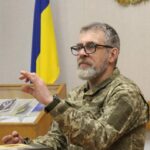
“Buddy, show your Ph.D. diploma”
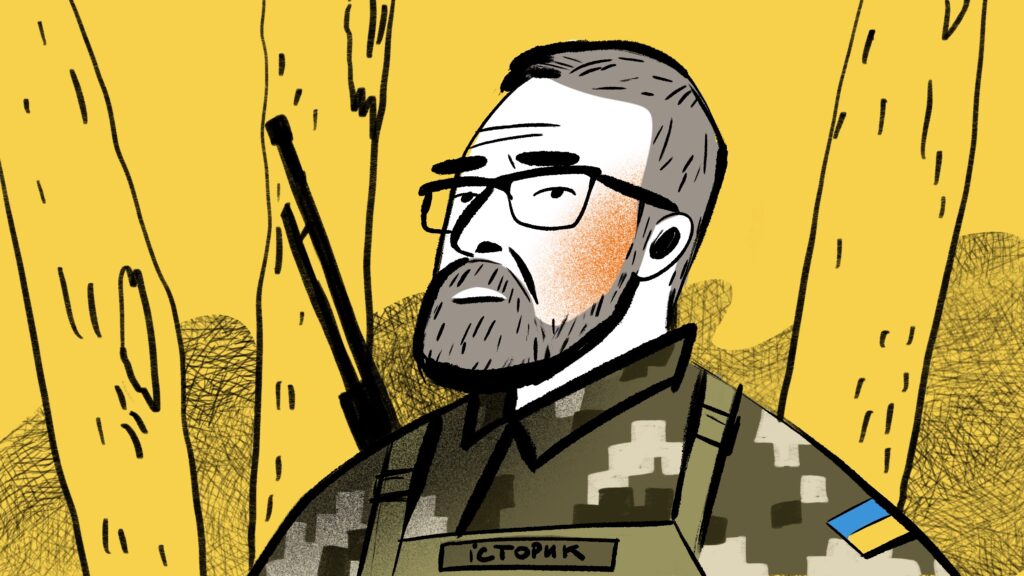
‒ Oleksandr, as far as I know, you have a degree in philology. Also, as a poet, you support your comrades on the front line and all those who read you at the rear. However, history has also become a huge part of your professional career. I noticed that even your Facebook account is called “Historian Historian”. So, which do you prefer: philology or history?

In fact, my Facebook profile appeared completely by accident. Before the full-scale Russian invasion of Ukraine, I was an extremely non-social-media person. In the summer of 2022, our squadron commander at the time – a month later he was killed during mortar shelling in Zaytsevo [an urban-type village of the Svitlodar urban community of the Bakhmut district of the Donetsk region – S.M.] – found out that I was a person with some experience of writing, so he asked me to post something on the squadron’s page. He resolved the issue of my lack of a [social media] profile very quickly, by ordering me to urgently set up a personal page. Having found out that there are more than enough users with the nickname “Historian” on Facebook, I simply chose its double version: “Historian Historian”, because my call sign at the front is also “Historian”.
I am actually a professional philologist. After graduating from Taras Shevchenko Kyiv National University, I worked for a long time in various research positions at the Research Institute of Ukrainian Studies and was the head of the Department of Ukrainian Literature. Later, I had to work as a porter and a security guard, because it was quite difficult to financially support my family and my three children. I remember that when I was guarding one of the schools in Kyiv, I was often asked: “Buddy, show me your Ph.D. diploma!” [smiles]. When I received an offer to work at the National Museum of the History of Ukraine, I did not hesitate for a moment, because the museum job fascinates me.

A Platter Near Paradise
(2022)
“War does not ask who is ready and who is not ready. It just comes”
‒ Tell me, please, did you have any professional anticipation of the beginning of a full-scale invasion?
War does not ask who is ready and who is not. It just comes. I was aware that there would be an invasion, but I thought that it had already happened in 2014. During the Maidan, I started volunteering, later I traveled with volunteer missions to what was then Artemivs’k, now Bakhmut [a city in the Donets’k region. – S.M.], but I had no special training. When the invasion began on the 24th of February, when I saw my burning Hostomel, the airfield assault, everything began to look completely different.
‒ Are you from Hostomel?
I am from a village called Mostyshche. It became part of Hostomel in the 1970s, but the old people still use the old name of the village when saying where they are from. In the first days of the invasion, Russians were shooting and shelling that part of the village that was closer to our place. Shells flew into the houses of some of our neighbours, and part of the village’s territory was mined, but the occupiers did not physically enter our house.
‒ As far as I know, your house was also damaged by enemy shelling. What is its condition today?
My wife hired masons, and they repaired the wall that had been destroyed when the shell flew into the room. The craftsmen covered the roof, which had been cut into fragments, and restored the heating.
“I was very afraid that the Russians would shell the museum with missiles, and those exhibits that had once been saved from the Russian Bolsheviks would simply burn”
On the 24th of February, leaving my wife and children at home, I went to work in Kyiv. At that time, I already was the head of the Museum of the Ukrainian Revolution of 1917–1921, which is a part of the National Museum of the History of Ukraine. It was, as such, a “museum within a museum”. I was very afraid that the Russians would shell the museum with missiles, and those exhibits that had once been saved from the Russian Bolsheviks would simply burn. We have, for instance, the originals of [Taras] Shevchenko’s paintings. It is even difficult to imagine that they could be destroyed.

When I arrived at the museum, my colleagues were already there. The administration tried to get at least some instructions from the Ministry of Culture regarding further actions, but no one answered their calls. Without permission from above, we had no right to open shelves with exhibitions. But it was pointless to wait for the shelling to start, so we began to move the most valuable things to the basement, while simultaneously calling the military commissariats. Everywhere I called, I heard the same answer: “Grandpa, don’t bother us!” Then I turned to an acquaintance of mine in the territorial defence unit, and from the 27th of February I was among the defenders of Kyiv. Later, I continued my service thanks to the so-called voluntary self-mobilisation, which made it possible to create separate military units without any decisions from the military medical commission or special military training.
“When I imagine how my wife and my children are hiding between the graves of my father and grandfather, my heart squeezes unbearably”
‒ What happened to your family while you were saving museum collections?

At first, my wife and children were hiding in the basement. Then volunteers took her to one of the resort houses in Pushcha, which was later shut down. Some time after, she told me how she was walking from there through the forest with one of our daughters. The village cemetery begins behind the forest, and they were caught by mortar fire there [voice trembles]. At that time, I was already in the trenches in Obolon, where we were mining everything we could in anticipation of battles in the city. We thought that we would all die, but we would not give up in order to leave behind a beautiful, heroic legend… At that time, my wife and my second daughter – the youngest and oldest had already been taken away by their godmother – were under mortar fire. When I imagine now how my wife and my child were hiding between the graves of my father and grandfather, my heart squeezes unbearably.
“Perhaps, I had done some good things in my previous life, that is why God sent me my Natalka”
‒ Did your family manage to be evacuated?

Later, they did go to Ternopil to my friend Vasyl Vanchura, but my Natalka did not agree to leave Ukraine at all. She had volunteered even before the war and now actively continues to do so. She has even published the book Volunteers: the power of those who care, for which she was awarded the Les Tanyuk Prize last year. Perhaps, I had done some good things in my previous life, so God sent me my Natalka. I just forgot what good things I did [smiles].
“… my comrades and I were enrolled in the National Guard, in the Svoboda volunteer battalion, which functioned as part of the military unit that was assigned to defend Hostomel”
‒ Tell me, please, how did you end up in the ranks of the military?
At the very beginning, there were only a few chances: I was fifty-three years old at the time, and I could hardly have passed the military medical commission. But due to the complexity of the situation, no decisions from the commission were required at that time, so my comrades and I were enrolled in the National Guard, in the Svoboda volunteer battalion, which functioned as part of the military unit assigned to Hostomel. Since the middle of May 2022, our unit has been consistently at the front: both in the area of Siverskyi Donets’, and in the neighbourhoods of Voronovo and Metyolkino [an urban-type settlement of the Severodonetsk urban community in the Severodonetsk district of the Luhans’k region. – S. M.].

During the battles in those territories, I was concussed for the first time: a mine exploded nearby, and a fragment knocked out the left lens of my glasses and went into my cheekbone. I received the second concussion in November 2022, in the Kurdyumivka area [an urban-type village of the Toretsk urban community of the Bakhmut district of the Donets’k region. – S. M.], towards Bakhmut. Later, we fought in the area of Verkhnokamyanskyi [a village in the Zvanivska rural community of Bakhmutsky district, Donets’k region. – S. M.] and Zaitsevo, for which fierce battles were constantly fought, and from the end of October 2022 we were in the Bakhmut district. Until the beginning of February 2023, we were constantly near Bakhmut, where we waited to be rotated out.
“Returning on short leave after Zaitsevo, I decided to take a book from my home library with me to the front line. It was a rare 1929 edition, Kulish’s poetry with a foreword by Zerov”
‒ Can you remember the first time you went to the front line?
Before going to the front line for the first time, I drank some coffee, and I didn’t take any special [equipment] with me; few of us at that time believed that we would be able to survive anyway. Returning on short leave after Zaitsevo, I decided to take a book from my home library with me to the front line. It was a rare 1929 edition of [Mykola] Kulish’s poetry with a foreword by [Mykola] Zerov. I always carried it in the chest pocket of my jacket, although it was often quite inconvenient, as the armour is tight there, especially when I had to lie down. I truly love books, so I wanted their energy to be with me, and especially transmitted to me from a generation of writers who were spiritually unsubdued, but who at one time had responded to the Soviet system only with words, being unable to respond with weapons. I have such an opportunity, though, and it really makes me happy.
‒ When did you realise that you could support your comrades with your poetry?
Even before the war, I was working with texts. The Ternopil publishing house “Dzhura” published my two collections of poetry, Military Communities and The Power of the Serpent, and a book of essays, Essays of the Republican Autumn. The newest collection of poems and essays, A Platter Near Paradise was published just after the full-scale invasion. It was destined to appear in May, during active warfare. Now a book of purely front-line poems In the House of a Dry Heart is being published there in Ternopil. Previously, I had published some of the poems in the columns of the Kyiv Ukrainian Literary Newspaper. When I was at the front line, I tried to rethink my literary experience and at some point, I realised that war does not need excessive metaphors. In my circumstances, being at the front, the world around me condensed into the quintessence of an aphorism. Events became symbols, and the future situation unfolded like a parable, so it did not need additional metaphors. In addition, there was also a utilitarian need in the poems, after which my wife Natalka organised volunteer meetings around my texts. My comrade with the call sign “Alpinist”, who died in battle on the 23rd of December, had often told me: “Write, Historian, write; they give you money for this – you will be able to buy optics [thermal imaging cameras. – S. M.]”.
‒ So, your work during the war can also be considered volunteering?
Yes, I think so. I would call it “poetic volunteerism”.
“…Many guys die, and many are injured, but if you dream of putting many bullets in the devil, you are with us”

‒ Can you describe the average age of your military unit?
At first, there was a very big age difference between comrades. I, of course, belonged to the oldest group. Only Mr. Tsybulya, who at that time had turned fifty-eight, was older than me. One day a rocket flew by and a sandbag fell on his leg, so he is now stationed behind the front line. There were many young people in the unit. The “Freedom” battalion allowed everyone who wanted to fight, but not to sit in Uzhgorod or Lubny wearing camouflage. We went to hot spots almost immediately. Now our unit has its own glory, if I may say so: if it is necessary to cover a dangerous section of the front, the “Svoboda” battalion is sent there. Of course, many guys die, and many are injured, but if you dream of putting many bullets in the devil, you are with us.
“When you go to the zero line, what kind of life can there be!?”
‒ Is there an opportunity at the front to at least elementarily arrange your life?
When you go to a zero line, what kind of life can there be!? There are only pits covered with branches, tarps, and a little earth. There are very few dugouts. There is simply no way to dig them up since any activity can be tracked by an enemy drone, and you will be immediately spotted. At the zero line you eat hardly anything. This can last for three days, maybe five, maybe eight, until there is another rotation. And it will be because people become less vigilant very quickly in such conditions. Some people are brought in, others are taken out to three or four kilometers from the zero line. Usually, they are taken to some village where at least the walls of the houses remain. It is desirable to have pure drinking water at least. I don’t pay much attention to it, but if the opportunity arises, of course, we try to wash things, and take a shower. Although in general at the zero line such needs are almost ignored.
‒ What does food consumption look like at the front?
Our food at the zero line is limited to dry rations. For example, you would just put five or six energy bars in your pocket and leave. If possible, you would chew one or two bars and drink water. If the position is relatively calm, you can eat a packet of crackers. When the water in the bottle freezes in the cold, the boys cut the bottle and chip off the ice to at least suck the water lollipop. But there is crazy adrenaline because it is a war, and therefore it gives us a certain facility, that we can live like this.
‒ Are there cases when certain physiological processes in a body can expose men or women to danger?
Of course there are. For example, we had a man who had a bad cold and was constantly coughing, so the guys made him leave the zero line so that he wouldn’t draw the enemy’s attention to our positions. There are various situations, sometimes even funny and driving. I remember that after another battle near Zaitsevo, we were left without shelter and had to walk for a very long time. I wanted to drink terribly. Having reached the basement, from which our men did not come out for a long time due to shelling, I found a bottle and was very happy that I would finally quench my thirst. And, having already taken a good sip, I remembered that even before the war I had read about the benefits of urine therapy for the human body [smiles].
“You, Khomenko, don’t be afraid that you will be killed in the war. Tell yourself right away that you have already been killed… Then you will see, death won’t touch you”
‒ Does your battalion have certain special rituals?
It’s hard to say straight off. Our battalion has a tradition of having a bonfire after the combat rotation, almost before the arrival of another brigade. But I don’t remember any such special rituals. I remember the wise words of one soldier who once told me: “You, Khomenko, don’t be afraid that you will be killed in the war. Tell yourself immediately that you have already been killed. You are not the first and you are not the last, and they killed people before you, and they will kill after you. Then you’ll see, death won’t touch you.” These wise words were immediately etched in my memory, so I try to do so.
“The front mechanises everything: both life and death… real human emotions at the front are worse than weapons”
At the front, you get along with people very quickly, but you let them go just as easily. It was the same with one of my best comrades, Lubomir Pavliv. I remember he had his own sign [two fingers that seem to be holding a cigarette. – S. M.], with which he would invite me to go smoke. He died. After the death of comrades, you collect their things to send to their relatives, and you realise that tomorrow someone can collect your things. If you pass every death of a friend through yourself [if you take each death personally – J.B.], you will burn out very quickly. When the war is over, we will surely cry all the tears of the world. I personally feel that I may weep endlessly. But now it’s too early. The front mechanises everything: both life and death. They put another person in place of the person [who has fallen], and we hardly react to it. Such callousness today is the key to our emotional survival because real human emotions at the front are worse than weapons.
“Our core task is to stop this Russian monstrosity, driving her into the abyss forever”
When someone dies, we smoke, we stay together, and someone reads a prayer. In civilian life, the act of bidding farewell [to a fallen soldier] is now accompanied by new, specially-developed rituals [performed by civilians as part of funeral corteges, as well as by military personnel – J.B.]. Today, vivid memories of your friend, with whom you smoked and drank coffee yesterday, come alive in you, and tomorrow, someone may have unforgettable memories of you. If you turn on all this range of emotions, the mental and emotional expenditure can be so intense that you will not have enough energy for the main thing, and the main thing is to stop the darkness, which will not stop of her own accord. She will crawl where she is allowed to go. Our core task is to stop this Russian monstrosity, driving her into the abyss forever.
‒ What is your biggest fear today?
At the front, we are mostly worried not for ourselves, but for our peaceful cities, and for our relatives. For me, the biggest fear is that there are enemies in the heart of Ukraine, everything else is details.
‒ What do Ukrainian military men most often call Russians?
Most often, they use obscene vocabulary, and I call them “Moscovites” [a pejorative name for Russians deriving from “Moscow” – J.B.]. To be honest, the word “Moscow” is so comprehensive that it combines all possible negative connotations.
‒ How are issues with smoking resolved at the front?
Volunteers send us cigarettes. There are people at the front who do not smoke, but there are very few of them. You can’t smoke just anywhere at the forward positions, especially at night. By the way, if you see a person who smokes and covers the cigarette from above with his palm so that the light does not shine, it means that he has definitely returned from the front.
‒ How do you keep in touch with your relatives when you are at the front?
Mostly through the Starlink network. If you use a mobile phone, Moscovites will immediately understand where the call is coming from, and they will launch a missile attack there immediately. After leaving the zero line, you go somewhere to link to Starlink, and then you can write to your relatives through Telegram or Signal. You will send a smile or even be able to hear a beloved voice.
‒ Do the soldiers celebrate any holidays at the front?
I remember my brothers gave me nice cigarettes for my birthday. Sometimes, for a birthday, some cartridges with increased armour penetration can be handed over [smiles].
‒ Does the military have any apotropaic objects [to ward off evil]?
Yes, there are. For example, I carry a picture of my youngest daughter, Tetyanka, in my pocket. The nephew of one of my comrades also sent me his little drawing on a piece of paper. These small and surprisingly light pieces of paper, which were touched by children, are very warming and inspiring.
I think that in the Ukrainian army, you can probably count forty thousand “Greys” and twenty thousand “Blacks” in various units since such call signs are very common”
‒ Being a philologist, did you pay attention to the process of formation of military call signs?

He was murdered on December 23rd, 2022, near Bakhmut
Usually, a person chooses a call sign for himself. It can be an abbreviated surname, a type of activity, some preferences, or even a joke. For example, a tall, stocky person with beautiful hair may have the call sign “Bald”. And why? So that no one would guess [smiles]. There is no special topic. For example, I have one comrade who was very fond of the history of the Vikings, so he has the call sign “Viking”. It happens sometimes that the call signs are coined from one’s birthplace. One guy from Crimea, I remember, had the call sign “Crimea”. Our fallen friend Oleksandr Polishchuk had the nickname “Alpinist” because he used to engage in mountaineering. He was an impressive, bright person. Lubomir Pavliv was called “Grey” because his hair was grey. Although, I think, in the Ukrainian army, you can probably count forty thousand “Greys” and twenty thousand “Blacks” in different units, since such call signs are very common.
“All those who left in February for the army are unlikely to see the end of this story, but they stopped the darkness”
‒ In your opinion, did the Ukrainian army undergo any evolution during the first year of the war?
In my opinion, the main task has already been completed. If there is no bigger horror, i.e., atomic weapons, then the liquidation of Ukraine is no longer possible. The capture or entire destruction of the Ukrainian state, fortunately, did not happen and cannot happen now. Our army, of course, has become better equipped. In the summer of 2022, we didn’t have what we have now. There is equipment from Soviet times that came to us from the post-Soviet states. In addition, the Russians are superior in manpower and still in firearms. We have significant advantages in logistics and coordination activities. But if you do not have large calibres, then intelligence and logistics are not enough. Many Ukrainians die. All those who left in February for the army are unlikely to see the end of this story, but they stopped the darkness. And a new wave of either mobilised soldiers or volunteers, I am sure, will send all this evil back into the abyss.
“At first certain lines come to mind, and you keep them with you like a little flower in your pocket”
‒ Please share your experience of creating poems at the frontline.
At first, certain lines come to mind, and you keep them with you like a little flower in your pocket. And when you go to a more peaceful place, then a kind of integrity is born. In general, the text is a matter for a more stable time, and the front is a place for short-term moments. Often you simply do not understand what will happen in the next fifteen minutes; you can only very approximately imagine a maximum of half an hour ahead. The thought just comes, and in a moment there are fiery fragments in front of you, because nearby there had been a bang from a tank that had exited three kilometres away from you, which you had not been able to hear. Lucky? – Lucky. Unlucky? – Unlucky.
‒ You probably already know all types of weapons today.

Honestly, I don’t. I’m just an ordinary shooter: a machine gun, a grenade launcher. Actually, we don’t even have that kind of impressive weapon now. We mainly have Soviet-era weapons. Of course, I can distinguish many things by sound, but definitely not everything. I was a classic humanitarian before the war, and I have remained so until today.
“Literally, on the last night of the combat rotation, I walked through the rooms, as if among the shadows of recently deceased comrades, and remembered the bright aura of everyone with whom I stood side by side the previous day”
‒ Are there any very special poems among your front-line poetry?
Hard to say. They are all special to me to some extent. Still, I could probably distinguish the last one I wrote before leaving the war zone. It appeared in very difficult conditions, there were many dead and wounded among our people. It was our most difficult and most dramatic combat exit.
‒ Was it under Bakhmut?
Literally, on the last night of the combat rotation, I walked through the rooms, as if I were among the shadows of recently deceased comrades, and remembered the bright aura of everyone with whom I stood side by side the previous day. I realised that we would soon leave and others would come to the rotation in our place. They would be injured by a different pain, but they would now know us, our comrades. It was as if I could hear their call signs between the walls in this space, now so light, because it was almost under the very sky, and I wanted to remember each one.
‒ Can you read this poem?
It sounds like this:
I heard the words, they were ashes in a year,
I saw the wounds of the tracks, they were sewn up by the night,
I entered the houses, they were a burning sun,
I touched people who are already on a cold moon,
I went down many roads and they all had no beginning,
I have lived many lives and each one had no end,
I don’t even know why that name is both difficult and unfamiliar,
I’ll just ask those whose call signs have become quite easy.
‒ Thank you, it is a very strong poem. Tell me, please, what is soul therapy for you today?
It is difficult to say. Once, between his two arrests, Vasyl Stus wrote the poem “Looking into tomorrow – darkness and darker darkness.” So, the last quatrain there is as follows: “…find by hand the ancient masonry, / go and rest in it, / in a forgotten age. A warm memory / It will still come in handy at the trial.” You need to be inspired, to embrace Kyiv deeply, so that, later, when you find yourself in another place, you can revive your memories. For me, front-line poetry is a certain bridge to the world that was very dear to my heart: the world of books, coffee shops, book collections, literary-intellectual gatherings, lyrical texts, second-hand booksellers, searches for books with prefaces by Mykola Zerov, etc. When you rock these memories like a boat, it’s as if you partially heal. My personal therapy is in these memories.
“No, I have not been convicted! No, I am not imprisoned! I have been chosen as a witness of my time”
‒ What is your own prediction regarding the Russian-Ukrainian war?
If there are adequate weapons, large calibres, then we will be able to drive the Moscovites into the cold abyss from which they crawled. We need modern weapons that would allow us to compensate for all their advantages and drive these monsters back to hell.
‒ What is the mission of Ukrainian historians today?
This is a very difficult question that lacks an unequivocal answer. I was once very impressed by the lines from the collection of political prisoner Mykola Horbal – he was in the same camp with Vasyl Stus – “Details of an Hourglass”: “No, I have not been convicted! No, I am not imprisoned! I have been chosen as the witness of my time. Do you hear? Only a witness.” So today I am also just a witness of our time, I do my job and believe in the Victory of Ukraine.
The interview was conducted by Svitlana Makhovska.
The publication uses photos from Oleksandr Khomenko’s private archive.
This publication is also available in Ukrainian.