

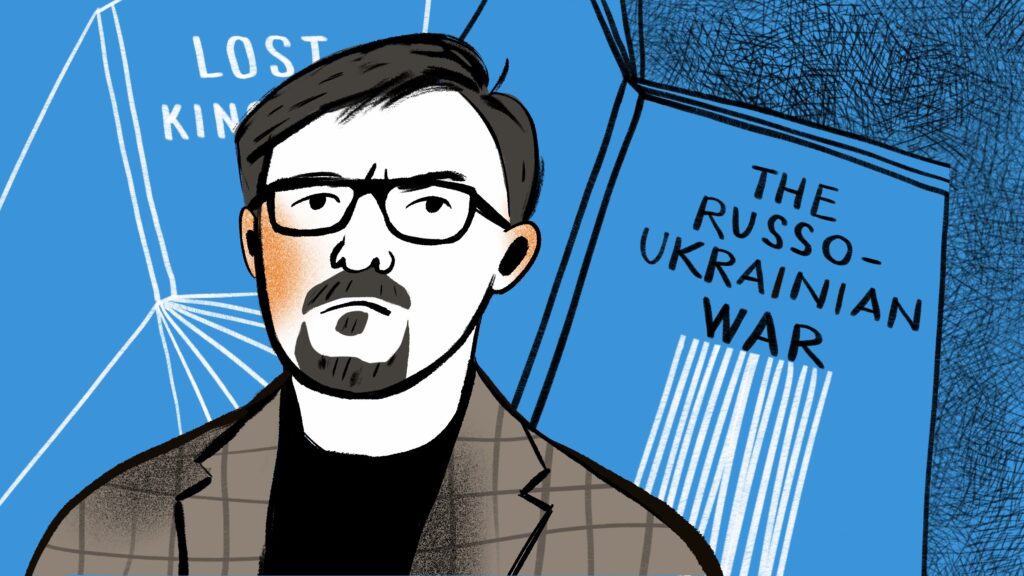
— Professor Plokhii, could you please tell us how you first received the news of Russia’s full-scale invasion of Ukraine? Can you recall what that moment was like?
– Yes, it won’t be difficult, because shortly after the full-scale invasion, I felt that the memory of the sharpness of the impressions was changing, layers of other stresses and memories were piling on top, so I decided to write it down almost immediately, over the course of a few weeks. To some extent, these notes later transformed into the beginning of my book about the Russo-Ukrainian war. I anticipated the war, but I hoped it wouldn’t start. I found rational reasons to somehow support these hopes.

On February 24, I woke up very early for some reason. At that time, I was in Vienna. First, I checked my email, and then the news. The first thing I saw was the subject line of an email from a colleague at Harvard: “My Goodness.” I immediately understood everything. Then, I read an email from a colleague in Dnipro, who asked me to store on my computer his academic work. He was asking if it was possible to send it to me. I realized that the scale of the war was much larger than I had thought before, and it was clear that Dnipro was now under attack as well. Only then did I check the news. It was a full-scale war, which the Americans had been predicting for weeks. So, the logic I had built to support my hopes for better scenarios fell apart. That was when I experienced the first shock. It truly defined my psychological state in the first hours and days of the full-scale war. When the shock started to subside, the question arose: what exactly can I do? And my answer was to spread information: from the interviews I gave, to, by the end of March, deciding to write a larger piece about this war. It was initially planned as a small book, but then it grew bigger. In it, I aimed to explain the origins of the war, as well as the phenomenon of why Ukraine did not fall in three days.
“This is a book about contemporary history, written while this history was being made, in order to influence it.”

— The work on the book, probably, has also been a form of therapy for you.
— Of course. It was, unlike the interviews I gave, a larger project, one in which I had some control over what I was doing. It was very important to have something that you could control. So, you are right, yes, psychologically, it was also important.
— Did the text of the book mature only after Russia invaded Ukraine? Or did you have certain ideas for writing this text earlier?
— No, it happened after. After the full-scale invasion, I was approached several times with offers to write a book. The proposals came from my American publisher, as well as from a literary agency in London that helps me find publishers. They said that many people would be interested in hearing my opinion on what was happening, since I had previous publications that were printed in fairly respected journals with significant circulation by the standards of an academic author. To their invitations, I constantly responded, “No, this is absolutely impossible.” Firstly, I’m a historian, and these are events that are happening right now. Secondly, psychologically, I was absolutely not ready for this project. But somewhere around the third week of March, I suddenly realized that this was something I could do. I understood how I would do it. So, I would say that this idea came with a delay of about three weeks.
The project of writing the book essentially responded to several intellectual and psychological questions that arose before me. I did what I considered to be very important, and it was my response to the start of the war.
— How long did this project last? How long did it take to write the book?
— The timeline for writing was absolutely clear. At the beginning of the year, I took a sabbatical. The sabbatical ended in the spring, then there was a summer break, and after that, the academic year began. Given the academic schedule, the main text of the book was written before classes started. Afterward, I added one more chapter, made revisions, and updated the data, but most importantly — the key chapters needed to be finished before the academic year began. So, the book was written during my time off from teaching, so to speak.
— In this regard, everything is indeed defined in academic life; summer is the time for working on texts. This project was really quick and timely.
— This timeline was very important also for a different reason. The ideas expressed in the book influenced the interpretation of the war in the West. They were heard not only by the academic community but also by a broader audience. Considering how important the United States, Britain, and Western Europe are in supporting Ukraine, I believe today that what I did was the right thing. It was the maximum I could do under those circumstances. As of today, this book, according to Goodreads, is the most widely circulated among all other books about the war. So, it was published at the right time, and that is extremely important.
— Could you please tell us a bit more about this publication? What ideas did you use to communicate with the reader? What is your main idea?

— The book, on the one hand, became a continuation of certain themes that I had already been working on. On the other hand, it was a response to narratives that, if not dominant, were very influential in the West. For example, there was the narrative presented by Mearsheimer, which argued that the war was a natural response from Russia to NATO expansion. Another narrative, which was discussed in one way or another, was proposed by Putin. It was the narrative that Ukrainians and Russians are one people. In other words, the idea was spread about a possible civil war of Russians against Russians, rather than an armed aggression by one state against another. The responses I gave to these narratives were connected to my research over many years. A few years before the full-scale war began, my book Lost Kingdom: The Quest for Empire and the Making of the Russian Nation was published, which was later translated into Ukrainian as Загублене царство. Історія «Русского мира» з 1470 року до сьогодні. It was precisely the history of the ideas that Putin was voicing about a unified people, exploring how these ideas transformed over time. Specifically, the book discussed Solzhenitsyn as an intellectual bridge between imperial ideas and what Putin now promotes. So, I had certain research results that I adapted to the specific circumstances, to the specific statements made by Putin. This was my response to his narrative.

The second narrative was about NATO, which for me is a secondary matter compared to the history of ongoing disintegration of the post-Soviet space. This, again, is a topic I have worked on for a long time, starting with the book The Last Empire: The Final Days of the Soviet Union — Остання імперія. Занепад і крах Радянського Союзу in the Ukrainian translation. This was, in fact, an interpretation of the collapse of the Soviet Union as the collapse of one of many empires. And it is this perspective that I placed at the forefront, as a framework, as a way of organizing both my thinking and the material related to this war.
Thus, one of the central themes of the new book is a discussion of Russian imperial ideas regarding what Russia is, what the Russian people are, the unfinished process of nation-building in the post-Soviet space, and the Ukrainian response to it. Conceptually, the book responds to two key narratives, one of which was proposed by Russia, the other by a segment of American political scientists. But these were not counter-arguments that I tried to invent on the spot. The response to these narratives emerged thanks to a fairly long period of my own research. These events happening right before our eyes fit into the framework developed over a number of years. This not only helped me organize the material but also, I believe, better understand what is happening.
— What translations of the book already exist?

— I do not remember all of them. There are many. European languages for sure. There is a French and a German translation. Interestingly, the German translation was published before the English original. There are translations in Polish, Romanian, and Swedish, and a Japanese translation is in preparation. Previously, most of my books were translated into simplified Chinese in China. Now, the book has only been translated in Taiwan. In other words, China refused to translate or publish my book.
The biggest surprise for me was the Russian translation. Again, most of my books had been translated into Russian before, for which I regularly received criticism on Facebook. Criticism on Facebook has its peculiarities (laughs). This time, I absolutely did not expect a Russian translation. However, I received a request from a Russian-speaking publisher in Israel, which I agreed to. Interestingly, before the Israeli publisher released the book, a fairly good translation appeared online for free download. I do not know who did it, no one ever contacted me or the publisher. This is currently the biggest mystery when it comes to the translations of this book.
— So, it is a pirated version of the book in Russian?
— Yes, but someone must have invested money and time into this translation, and then made it available for download without payment or any other restrictions. I welcome that, of course. I did not protest, did not contact anyone, or demand any explanations or compensation. This is the first time something like this has happened in my experience. Taking an already finished translation, stealing it, and posting it— that is normal (laughs). But taking it, translating it, and then posting it for free access—that is something new.

— Modern conditions dictate such unconventional steps. It seems that you were able to communicate very effectively with your audience through this publication.
— Yes, the expectations I had were fulfilled, so I am very happy about that.
— Were there those who did not support the idea of writing this book?
— Criticism, especially from Ukraine, was constant: “How can you do this? You should wait until the war is over.” Waiting until the end of the war was not an option. The book was not written to look at it from the height of having experienced the war in the past. It is a book about contemporary history, written while that history was being made, in order to influence it.
— Thank you for this very timely project.
“Maybe it is a sin to say this, but the war has created opportunities for Ukrainian academia.”
— How did the Ukrainian Research Institute at Harvard University react to the start of the full-scale war? What institutional measures were implemented?
— At that time, I was in Vienna. However, I remained in constant contact with the institute. I was pleased with how my colleagues reacted to the events. Immediately, we received strong support from the administration of Harvard, particularly from the president of Harvard at that time, Lawrence Bacow. His mother or father was from Belarus, and his relatives survived the Holocaust. Lawrence Bacow, on his own initiative, raised the Ukrainian flag above Harvard, which was unprecedented. He also wrote a letter of support, but it was essentially a private letter to me, which I could share publicly.
Unfortunately, this led to critical reactions from other circles, from other communities. As if, why is there special treatment for Ukrainians? In other words, various people expressed their dissatisfaction, especially later, in the context of the war between Israel and Gaza. So, this support for Ukrainians essentially remained at the moral level. After that, Harvard could no longer create programs or other opportunities specifically for Ukrainians. However, the support from our colleagues at other centers, particularly the Davis Center for Russian and Eurasian Studies, as well as the European, Jewish, Middle Eastern, and other centers, was incredibly sincere.
We have a Fellowships program at Harvard. Perhaps it was not entirely fair to those who had applied to the program, but in the first year after the full-scale invasion, all of our fellowships were allocated to applicants from Ukraine. Some of the applications were taken on by the Russian, Middle Eastern, and Jewish centers if they aligned with their thematic focus. This is how we tried to act and offer our support.
In addition, we became part of two waves of short-term grants that were implemented in collaboration with the Institute for Human Sciences in Vienna. The Harriman Institute also joined in, I believe, for one or two programs. We directed the maximum amount of funds we had to Ukraine.
— It is widely known that the grant opportunities provided to Ukrainians were mostly utilized by women scholars. How would you comment on this situation? How was it at Harvard?
— Yes, I would like to comment on this interesting situation that arose because of the war. At least three grants, maybe more (this is what I remember now), were awarded to men in Ukraine, but they were unable to come. Two of them are in the military and remain there. We did not expect this. In fact, the conditions of the war created a unique situation in which women, who had previously faced numerous issues of marginalization and even discrimination at many levels in the Ukrainian academy, turned out to be the only category of Ukrainian scholars who were able to receive not only short-term grants but also opportunities for much longer-term project and research funding, such as those at Princeton and other institutions.
Perhaps it is a sin to say this, but the war has created opportunities for Ukrainian academia. We will observe how this will change Ukrainian science as a whole, but this experience is very important. We saw that women scholars, including female historians, took a prominent place in academic exchanges. It will be very very interesting to observe this phenomenon from an anthropological and sociological perspective—what will happen next and what impact it will have on the further development of Ukrainian academia. It could have various outcomes, but the fact is that there has been a deeper immersion of Ukrainian women scholars into the American and European academic world.
— Absolutely, these processes will undoubtedly have an impact on the Ukrainian academic environment. However, closer cooperation with Ukrainian female scholars surely also has an influence on the Western academy, doesn’t it?
— Of course, changes in the Western academic environment are also taking place. This is also worth noticing. I am convinced that I see some things more clearly than those who arrived from Ukraine yesterday or the day before that, because I have the opportunity to observe these changes as they progress. But on the other hand, when you are inside, many things go unnoticed. This is why the perspective of people who are either encountering the Western academic world for the first time or who had only short-term cooperation before, but now have a much deeper experience, or even some permanent positions, is incredibly important and interesting. So, in my opinion, the war has led to, so to speak, unexpected consequences. I have no doubt that the processes happening within the Ukrainian academic environment will also influence Ukrainian studies, Slavic studies in the West, and the study of the region in general.
— What kind of impact are we primarily talking about now? Are you referring to a change in thematic research directions? A greater representation of Ukrainian studies abroad specifically by female scholars? What kind of changes should we expect?
— I do not know. I am not going to predict now what kind of impact it will be. Truly, time is needed for that. But I am absolutely open to the new.
In recent years, instances of outright rejection of Western-based Slavic studies by many Ukrainian researchers (male and female) have surfaced in the public sphere. Amid the war, deaths, and bombings in Ukraine, it is psychologically very difficult for many to share the same academic platforms with researchers from Russia or those studying Russian culture, and so on. People react differently, often with understandably sharp responses to the challenges of war. However, I have no doubt that changes will eventually take place in Ukrainian studies within Ukraine, and that the current situation is already impacting Ukrainian studies and Slavic studies in the West.
In terms of research directions, for several years now, historians have made a very significant contribution to fields such as the history of memory. This is a positive development, and I think historians can add something valuable to this, but at the same time, it is somewhat surprising because this is not traditionally the domain of historians. This territory belongs to anthropologists, sociologists, political scientists, and others. Unless no one else is addressing it, then we, the historians, start to explore this territory as well. But it is not typically the domain of historians, since we are trained to study sources from the 16th or 20th centuries.
“The strategic goal is to be heard, to be understood, and to expand our presence, our influence.”
— By the way, you touched on a very sensitive issue—should we, Ukrainians, share academic platforms with Russians? Should we protest, since there are many cases where it is Ukrainians that are denied participation in events due to their uncompromising stance? What is your opinion on this matter?
— Whether to protest, and how exactly, is a question of general policy regarding the spread of our presence in both the academic and media spheres. Therefore, these issues should be addressed depending on the specific circumstances. A general ban, not as a tool, but as a strategic policy, would lead to our complete absence. Silence would lead to the normalization of certain things that are absolutely unacceptable for us. That is why I do not have a “fit all sizes” advice, as it all depends on the context. The key here is to think about it as tactical measures, but with a strategic goal in mind. The strategic goal is to be heard, to be understood, and to expand our presence and influence. If a specific protest, expressed by refusing to participate, helps with this, it is a good approach. If such a protest actually pushes us into a ghetto and deprives us of our voice, then it is a very bad tactic, because it conflicts with the strategy, at least as I see it.
— You mentioned that in the first year after the full-scale invasion, Ukrainian scholars, particularly women scholars, received unprecedented institutional support. Could you elaborate a bit more on who came, and what events were held?
— We were in a very difficult situation when Professor Geroge Grabowich (Hryhorii Hrabovych) retired, and there was no one to teach Ukrainian literature at the university. So, for us at Harvard, it was extremely important that Olena Haleta and later Tamara Hundorova helped us a lot in continuing the presence of Ukrainian literature and Ukrainian culture on campus. In those conditions, when students’ interest in Ukrainian studies, though slowly, began to grow, this was crucial.
Among those who arrived to us from Ukraine was the renowned Kharkiv political scientist Oleksandr Fisun. He had Western recognition and reputation, which was key for us. From the perspective of academic influence, his presence was very important.
We also tried to involve people in presentations and conferences who were based at other universities, mostly in the eastern United States, including Volodymyr Kulyk and Yana Prymachenko.
The presence of researchers and educators from Ukraine became a very important positive factor, as not only we, but also our Western colleagues, were able to hear an authentic Ukrainian voice—a voice directly from Ukraine. For a long time, either the diaspora or people like me, who have been in the United States for a long time, represented Ukraine. But in reality, this was already a second- or third-hand interpretation of what Ukraine is. It is important that there is now an opportunity to hear specifically Ukrainian voices. In other words, something occurred that is described in English as a silver lining, where even a very bad event can have some positive outcomes.
— Slavic studies abroad are usually associated primarily with Russian studies. Is this changing? What is the current state of Ukrainian studies in American academia overall?
— Very interesting things happened immediately after the start of the full-scale war. Non-Ukrainianist colleagues organized two events called “Marathon,” where scholars, including researchers from Ukraine, participated and presented their work. It was a very engaging initiative. Firstly, it became evident how many people in the academic community—within Slavic studies and among those researching the Soviet Union and Russian history—were shocked by what had happened and genuinely wanted to help in some way. People were writing, asking how they could help. This was one way of signaling that a particular scholar stood with Ukraine. To some extent, it was also a form of psychological support for themselves and their colleagues.
I saw colleagues there who had never previously shown any pro-Ukrainian sympathies. Yet, everyone tried to contribute and bring something from their own work. People searched for related topics, as you cannot write an academic paper or become an expert in Ukrainian history or literature in just two or three days. On one hand, it was a manifestation of widespread support for Ukraine. On the other hand, it also reflected what Slavic studies represent in their literary, cultural, anthropological, and historical dimensions. In reality, Russian topics dominated about 90% of the field, and people were trying to learn some more and adapt them in some way. This was a snapshot of the Western academic world.
Then the process of discussing decolonization began. People approached it very cautiously, even skeptically, because their entire lives and academic work were suddenly put on the line, raising questions about what to do next. Should they focus on Ukrainian studies or something else? But that would require specific knowledge, at the very least a knowledge of the Ukrainian language. On the other hand, the atmosphere was such that taking an openly negative stance on decolonization was problematic, if not impossible.
Moreover, at one of yearly Slavic and Eurasian Studies (ASEEES) convention, the main theme was decolonization. There are ongoing debates about the term “decolonization” itself—whether it is accurate or applicable to Ukraine. However, the processes taking place in academia are very significant. I was personally skeptical about this term and had many questions, but for now, it is the accepted if not prevailing one. It allows us to address an important phenomenon in our history and scholarship—the political and cultural legacy of empire. So, for now, we conditionally accept it, though I prefer to focus primarily on the de-imperialization of Russian narratives.
The process of strengthening the position of Ukrainian studies and other disciplines within Slavic studies has only just begun. The U.S. and Canada are not like countries such as Germany, where the government makes a decision, allocates funds, and things happen immediately. These are not countries where you can simply tell a university president, “Okay, open Ukrainian studies.” Even if you do that and provide short-term grants, the initiative will not survive without students. Because of this, my personal vision of “decolonization” was oriented toward the long term. I thought about how the new atmosphere would create conditions in which today’s graduate students would rethink their topics and approaches, and, as a result, changes would occur in the future. This is similar to what happened after the collapse of the Soviet Union. The first new dissertations and people occupying new positions emerged by the late 1990s, as academia operates with a delay. These were my hopes. I was pleasantly surprised by what happened in the last few years when several permanent positions in Ukrainian studies were created in American academia. Discussions are also taking place in several leading universities about securing donor funding to establish new positions. These are primarily teaching positions in Ukrainian language and literature, but there are also talks about new positions in history. In other words, movement has begun, and it has started faster than I expected.
My concerns were that, although American academia generally responds to contemporary challenges, it does so institutionally with short-term grants. The future of the discipline, however, depends on permanent positions. Permanent positions rely either on donor contributions or on sustained student interest. Last year was quite promising. Whether this process will continue or not remains to be seen, but it is one of the outcomes. Of course, none of this would be possible without Ukraine’s resistance—that is the foundation. However, the way refugee scholars from Ukraine have been welcomed into universities is a result of those same Western academic “marathons.” These outcomes are already noticeable today, much sooner than, frankly, I had hoped.
— What is happening with Russian narratives in American academia? Are they still as powerful as before?
— Most people who entered Slavic studies to research Russian history, Soviet history, and so on, did not do so because they saw Russia or the Soviet Union as an enemy, but out of an interest in Russian culture, Russian history, etc. For them, the rise of aggressive authoritarian Russia is a very painful topic. However, they are changing as well. They are changing in a direction that I believe is the most important—reconsidering Russian culture and history through the paradigm of empire, through the paradigm of cultural colonialism. This is happening, of course, as a result of the war and the actions of the Ukrainian community, which has grown stronger thanks to scholars, essentially through the refugee experience.
But this also aligns with broader trends in Western scholarship, where research on empires and colonial processes is now extremely popular. For example, the study of the French Empire is currently given more attention than the history of France itself, and the study of the British Empire receives more focus than Britain itself. This is part of the decolonization process that took place in European colonies in the 1960s, which had the same impact on the study of English history and culture as the war in Ukraine is having on the study of Russian history and culture today. In my view, the Russo-Ukrainian war is one of the components of the global process of the imperial collapse, and it directly influences Slavic studies. Slavic studies, in comparison to the rise of decolonization approaches to the study of other European empires, operates with a 30–40-year delay. The changes taking place will also make it much easier for scholars, who are currently confined to the “ghetto” of Slavic departments—many of which are Russian departments—to find common ground with their colleagues, for example, in Comparative Literature or Roman Languages and Literatures. Therefore, I believe that what is happening now is just the beginning of the restructuring of this field.
“The American academy changes direction much more slowly, but when it does change, it does so for the long term, because it is less dependent on political trends.”
— Do you see a difference in the development of Ukrainian studies in American and European academia?
— European scholarship, especially in the humanities, is much more dependent on the functioning of state institutions and foundations, which are also tied to government bodies. Things happen much more straightforwardly there: if grants for Ukrainian studies topics are more heavily supported, scholars quickly reorient themselves. The research I am aware of primarily takes place based on grants provided. This involves a refocusing of topics. I see this most clearly among scholars who previously studied Soviet history and are now shifting to Ukrainian themes. This is quite evident.
In American academia, grants also play a role, but much less than in Europe. In my view, researchers have more freedom in US. Graduate students have much more freedom to choose the topics they want to pursue. In contrast, in Austria or Germany, PhD students are often recruited based on a specific theme because there is a grant and financial support tied to it. So, there are some differences, but even within the European Union, there are variations from country to country. However, the general trends are the same both here and there. Europe can react more quickly to certain challenges. American academia changes direction much more slowly, but when it does, it is for the long term, as it is less dependent on political trends or government policy.
— There is information about assistance for Ukrainians on the website of the Ukrainian Research Institute at Harvard. I would like to ask you more about it. How did the institute get involved in this initiative? Is this support only for scholars, or is it broader?
— We are an institution known not only in academic circles. There are things that we do ourselves, related to our mandate — supporting research on Ukraine and in Ukrainian studies. I was actually talking about this, about our Fellowship program and how it was reshaped, as well as the additional grant programs we have participated in. But beyond that, our role is to be a representative and a voice for Ukrainian scholarship outside of the academic world. A large part of this is carried out through our new program on contemporary Ukraine, funded by Jim Temerty, led by anthropologist Emily Channell-Justice. By the way, her first Slavic language was Ukrainian, which is one of the signs of change in Western scholarship in recent years. We engage in active research activities, host many academic events, and also hold an annual conference dedicated to Ukraine, where we try to bring together science and, say, people from outside the academic world — people who influence politics, such as think tankers. In other words, we try to fill the gap between academia and decision-making regarding Ukraine.
Another direction that is developing very actively right now, thanks to the director of our publishing department, Oleh Kotsyuba, is the translation of contemporary Ukrainian literature, including academic works but primarily focusing on contemporary Ukrainian literature. Oleh initiated a special seminar for translators, which took place last summer in collaboration with the Canadian Institute of Ukrainian Studies and Polish colleagues.
We primarily work within the academic environment, but considering that we are well known outside of academia, we have frequently been approached for commentary since the beginning of the war, starting in 2014. The requests were so numerous that we were unable to keep up. We came up with the idea of creating a list of experts in Ukrainian studies from various fields, whom journalists and possibly policymakers could consult. We created and published this list in collaboration with other Ukrainian academic organizations.
Then the full-scale war began, and we started receiving many inquiries about how people could help. This is a public function that goes beyond the university, academia, and Ukrainian studies. Eventually, we created an online directory—if you want to donate, if you want to help Ukrainians who have arrived here, here are the organizations, contacts, and people you can reach out to. We had always been somewhat integrated into the Ukrainian community, but with the start of the full-scale war, the number of people interested in Ukraine or in helping Ukraine increased. So, in effect, we are also fulfilling a public and societal function.
— Thank you very much for this conversation.
— You are welcome. It was a pleasure to talk to you.
The conversation was conducted by Oksana Ovsiiuk.
The publication uses illustrations from open sources.
This publication is also available in Ukrainian.