
“I was born in Crimea, in Sevastopol, so in 2014, I had nowhere to go back to”

– Please tell us about your scientific path and interests?
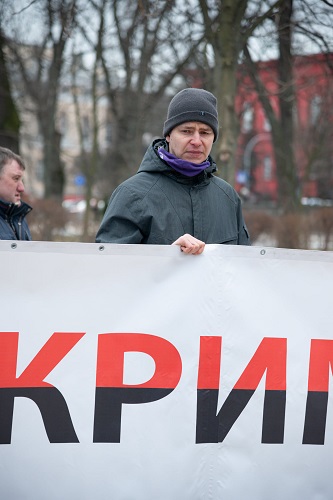
In 2008, I entered the Department of History at the Kyiv-Mohyla Academy. Later, I got into a joint master’s program, with Kyiv-Mohyla Academy and the University of Warsaw, which I graduated from in 2014, right after the Maidan. I was born in the Crimea, in Sevastopol, so in 2014 I had nowhere to go back to. In addition, when Russia annexed Crimea, I realised that our society had not even realised what had happened. Neither had the international community. And I probably couldn’t fully comprehend all the machinations myself. But since I grew up in Crimea, I felt intuitively that the annexation was not so simple. That’s when I decided that I could, and wanted to, deal with the Crimean context. I started looking for answers to questions about the past and present of the Crimean Peninsula, collecting various narratives about Crimea. It seemed to me at that time that my cultural and anthropological background as a Crimean could help me in this search. Very often, Crimea is studied by people who do not know it from the inside, so the result is not very good. I was hoping that my background and experience of living in Crimea would give me an advantage when it came to studying Crimea. But it was very difficult to decide where to start.
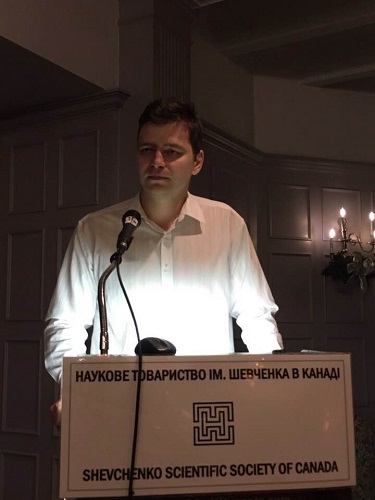
In 2014, I entered the postgraduate program at Kyiv-Mohyla Academy and went to work in journalism, and in 2015 I entered the Ph.D. programme at the University of Western Ontario [Canada – S.M.] and, so went to study there. New experiences, new people, new courses in North American history… One of these courses, which I chose for myself quite by accident, was related to imperialism, settler colonialism, and postcolonial theory in general. Reading about the colonisation of North America, I could see resemblances in the history of the colonisation of Crimea. When it came time to write my paper, I dared to ask: “Can I try to apply this theory to Crimea, which was closer to me than North America?” This is how the direction of my research was determined. As it turned out, postcolonial theory correlates very well with Ukrainian realities. Of course, there are many differences between Crimea and North America, but the number of similarities simply surprised me. The similarities between the practices of the Russian Empire, the Soviet Union, and other settler colonies were striking.
“Even people who are critical of Russia often repeat things that should not be repeated”
– You mentioned that the reading of Crimea from the outside often differs from the perception of Crimea by Crimeans from the inside. How often did you encounter this during your research?
Constantly, even, in my opinion, too often. I get very emotional in my publications because of what other researchers – and not only researchers – write about Crimea. I am convinced that knowledge [production] about Crimea is one of the greatest tools of colonisation. Colonisation is not only about the physical displacement of people but also about creating a completely new reality. And in Crimea, this reality is guided by a discourse that was created first in the Russian Empire, then modified in the Soviet Union, and later in the Russian Federation. It is the discourse of the coloniser. I cannot call Russian-speaking Crimeans “Russian”. They do not fit into the concept of “Russian” at all, because most Crimeans before 2014 knew Russia only from media images and had never been there.
One of my favourite [examples of] colonial narratives is the Stalinist deportation of Crimean Tatars in 1944. Whatever book you open, it says that Crimean Tatars were deported for “treason”. This is a very sophisticated manipulation, a kind of game between the coloniser and the colonised. In every other book, you will find a shift in emphasis: first, the narrative about “Crimean Tatars being traitors” is presented, and then their justification starts. Even the Crimean Tatars themselves play along with this, recalling how many heroes of the Soviet Union were among them. By justifying yourself, you play the coloniser’s game, because you enter a dialogue with his narrative and thus legitimise it. The victim is forced to make excuses. And there are many such things. Even people who are critical of Russia often repeat things that should not be repeated.
“The events in Crimea and the East are different formats of wars that started a little earlier than I expected”
– Did you have a feeling that the annexation of Crimea was just the beginning?
Hearing my answer to this question, my teachers from Mohylianka would start clutching their heads, because we were taught that a historian should not look into the future [smiles]. Nevertheless, I will answer it. Even since 2008, I have had a strong feeling that something had to kick off. I was a little wrong about the timing. According to my assumptions, the war in Crimea was supposed to begin in 2017, during the withdrawal of the [Russian] Black Sea Fleet. I was sure that Russia would not withdraw the Black Sea Fleet peacefully. The events in Crimea and the East [in Donets’k and Luhans’k] are different formats of warfare that started a little earlier than I expected. In Crimea, not everything was as peaceful as Russia wanted to show, this is also one of the elements of the coloniser’s narrative. After the war started in Crimea and Donbas, I knew that there would be a big war. It seemed to me that this regime, by its logic, had to attack sooner or later.
– How did you see your mission in this war?
In 2014, I was twenty-one. I received a military summons (povistka) and even went to the military unit. I was not accepted because I had already started my postgraduate studies at that time. Of course, after that, I could have joined a volunteer unit, but I was looking for various arguments not to do so. Simply put, I was scared. I continued to engage in social activities and tried to volunteer. The excuse I found for myself was that my research was potentially more useful for society and the state than the fact that I would be in a trench. And this is not an excuse, but rather a way of self-soothing. Anyway, many knowledgeable and skilled people who should be in the rear are now on the front line. But I assumed that the moment would come when I would have to go to the front.
When, at the end of 2021, there were talks about a possible Russian attack on Ukraine, I began to worry, because a year before [in January 2021 – S. M.] I had returned from Canada with my wife and our little son. I had lived in Canada from 2015 to 2020. At home, I continued to engage in public activities and study the Crimean Tatars. Before the full-scale invasion, I was in Kyiv with my family.
Realising that the attack was inevitable, I began to prepare. I planned to put food, water, clothes, and a small few tourist supplies in my so-called emergency suitcase. I tried not to reveal my preparations so as not to create panic. I did not buy ten packs of buckwheat at once, but one pack at a time in different stores. Later I found out that first one of my friends had joined the territorial defence reserve, and then another. I liked the idea of the territorial defence reserve because of the opportunity to train in a specially-organised structure. In addition, the law on national resistance had just come into force [the 1st of January 2022 – S.M.].
On the 22nd of February [2022 – S.M.], I went to the Dniprovskyi military enlistment office [the military enlistment office of the Dniprovskyi district of Kyiv – S.M.] to sign up for the Kyiv Territorial Defence and even signed a contract. At that time, I had the medical commission’s conclusion almost ready, but I signed the contract only by myself, with a few formalities remained to be resolved. It was on the 24th of February 2022 that the medical report had to be ready…
“…on the 24th of February, I was woken up by my son, who was one and a half years old”
But on the 24th of February, I was woken up by my son, who was one and a half years old. I assume that he had been woken up by the explosions, because children have very sensitive sleep. Soon after, I received a phone call. My friend called and told me to turn on the news. A few minutes later we heard explosions outside the window. I live in Teremky [a district of Kyiv – S.M.]. The explosion was very close. I didn’t quite understand what to do, but by then I had already overcome my fears and knew for sure that I would join the army. When the transport started running, I went to the military enlistment office, leaving the car with my wife. Our unit was formed only late in the evening, around 10p.m. So, I could not get home on the 24th of February, because no public transport was running. I spent the night at a friend’s house; by chance, we were from the same NGO and ended up in the same company.
– How did you prepare your family for possible events?
It was very difficult for my wife to accept that I went to the military commissariat instead of leaving with her. She left Kyiv with our son on the 25th of February, 2022. I did not see them for the next few months. My wife was afraid of the road, as we were both not quite experienced drivers at that time. But she still had to take our child and another family with a child to the Ivano-Frankivsk region on her own without stopping. It was fortunate that I had filled up the car with petrol the day before the full-scale invasion, on the 23rd of February, 2022. In anticipation of the offensive, I constantly tried to keep the fuel tank full. My wife and son spent the night of the 24th of February, of course, in a bomb shelter, and then they went to western Ukraine. It was a very difficult experience for everyone. My son is very attached to me; I put him to bed every evening. That’s why the first weeks of separation were extremely difficult. Our son cried and didn’t want to eat; he had a hard time falling asleep, and called for his dad.
“We were fiercely motivated: with only a machine gun, we were ready to tear the tanks apart with our hands, but most importantly, we were united by the belief that we could stop them”
– Did you have the opportunity to undergo at least basic military training in the first days after Russia’s invasion of Ukraine?
On the 25th of February, 2022, in the morning, my friend and I went to the headquarters. We were assigned to units and given weapons: assault rifles and four magazines of ammunition. It was ten in the morning, and in the afternoon, we were already on one of the defence lines of Kyiv in the Brovary direction, one of the directions of the Russian offensive on Kyiv. We were not on the front line, of course, but the 72nd Brigade “Black Zaporizhian Cossacks” was covering us from the front. So, all our training took place during the offensive. At that time, the Ukrainian territorial defence force consisted of very different people, with different training and experience: some had combat experience, and others had never held a weapon in their hands before. The briefing lasted exactly ten minutes: here’s the trigger, here’s how to hold the rifle… At that time, there was simply no time for more, because we were expected to be at our positions. I spent the 25th of February, 2022 with a few of my comrades on the roof of a hardware store, waiting for the tanks. We were fiercely motivated: with only a machine gun, we were ready to tear the tanks apart with our hands, but most importantly, we were united by the belief that we could stop them. Now, of course, I realise that we would have all died there.
– What helped Kyiv not to surrender?
It’s hard for me to answer this question because I don’t have enough information. I only know what I saw from my position. I can’t even draw conclusions about other districts of Kyiv, as I have only heard about them from other people. I know that there was a battle near Akademmistechko [a Kyiv metro station – S.M.], I heard explosions, I heard sirens, I saw the work of the “Black Zaporizhian Cossacks”, who stopped the Russian advance in the Brovary direction. They were incredible. If not for them, I might not be talking with you today.
– What was the hardest part of the military for you?
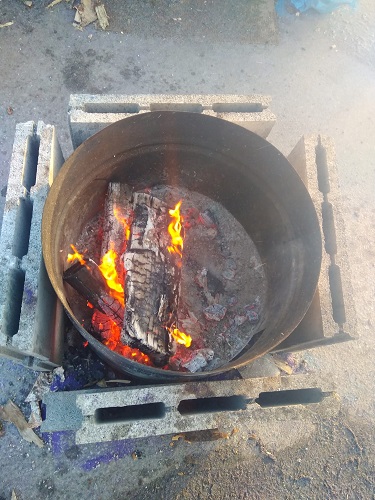
The first few weeks were physically very hard. We hardly slept, we had a gruelling rota: two hours on guard and two hours off. During this time, you had to eat and sleep, having previously found a place, which was a very difficult task, because all the places were occupied. We slept on the floor, on benches, without bunks or sleeping bags, for one hour at most. Such sleep quickly leads to a loss of internal resources, both physical and psychological. Later, we started training, mostly in first aid, which, in my opinion, was not very well organised at the time.
From the first weeks, fear was the main emotion. Fear is normal; you just need to get used to it. The body goes through completely different internal processes and sensations that we are not used to. You need to accept the possibility of your own death. This acceptance is the factor that gives you psychological stability. This acceptance does not mean that you give up and prepare for death, no. It is a way to find an internal resource for the struggle for a person who has never been involved in this struggle. There were several instances where we were told to prepare for armoured vehicles. We had to stop tanks with Molotov cocktails [smiles]. We had one small anti-tank unit, but it consisted of people as inexperienced as we were, who learned to use NLAWs [short-range hand-held anti-tank weapons – S.M.] during the battle. But we were still seriously preparing to throw Molotov cocktails at tanks and then shoot at those cocktails to set the tank on fire. We believed that this idea was real, which was essentially absurd. We were so charged up at that time that there was no doubt about our ability to stop enemy’s armoured vehicles.
“A brother-in-arms is a person with whom you share a unique common experience that only the military can understand”
– What does the phenomenon of brotherhood mean to you?
I don’t know if an outsider can understand, but I’ll try to explain. A brother-in-arms is a person with whom you share a unique common experience that only the military can understand. A comrade-in-arms is a person who eats and sleeps with you, a person to whom you must entrust your own life, and he entrusts you with his. The death of a comrade-in-arms involves a completely different set of emotions, in my opinion, from the death of a relative, but it is neither the same as the death of a friend. The death of a comrade-in-arms prompts reflection, remorse, and a sense of guilt that you survived, and he did not. After all, a comrade-in-arms is someone you would help, if necessary, even at the risk of your own life. And you expect the same from him.
– Are there any ethnic, national, or linguistic disputes among your brothers-in-arms?
I did not observe any xenophobia or ethnic disputes among my brothers-in-arms. The issue of language was raised, but not at the level of heated debates, but rather a discussion. There are Russian-speaking people in our unit. In general, we have an atypical unit, where most of the company has some higher education, so the level of communication is relevant. Our company commander is bilingual. I have a very clear position on the language: I speak exclusively Ukrainian, and I consciously switched to it, being a Russian-speaking person from Sevastopol. I do not switch to Russian with anyone. In the current circumstances, all disputes are superfluous. When the war is over, we will discuss it.
– Could you share your thoughts on how your comrades’ call signs emerge?
In the army, call signs, or nicknames, arise from a particular [personal] attribute. You can be given a nickname by your comrades, although there are cases when a person chooses one for himself. One of my friends was called Sultan. He wore a beard, but one day he shaved his head and he reminded someone of a real sultan – with a beard and no hair on his head. Some people got their call signs from the brand of their car; for example, we have a Kamaz in our company. Another colleague is called Glaz because he was an observer on a tower for some time. In other words, the emergence of call signs has no clear rules, it is rather an intuitive phenomenon.
– What is your nickname, if you don’t mind me asking?
I can tell you, but I can’t explain why it is. My nickname is Trio, but it means absolutely nothing. For me, it’s just a short word, a combination of vowels and consonants that is easy to pronounce.
“The military’s living quarters are mostly located a couple of dozen kilometres away from their combat positions”
– Could you please tell us how the military living arrangements are organised?
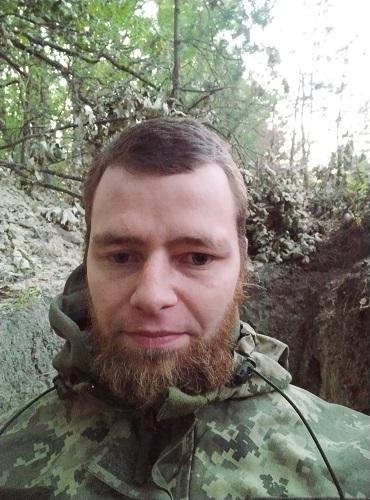
We do not stay at the zero line all the time, and it mostly depends on the commanders. However, I have seen cases when soldiers were forced to stay at the zero line for several weeks in sub-zero temperatures, which was extremely difficult. The military’s living quarters are mostly located a couple of dozen kilometres away from their combat positions. These are usually empty houses in villages or towns whose owners have died or left. There are often both informal and formal leaders in the army who manage the organisation of everyday life. Men are responsible for all essentials. Someone cooks, someone cleans, someone packs, someone folds. Of course, those responsible for certain processes change from one place to another. Some of them live in the same house all the time, others periodically change their homes in anticipation of possible scenarios. Each time, different people prepare the food.
– Do you have any festive meals in the army?
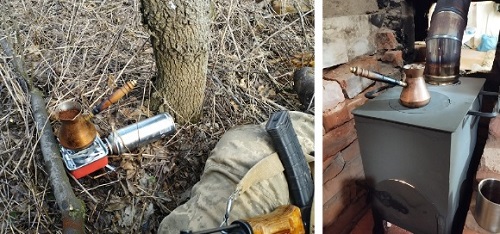
I can’t say that there is anything special to celebrate at the front. There may be a simple dinner if it’s someone’s birthday, or not. It all depends on the conditions and the need to go to the [forward] position.
– What has been the geography of your military journey?
Last year, my comrades and I were in the Kharkiv region, right after the Russian troops withdrew from Kyiv. That was my first experience of coming under mortar fire. Then we went for a short time in the Bakhmut direction, to the Luhansk region, where one of the hottest spots was. Recently, I also came back for rotation from the Bakhmut sector, where I stayed for several months.
– How do you see Russians fighting today?
It is difficult for me to say what they are like in battle. Those with whom I had to communicate were mostly prisoners. These are people with simplistic priorities. Some of them came to the front because of a long prison sentence, and their family is waiting for them at home. You can judge their morality by the way they treat their dead. The Russians simply leave them in the middle of the forest and do not take them back. That’s all, there is nothing else to talk about.
– Has the Ukrainian army changed through the first year of the war?
I have the opportunity to observe only my unit and those units with which we interact. People are very different everywhere, so it is difficult for me to say whether they have changed or not. Our unit has learnt some things, and gained a lot of experience, including the ability to stay in formation despite constant shelling. We have learned tactical medicine, in my opinion, better than many others. We have a very good company commander and competent people. It is difficult for me to comment on the dynamics in the Ukrainian army in general, so I am only talking about what I have seen with my own eyes.
“I can be suspected of ‘Crimean Tatar nationalism’, although I am not ethnically a Crimean Tatar”
– Do you have any idea when the war will end?
I will say right away that I do not know when the war will end. And I will not even try to predict anything. In my opinion, Russia has long lost this war, but we have not won it yet.
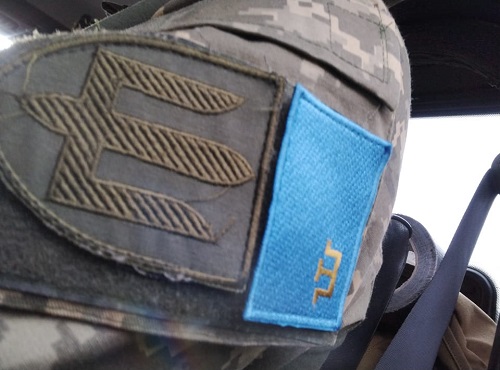
Maksym Sviezhentsev’s chevron with the emblem of the Crimean Tatar people, September 2022
– What mechanism for establishing a dialogue with Crimea could be the most effective after Ukraine’s victory?
Firstly, I think that Crimean Tatar autonomy should be restored in Crimea because Crimean Tatars are the indigenous people there; they deserve their own political and cultural rights. Ukraine is obliged to ensure these rights today. I constantly emphasise everywhere that there should be a functioning Crimean Tatar kindergarten in Kyiv. I should say here that I am not a Crimean Tatar. People might suspect me of “Crimean Tatar nationalism”, even though I am not ethnically a Crimean Tatar. Ukraine [however] should do for the Crimean Tatars everything that Ukrainians would eventually like to receive culturally and politically themselves. If Ukrainians were a minority in Ukraine, what would they want first and foremost to prevent from disappearing, to avoid assimilation? We must do the same for the Crimean Tatars. What should be the model of this autonomy, and what should the vertical axis of power look like; this is a very complex issue that the Crimean Tatars themselves must first decide on. Ukraine, on the other hand, must think about how to “fill the basket” of Crimean Tatar needs. But in no case should we impose anything, because this is one of the elements of decolonisation. We have to be in dialogue with them so that we do not turn into an empire, an enemy [like the one] with whom we are now at war. At the same time, in addition to Crimean Tatars, there are some people who are not of the indigenous population [living] on the peninsula. For example, my mother is Ukrainian, my father is Russian, and I am a descendant of the colonisers of Crimea. To live in Crimea in the future, I have to integrate into the decolonisation context and learn the Crimean Tatar language, for example. This means that the priority is to ensure the rights of the indigenous population, which has suffered from a long genocide lasting several centuries. And if we talk about positive discrimination, then yes, I am in favour of positive discrimination in this case. As for those who came to Crimea after 2014, I am very categorical: They should leave and return to Russia. From the very beginning, these people should have realised what they were doing when they bought property in the occupied territory. I don’t know how to make this process of “return” more democratic, one without “mass hangings and executions”, but we should start preparing for it now.
“…we need a professional system of psychological assistance for military personnel, which, unfortunately, we do not have yet”
– In your opinion, what do the men and women returning from the front line need most today?
It is very difficult for me to answer this question. I see how people around me are affected, and I also try to return to a peaceful life every time [after each rotation – J.B.]. I am going through these stages now, and I went through them after my previous rotations. Of course, we need a professional system of psychological assistance for military men and women, which, unfortunately, we do not have yet. The concept of decompression is very relevant here. Decompression is a psychological rehabilitation of the military, focused on their return to civilian life. But there is a big problem, because we do everything for the sake of “ticking the box”. People with dubious psychological education, allegedly military psychologists or not, with dubious military experience, come and try to talk to you about things they don’t understand. And this communication takes place simultaneously with the whole unit, or worse. It all boils down to filling out a certain number of questionnaires. I’m going through another decompression soon. And I do hope that something has changed since the last time.
“…when we hear air-raid sounds, people in the rear run in one direction, and people in the front run in the other”
– How do you feel about the new myths related to the war?
Myths arise because people need them. After all, a myth is essentially an institution of society. And I don’t think there is any need to explain the difference between myths and reality. It’s like the difference between an event and its recording in a historical source. Myth is one thing, and the army is another. The army is a cross-section of society, with completely different people and all their positive and negative manifestations. Some people expect special treatment from others because they are military, and some expect nothing from anyone at all. Similarly, in society, there are different people with different backgrounds, personalities, education, and worldviews. The army is the same society but in atypical, stressful conditions. When we hear the air-raid sounds, people in the rear run in one direction, and people at the front run in the other.
The interview was conducted by Svitlana Makhovska.
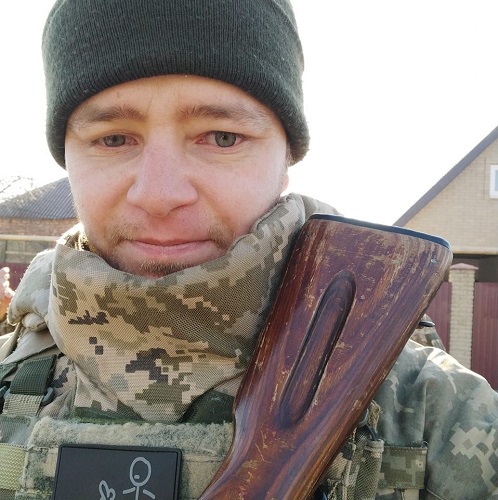
The publication uses photos from the personal archive of Maksym Sviezhentsev.
This publication is also available in Ukrainian.