

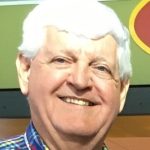
There is an absurdity and irony in Putin, a disciple of fascists Ivan Ilyin and Alexander Dugin, that prompts him to label a Jewish Zelenskyy a Nazi.
Who’s Calling Whom a Nazi?

Russian President Vladimir Putin calls Ukrainian President Volodymyr Zelenskyy a Nazi. Since Ukraine’s president is Jewish and lost family members to the Nazis in the Holocaust, how is one to make sense of Putin’s absurd assertion? Parroting Putin, on May 1 Russian Foreign Minister Sergei Lavrov claimed, “It means absolutely nothing” that Zelenskyy is Jewish because “the most ardent anti-Semites are usually Jewish.” [1] A scandalized Israeli Foreign Minister Yair Lapid declared Lavrov’s comments “both an unforgivable and outrageous statement. Jews did not murder themselves in the Holocaust. The lowest level of racism against the Jews is to accuse Jews themselves of antisemitism.” [2] Lavrov’s misrepresentation puts one in mind of the equally skewed Soviet spin on the Nazi German murder of tens of thousands of Jews at Kyiv’s Babyn Yar in 1941. When I visited the site in 1974, the inscription on the small, knee-high granite slab failed to note that Jews had died there. Putin’s and Lavrov’s Nazi-style antisemitism (like Soviet propaganda beforehand) cannot square logically with a Russian war aim to “de-Nazify” Ukraine. It is as nonsensical as Russia’s war against its neighbor itself.
Authoritarianism
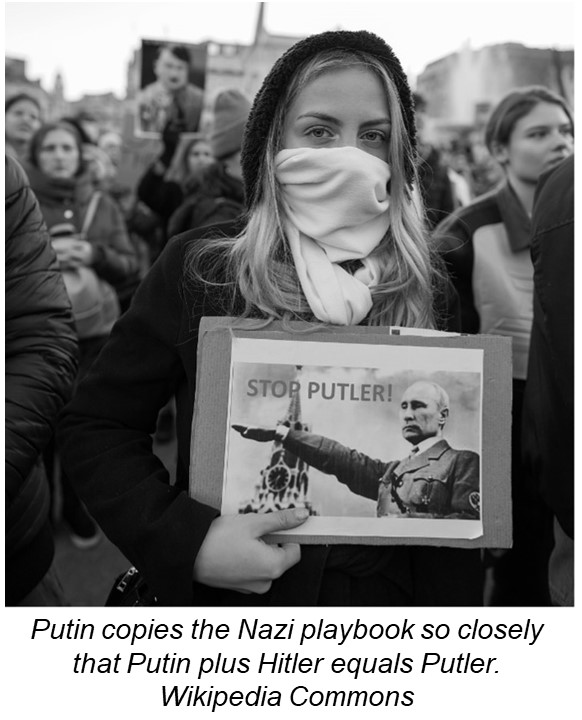
What follows is an attempt at explanation—not justification—for Putin’s “special military operation” and his provocative name calling, by which he maligns not just Zelenskyy, but the entire nation of Ukraine as somehow Nazi. To start with, unpacking a bit of political terminology is essential. The 20th century word Nazi (an abbreviation of National Socialist) is part of a constellation of variants of authoritarianism that needs to be set in historical context. Authoritarian regimes have been around for millennia, be they led by kings, emperors, shoguns, dictators, or in the case of Russia today, a president. Such political systems all have in common populations that are nearly powerless and lack autonomy, agency, and personal freedom. This is in contrast to democracies which have as their goal, sometimes realized, sometimes aspirational, to cultivate a citizenry that has a say in affairs of state.
The Continuing Utility of the Concept of Totalitarianism
For decades the practice was to label the most extreme authoritarian regimes totalitarian, personified in Mussolini’s Fascist Italy, Hitler’s Nazi Germany, and Stalin’s Communist Soviet Union [3]. While out of favor with most historians and political scientists today [4], the term still retains explanatory utility. In teaching 20th century European history, I used a four-part definition for a totalitarian regime: 1) a resolute minority obtains power 2) by means of force or the threat of force, 3) imposes its will on the total life of a society, and 4) employs modern technology to perpetuate that control. Parts one and two in which a resolute minority uses force and the threat of force to wield power are ages old. What was new in the 20th century was parts three and four in which a regime enforced its will on the total life of society using modern technology.
By this definition, in the 1930s and 40s, a Nazi Germany and a Communist Soviet Union, though poles apart in political ideology, were indistinguishable in their resort to mass executions and terror on a scale never before achieved in history. Hitler and Stalin may have been no more perverse and sadistic than the most famous tyrants of old, but they possessed unprecedented, technocratic wherewithal to kill millions upon millions of their own people and police states employing modern means of control to prevent anyone from stopping them.
What Sets Fascism and Nazism Apart from Communism
If totalitarian states have in common the utilization of mass terror on a hitherto unknown scale, what then set the right-wing extremism of Fascism and Nazism apart from the left-wing extremism of Marxist Communism? Primarily, it was Fascism’s and Nazism’s ideological conception of history and an obsession with supposed racial superiority. Both Fascist Italy and Nazi Germany deeply resented World War I settlements that deprived them of what they considered was rightfully theirs. In their humiliation both recalled perceived previous (glorious) states of existence (in Italy, the Roman Empire, and in Germany, pre-World War I military, economic, and cultural preeminence). The Italian and German sense of grievance, of having been “cheated,” was deep-seated and firmly coupled with fantasies of race-based hubris such that they were willing to risk a second world war to avenge their unbearable fall from grace and power. In contrast, Soviet Communist future-oriented fantasies envisioned, in theory, a classless, paradoxically godless heaven on earth that would be global in conception, rather than narrowly nationalistic.
An Authoritarian /Totalitarian Putin
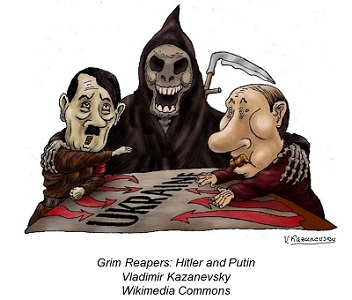
So where does Russia fit today on an authoritarian/totalitarian spectrum? Putin’s regime has become ever more repressive and authoritarian, with its citizens now residing in a country increasingly fitting the definition of a totalitarian state. Russia’s move in this direction has been particularly notable since Putin’s return to the presidency in 2012 which was attended by the suppression of large-scale demonstrations fueled by widespread belief that his reelection was a fraud. Especially in the past decade, Putin has emasculated the legislature, the courts, regional governors, and religious leaders. At the same time, political opponents and truth-telling reporters have been forced into exile, poisoned, imprisoned, or murdered in cases that will never be solved as long as Putin holds sway. Meanwhile, independent media and civil society NGOs have been legally labeled “foreign agents,” taxed to death, threatened into submission, or driven underground or abroad. Now, especially since the invasion of Ukraine on February 24, media and ranking clerics in Russia are no more than mouthpieces for Kremlin propaganda. All this, of course, bespeaks a movement toward full-fledged totalitarianism. The question open to debate is whether Putin’s dictatorship is one of the left or the right, more in the cast of a Stalin, a Mussolini, or a Hitler.
The evidence suggests that Putin’s descent down the “road to unfreedom,” to use Yale historian Timothy Snyder’s apt phrase, [5] has more to do with Fascism and its even more lethal derivative Nazism than it has to do with Communism, making it all the more nonsensical for Putin to call democratically elected President Zelenskyy a Nazi.
Umberto Eco’s Fascist Descriptors
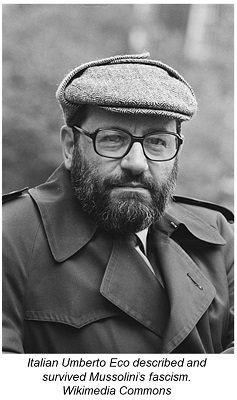
Italian scholar, novelist, and cultural critic Umberto Eco, who lived under Fascism, considered its ideological underpinnings “fuzzy” and “a beehive of contradictions.” [6] Nevertheless, he managed to enumerate 14 Fascist descriptors that fit Nazism just as well. In distilling Eco’s list to its essentials, certain characteristics emerge that may be applied to all totalitarian states: militaristic (including contempt for the weak and vulnerable, a “might makes right” mentality, and an obsession with perceived enemies); propagandistic (including the employment of an impoverished vocabulary and mind-numbing Newspeak-style repetition to pound home lies, coupled with the suppression of independent thought and critical thinking); and cultic (glorifying the “heroic” leader, machismo action over reflection, and the cultivation of a perceived noble past unmatched by any other people, a past that must be endlessly praised, emulated, and surpassed at the expense of others).
Still, Eco notes other salient features of Fascism that apply to Putin’s regime as easily as those of Mussolini and Hitler. These hallmark “isms” of right-wing totalitarianism were—and are—irredentism, traditionalism, nationalism, and racism.
Putin’s Irredentism
Putin’s obsession with restoring the glory of the Russian empire, be it tsarist or Soviet, is perfectly clear from his words and actions. He famously declared the breakup of the Soviet Union to be the greatest tragedy of the 20th century. Further evidence of his irredentism centers on his articulation of “Russkii mir,” the “Russian World,” meaning in his mind Russia’s rightful suzerainty over any land inhabited by Russian speakers. [7] This notion understandably panics a host of now independent former Soviet republics, including not only Ukraine but Estonia, Latvia, Lithuania, Moldova, Georgia, and Kazakhstan, all with sizeable Russian-speaking minorities. One of Putin’s bogus justifications for war against Ukraine has been to prevent Kyiv’s perpetration of genocide against Russian speakers in the Donbas, whether they want to be “saved” by him or not. The parallel is obvious with Mussolini’s irredentist territorial claims upon Yugoslavia’s Italian-speaking Trieste and with Hitler’s seizure of ethnic German Austria and Czechoslovakia’s Sudetenland German minority.
Putin’s “Traditionalism”
As for “Tradition,” it celebrates conservative family values, including sexual relations exclusively within the bonds of marriage, which Mussolini and Hitler promoted rather than practiced. Putin likewise pays lip service to conservative social, sexual, and ethical mores. But his divorce, rumors of mistresses, his support for decriminalizing domestic violence, and strong circumstantial evidence that Russia’s president orders contract killings of nonconforming reporters and political opponent—all hardly merits a reputation as a champion of conservative Christian “Tradition” writ large.
Another component of feigned Fascist deference to “Tradition” centers on its posturing as protector of historic majority churches. Whereas Soviet Communism sought to eradicate religion, Fascist Italy and Nazi Germany coerced and coopted Catholic and Protestant churches for state purposes. Putin also has cowed and commandeered churches, including the orchestration of their “patriotism” even to the point of blessing Russia’s unprovoked war against Ukraine. No one, for example, defends Putin’s carnage in Ukraine more shamelessly than Russian Orthodox Patriarch Kirill, a stance that has profoundly divided global Orthodoxy. [8]
Putin’s Nationalism and Racism
In addition to irredentism and traditionalism, Umberto Eco identified nationalism and racism as distinctive hallmarks of Fascism, and they are essential, intertwined features of “Putinism” as well. “Russian World” propaganda popularized by Putin and Patriarch Kirill is nationalistic and racist to its core. The preachment is that only “Great Russians” can save “Little Russians” (Ukrainians), indeed all of Eurasia, from Western decadence defined as anarchic individualism, selfish interest group narcissism, spiritual (read Catholic and Protestant) heresy, and cultural and sexual degeneracy. In the midst of the present war, Putin’s media machine formulates all manner of chauvinist and racist fictions: that Ukraine has never been a legitimate nation; that its people speak either Russian or a dialect of Russian; that its religion is or ought to be exclusively Russian Orthodox under the tutelage of the Moscow Patriarchate; and that its history is nonexistent apart from the “protective” umbrella of Russia hegemony.
Putin’s Nazi Hat Trick
The Nazis likewise employed nationalistic and racist rhetoric to dehumanize non-Germans, thereby paving the way for concentration camps and genocide. The most prominent lie Putin repeats about Ukrainians is that they are all Nazis. While it flies full in the face of the truth, this fiction is the means he has chosen to dehumanize his present foe. His control of media allows him to beat home this falsehood by incessant repetition and without contradiction. The fact that 27 million Soviet citizens died at the hands of Nazi Germany means that the Russian population is predisposed to wholeheartedly oppose any people successfully labeled Nazis. Since only a minority, mostly tech-savvy youth, have managed to circumvent state-controlled media, a majority of Russians appear to believe that all Ukrainians are Nazis, with the corollary that they naturally therefore have to be corralled, “cleansed,” and brought back under Russian imperial “protection.”
Putin has distorted a mustard seed-size fact to demonize Ukrainians, that in their midst is a minority who harbor Nazi sympathies—just as in Russia. The key argument of this article resides in this central point: that the presence of a negligible number of fascist sympathizers in Ukraine in no way justifies Russia’s unprovoked invasion and its armed forces’ reign of terror against civilians.
Fascist “Mustard Seeds” on Ukrainian Soil
In brief, what has been the extent of fascist “mustard seeds” planted in Ukrainian soil? [9]
- While the Organization of Ukrainian Nationalists (OUN), founded in 1929, had certain fascist affinities (the collective will of the nation over the autonomy of the individual, a cult of war and violence, and a glorification of will over reason), it rejected racism and the idea of a “chosen nation.” In contrast, its main goal was national liberation, not the subjugation of other nations.
- While military elements of the OUN fought Poles before World War II and Germans and Communist Russians and Ukrainians during the war, some OUN elements tragically were involved in 1941-44 in lethal pogroms against Jews and Poles.
- Stepan Bandera, the quintessential Ukrainian “Nazi” of Russian propaganda, actually spent most of World War II in Germany’s Sachsenhausen Concentration Camp. In western Ukraine he first fought Poles in the 1930s and then Soviet occupying troops in 1939-41 and after the war, finally losing his life to KGB assassins in Munich. Georgiy Kasianov, head of the Laboratory of International Memories Studies, Marie Curie-Sklodowska University, Lublin, Poland, notes that Bandera was both “a national symbol of [the] anti-Russian liberation struggle in contemporary Ukraine” and “a major reason for Russian propaganda to depict Ukraine as resorting to fascist-style nationalism.” [10] Counter to the Kremlin line of a thoroughgoing “Nazi” Ukraine, a recent opinion poll showed Ukrainians evenly divided, with 32 percent viewing Bandera favorably and an equal percent viewing him unfavorably.
- In Ukraine’s three decades of independence since 1991, ultra-nationalist parties have never enjoyed anything like majority support. The movement’s high water mark came in 2010-14 as a reaction to the pro-Russian presidency of Viktor Yanukovych when on one occasion the strongly nationalistic Svoboda (Freedom) Party garnered 10.4 percent of the vote. Its fortunes have since waned, dropping from six representatives in the 450-member Rada (legislature) in 2014 to one in 2019.
- An ultra-nationalist Right Sector movement emerged during the 2013-14 Maidan Revolution, providing a militant defense of the pro-democracy, pro-Western movement that overthrew Yanukovych. Contrary to Russian misinformation, Right Sector activists in the fight against Yanukovych were a decided minority, some 500, while the total number of Maidan protesters numbered in the tens of thousands.
- A far-right Azov Battalion emerged in 2014 to combat pro-Russian separatists in eastern Ukraine and has since become a major foil for Kremlin propagandists seeking to paint all Ukrainians as fascists.
Journalist Konstantin Skorkin, a native of Luhansk, Ukraine, affiliated with the Moscow Carnegie Center, summarizes well the limited extent of fascist influence in Ukraine: “Far-right activists were indeed active participants in the Euromaidan [Revolution] and played a role in the formation of volunteer battalions in the Donbass. But it cannot be said that their ideology has become popular in Ukraine…. It is customary to recognize the contribution of the right to the defense of the country, but at the same time consider their xenophobic views unacceptable.” [11]
The Commanding Heights of Russian Fascism
The Kremlin’s labeling of others as Nazis lacks credibility especially because, unlike Ukraine, fascist sympathies are an ideological staple of Russia’s ruling elite and Putin in particular. The fact is that many countries possess minorities of far-right, fascist sympathizers—including the United States with its Proud Boys, Oath Keepers, and other white supremacist militants. But the presence of followers of a reprehensible ideology within a country does not justify dismissing that country as a whole as reprehensible, much less waging war against it, which is what Putin has done to Ukraine. If a nation could justify invading another nation based on the hat trick of equating a neo-Nazi minority with a nation’s majority, then Russia itself by right would be subject to invasion. Indeed, a hypothetical military intervention against Russia could more readily be justified than an invasion of Ukraine because, unlike Kyiv, many of Moscow’s ruling elite, including Putin, are beholden to home-grown fascist philosophers Ivan Ilyin and Alexander Dugin.
Ivan Ilyin, a Homegrown Fascist
Ivan Ilyin was among White (anti-Communist) intellectuals exiled abroad by Lenin in 1922. A thoroughgoing fascist, he welcomed Hitler’s rise to power in a 1933 article, “National Socialism: A New Spirit.” In a 1937 piece he wrote, “Fascism does not give us a new idea, but only gives us new attempts to implement this Christian, Russian, national idea.” [12] An ardent admirer of Mussolini and Hitler, Ilyin lauded their imperial and racial agendas, not even disavowing them following the Second World War and the Holocaust. To his dying day he championed Russian exceptionalism, Russian racial and spiritual (read Orthodox) superiority, dictatorship, the absolute necessity of Russia’s dominion over Ukraine, and more broadly Moscow’s holy mission to unite Eurasia “from Dublin to Vladivostok,” and defend it against all enemies.
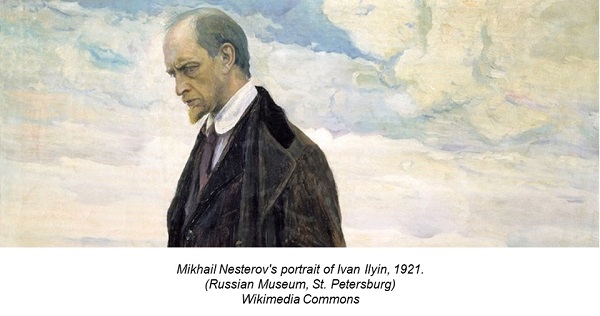
Putin frequently quotes Ilyin in his speeches, while other Russian public figures also pay him homage including Foreign Minister Sergei Lavrov, former president and prime minister Dmitri Medvedev, Patriarch Kirill, and various regional governors and United Russia Party officials. By 2005, twenty-three volumes of Ilyin’s collected works had been published in Russia. That same year Putin facilitated the return of Ilyin’s remains from Switzerland to the grounds of Moscow’s Donskoy Monastery and subsequently in 2009 honored his fascist mentor at a graveside ceremony. In 2006 Putin assisted in the repatriation of Ilyin’s personal archive from Michigan State University in the U.S. to Moscow. In addition, in conjunction with Russia’s 2014 military occupation of Crimea, Russia’s president saw to it that high level Russian officials and all regional governors received copies of Ilyin’s Our Tasks. In summary, as Glasgow-based political analyst Anton Barbashin has put it, “By approving of Ivan Ilyin’s philosophy, the Russian state is effectively sugar coating a holder of bitterly fascist views…. In a country where its people are proud of ‘defeating fascism,’ cherishing Ilyin is a tragic irony. [13]
Alexander Dugin, Another Homegrown Fascist
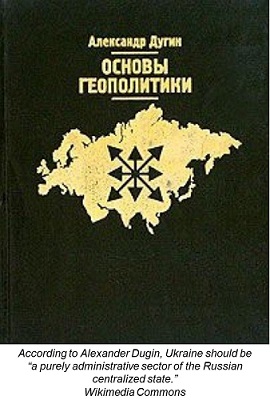
A present-day Russian fascist who was influenced by Ilyin and who in turn has influenced Putin is Alexander Dugin, a political philosopher and founder of the ultranationalist National Bolshevik Party and later the Eurasia Party. A number of Putin’s geopolitical views dovetail closely with those of Dugin: that the West is decadent, has been corrupted by individualism, and has forsaken traditional moral values. As Dugin sees it, the designs of the United States to dominate the world can only be countered by the saving power of a resurgent Russian civilization. He put it this way in a speech to thousands of Muscovites in February 2012:
The global American empire strives to bring all countries of the world together under its control…. We are the last obstacle on their way to building a global evil empire…. We have spilled seas of blood, our own and other peoples, to make Russia great! And Russia will be great! Otherwise, it will not exist at all. Russia is everything! [14]
Like Ilyin and Putin, Dugin also explicitly contends that Russia’s messianic mission is inconceivable apart from Ukraine, which should be “a purely administrative sector of the Russian centralized state.” To that end Dugin advocated the annexation of Crimea and the present war against Ukraine. As to the spread of this virus, both the Russian military academy and the state school system have adopted as required reading Dugin’s 1997 Foundations of Geopolitics. [15]
Russia’s Homegrown Fascist Militias
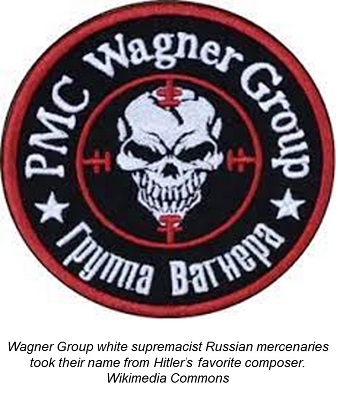
Putin’s Russia is not only a congenial haven for the fascist ideologies of Ilyin and Dugin, it also harbors white supremacist militia on its soil and makes common cause with their military adventurism abroad: to date in Syria, Libya, Mozambique, Central African Republic, Mali, Sudan, and Ukraine (2014-15 in Crimea and 2022 in Donbas and on the approaches to Kyiv and Kharkiv) [16]. The best-known Russian soldiers of fortune fight under the banner of the Wagner Group, named for German composer Richard Wagner, a favorite of Adolf Hitler. Its leader, Dmitry Utkin, is reportedly tattooed with a swastika, a Nazi eagle, and SS lightning bolts. In addition to war-making at Moscow’s behest, Putin reportedly dispatched some 400 Wagner combatants to infiltrate Kyiv for the purpose of killing or capturing President Zelensky.
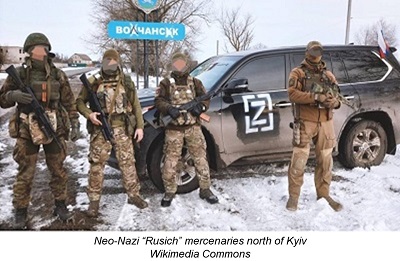
Loosely affiliated with Wagner mercenaries is the openly pro-Nazi Task Force Rusich. One of its leaders, Aleksei Milchakov, who has to his credit social media posts slicing ears off dead soldiers, was sanctioned in 2015 by the European Union, the UK, and Canada.
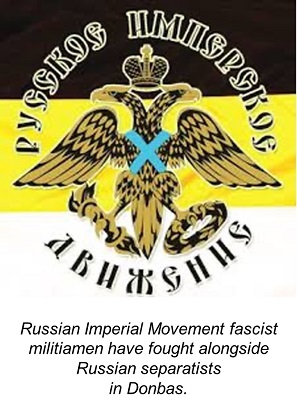
A third fascist militia is the Russian Imperial Movement (RIM), which openly operates military training camps near St. Petersburg that draw neo-Nazi and white supremacist recruits from western Europe. In addition to fighting alongside Russian separatists in Donbas its “graduates” bombed refugee camps in Sweden in 2016. As former FBI counterterrorism agent Ali Soufan and Ambassador Nathan Sales have concluded, despite his stated purpose to de-Nazify Ukraine, “Putin isn’t fighting neo-Nazism. He nurtures it.” [17]
Conclusion
Western efforts to explain Putin’s motivation for war have included his KGB roots and mentality; his desire to block Ukraine’s membership in NATO and the European Union; the lack of Kremlin advisers courageous enough to proffer unvarnished truths; his failure to anticipate the level of international diplomatic and military support for Ukraine and the scope of sanctions against Russia; Putin’s wounded ego and intense sense of grievance against the West and his desire to avenge Russia’s loss of empire and the dismemberment of the Soviet Union; the failure of Russian intelligence to anticipate the level and tenacity of Ukrainian resistance; Putin’s failure to take seriously Ukraine’s comedian-turned-president Zelenskyy; the demographic lure of reabsorbing 44 million Slavic souls into the Kremlin fold; the economic prize of Ukraine’s natural and industrial resources; and Putin’s aspiration to turn the Black Sea into a Russian lake by seizing the entire shoreline between the Donbas and Odesa.
Two additional, closely related motivations may have been especially powerful factors behind Putin’s decision to invade Ukraine. One was the prospect, frightening for Russia’s president, of having next door a prosperous and successful Slavic democracy that would be alluring to citizens disillusioned with his authoritarian kleptocracy. Second, Ukraine stands in the way of Putin’s geopolitical dream of a vast Eurasian civilization capable of besting what he views as a degenerate, decadent West. One need only read the rantings of Ivan Ilyin and Alexander Dugin and compare them with Putin’s 5,300-word July 2021 “history lesson” and his invasion-eve speech of February 23, 2022, to wake up to the fact that Russia’s president might have a truly expansive Eurasian aspiration in mind for his legacy [18].
Some might argue that Putin is far more pragmatic and opportunistic than cosmic in his thinking. But in the wake of Russia’s invasion of Ukraine grandiose designs appear to be trumping more modest goals, not least because Putin clearly takes seriously the imperialistic prognostications of Russia’s homegrown fascist philosophers Ilyin and Dugin whom he reads and quotes. Ominously, reading Ilyin and Dugin also is to be forewarned that their disciple in the Kremlin has much more on his mind than the “troublesome,” “illegitimate” state to his south.
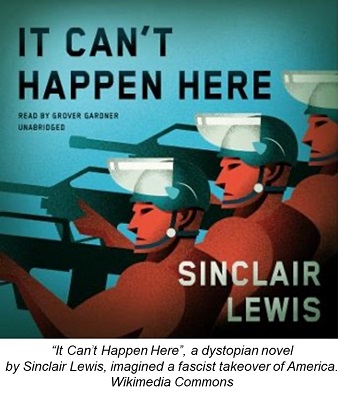
In Sinclair Lewis’s 1935 dystopian novel, It Can’t Happen Here, a president successfully subverts the legislature, the courts, and the media to transform America into a fascist dictatorship [19]. This cautionary tale, whose reprint sales soared following Donald Trump’s election to the U.S. presidency, should be required reading for anyone inclined to downplay Vladimir Putin as an existential threat not only to Ukraine but to other former Soviet republics and European and North American democracies.
Prepared for the website “Modern Ukraine”. Published for the first time. The publication uses illustrations from open sources (main photo).
Links and Notes
[1] Glenn Kessler, “The Roots of the Zombie Claim That Hitler Had ‘Jewish Blood,’” Washington Post, May 4, 2022.
[2] Andrew Roth and Angela Giuffrida, “Israel Summons Russia Envoy over Minister’s Hitler Comments,” The Guardian, May 2, 2022.
[3] For examples, Carl J. Friedrich and Zbigniew Brzezinski, Totalitarian Dictatorship and Autocracy, 2nd ed. (Cambridge, MA: Harvard University Press, 1965) and Hannah Arendt, The Origins of Totalitarianism, 3rd ed. (New York: Harcourt, Brace & Co., 1966).
[4] For examples, William Zimmerman, Ruling Russia: Authortarianism from the Revolution to Putin (Princeton: Princeton University Press, 2016); J. Arch Getty, Practicing Stalinism; Bolsheviks, Boyars, and Persistence of Tradition (New Haven, CT: Yale University Press, 2013); Lynne Viola, “The Question of the Perpetrator in Soviet History,” Slavic Review 72 (Spring 2013), 1-23; Michael Geyer and Sheila Fitzpatrick, eds., Beyond Totalitarianism: Stalinism and Nazism Compared (Cambridge: Cambridge University Press, 2009).
[5] Timothy Snyder, The Road to Unfreedom: Russia, Europe, America (New York: Duggan Books, 2019).
[6] Umberto Eco, “Ur-Fascism,” The New York Review, June 22, 1995.
[7] “A Declaration on the ‘Russian World’ (Russkii Mir) Teaching,” Public Orthodoxy, March 13, 2022; https://publicorothodoxy.org/2022/03/13/a-declaration-on-the-russian-world-russkii-mir-teaching/?fbclid=1wAR2K3OAucEVLc844Lmt-wO_RTZReAkiMOZfYgtkUAOxbKpGZ-Ud_Bbmy8jc.
[8] “Russia: Patriarch Kirill Should Be Prosecuted by the ICC According to NGO Report,” Human Rights Without Frontiers, April 21, 2022; https://bit.ly/386J8V4.
[9] The treatment of the extent of fascist influences in Ukraine is based on Konstantin Skorkin, “From Bandera to Azov: Answering the Main Questions about Ukrainian Nationalism. Where Did It Come From, How Does It Affect Modern Ukraine—And How Russian Propaganda Portrays It,” Meduza, April 17, 2022. See also “Kennan Cable No. 76: From Historical Fallacy to Tragic, Criminal Loss: Putin’s Case for Invading Ukraine,” Kennan Institute; https://www.wilsoncenter.org/publication/kennan-cable-no-76-historical-fallacy-tragic-criminal-loss-putins-case-invading-ukraine).
[10] Georgiy Kasianov, Memory Crash: Politics of History in and around Ukraine, 1980s—2010s (Budapest: Central European Press, 2022).
[11] Skorkin, “From Bandera to Azov.”
[12] Anton Barbashin, “Ivan Ilyin: A Fashionable Fascist,” Riddle Russia, April 20, 2022; https://ridl.io/en/ivan-ilyin-a-fashionable-fascist/.
[13] Barbashin, “Ivan Ilyin.”
[14] Masha Gessen, The Future in History: How Totalitarianism Reclaimed Russia (New York: Riverhead Books, 2012), 388-84.
[15] Steven Pittz, “A Civizational War?” March 27, 2022; https://www.city-journal.org/does-putin-take-his-cue-from-alexander-dugin.
[16] On Russian mercenaries at home and abroad see Ali Soufan and Nathan Sales, “One of the Worst Ways Putin Is Gas-lighting the World on Ukraine,” NBC News, April 5, 2022; https://www.nbcnews.com/think/opinion/putin-nazi-pretext-russia-war-ukraine-belied-white-supremacy-ties-rcna23043; and Carley Petesch and Gerald Imray, “Russian Mercenaries Are Putin’s ‘Coercive Tool’ in Africa,” Associated Press, April 23, 2022; https://apnews.com/article/d0d2c96e0ld299a68e00d3a0828ba895.
[17] Soufan and Sales, “One of the Worst Ways.”
[18] Vladimir Putin, “Article on ‘On the Historical Unity of Russians and Ukrainians,’” July 12, 2021; en.kremlin.ru; Victoria Smolkin, “’Fantasy Is Not History’ Historian Victoria Smolkin Assesses Putin’s Claim That Modern-Day Ukraine Is a ‘Gift’ from the Bolsheviks,” Meduza, February 24, 2022; Jake Cordell, “Rewriting History, Putin Pitches Russia as Defender of an Expanding Motherland,” Moscow Times, February 21, 2022; Glenn Kessler, “Fact-Checking Putin’s Speech on Ukraine,” Washington Post, February 22, 2022; Michael Schwirtz et al., “Putin Calls Ukrainian Statehood a Fiction. History Suggests Otherwise,” New York Times, February 21, 2022.
[19] Sinclair Lewis, It Can’t Happen Here (New York: Double, Doran and Co., 1935).


