


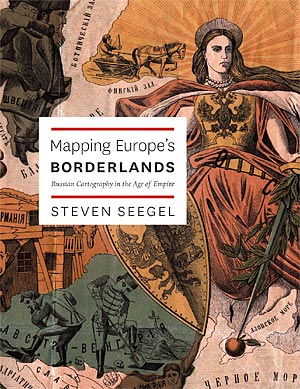
 Mapping Europe’s Borderlands. Russian Cartography in the Age of Empire
by Steven Seegel
The University of Chicago Press, 2012, 384 p.
The book of Steven Seegel is a meticulous analysis how such a natural science discipline as cartography might be used for political purposes. This macro investigation consists from several micro researches. It is not only because it is structured by 10 chapters and describes the history of Eastern and Central Europe from XVIII century till the first decades of XX century. It is also because the main argument is divided on two main directions. From one hand it is an analysis how maps were changed and how cartography was developed during several centuries, from another hand, it is a book about developing Russian imperial discourse and how this discourse influenced, controlled, inspired process of ‘mapping Europe’s Borderlands’ of the Russian Empire. The method of the case study gave a certain freedom to the author in the process of selecting and combining the materials.
Seegel collected a huge amount of the documents. The list of his primary and secondary sources is breathtaking as well as his linguistic abilities to work with the original documents written in different languages. The fact that the author read all documents in the language of original is important not only because the maps by themselves reflected the power dynamic on the region. He was thoughtful to the spelling of the geographical points. The spelling of toponymy is important for analysis the power (colonial, imperial, national) discourse: Lemberg/Lwow/Lviv, Wilno/Viln’a/Vilnus, Kijow/Kiev/Kyiv. It might be done an addition research on toponymic changes and the discourse of power.
Interdisciplinarity plays also positive role in the book framing. It is not only the connection between geography (cartography) and history. The research is much more complex. It is also religious studies, anthropology, ethnic studies and literary studies. Lelevel, Karamzin, Mickiewicz, Pushkin, Shafarik, Danilevskii, Zeromski found own place in the author’s narration. The author also demonstrated his awareness of the diversity (religious, ethnic, linguistic) of the region. After this research the Russian Orthodox monopoly in the region might be questioned.
This book demonstrated that knowledge is power as well as the producing knowledge is the power making act. It is not possible to understand the developing of the historical process without understanding how the state borders were mapping during centuries.
Tetyana Dzyadevych
Department of Slavic and Baltic Languages and Literatures, UIC (University of Illinois in Chicago)


