


Europe’s Democrats Mourn a Russian Imperialist?
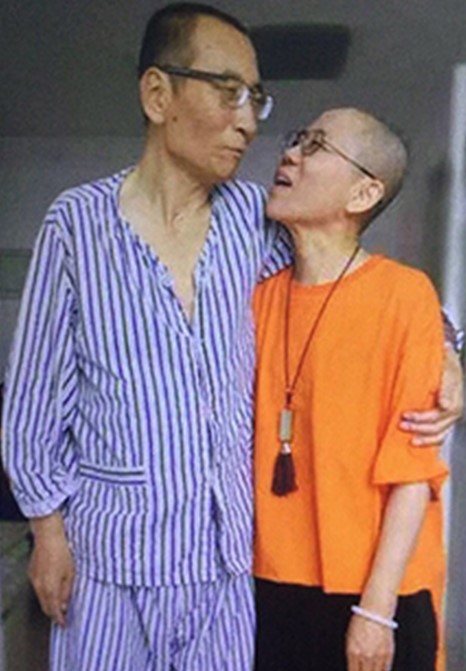
In February 2024, the death (or rather, extrajudicial killing) of the leading Russian opposition leader Alexei Navalny sent shock waves across the democratic world. It could have been a subdued affair, as in the case of the Chinese 2010 Nobel Peace Prize laureate Liu Xiaobo. Beijing arrested him on trumped up charges in 2008 and withheld medical care, leading to the dissident’s premature death in 2017. The Chinese authorities did not want to make Liu Xiaobo into a martyr for democracy. Hence, he was cremated and his ashes scattered at sea. No grave means no pilgrimage place. The studious absence imposed by the authorities rapidly translates into a steep decline in the remembrance and recognizability of the late activist. In 2008, Liu Xiaobo dared to co-author Charter 08, in emulation of Czechoslovak dissidents’ Charter 77 (announced in 1977). Charter 08 was unveiled on the 60th anniversary of the UN’s Universal Declaration of Human Rights. Chinese totalitarianism loathes democracy, liberal values and human rights.
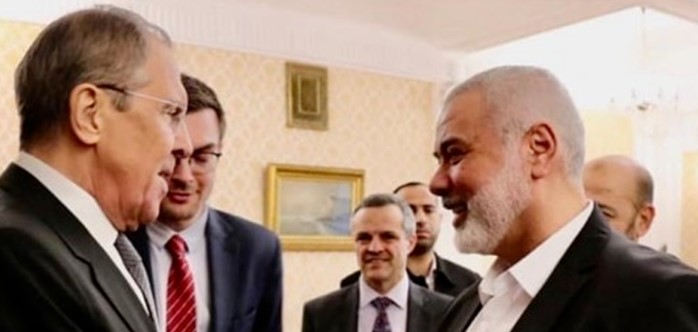
Why did then the Kremlin not follow the now typical silencing procedure, applied in totalitarian regimes after the untimely demise of another popular oppositionist with political aspirations? First, the expected preoccupation of the West with Navalny’s suffering, death and funeral helped in averting the gaze of the world’s public opinion from the second anniversary of Russia’s unprovoked war on Ukraine. To Moscow’s glee, the same purpose has been served by the terrorist organization Hamas’s attack on Israel in October 2023, followed by the Israeli intervention in Gaza. The Kremlin immediately unrolled the red carpet for Hamas leaders in Moscow. On top of that, the West failed to meet its pledges of weapon supplies to Ukraine. Kyiv had no choice but to withdraw from Avdiivka that after the months-long battle regrettably fell into the Russian hands. Moscow’s propaganda hails the victory as a proof that Russia is winning the war. This official conclusion helped legitimize the March 2024 ‘election’ of Mr Putin as the country’s life president. In reality it was nothing else but a ritualized reappointment to the Kremlin’s throne.
However, many in the West fall for the Kremlin’s ruse and see the death of Navalny as a ‘lost chance’ for a democratic Russia of the future. In his relentless struggle against corruption and the ruling kleptocracy in his country, Navalny remained an unrepentant Russian nationalist and imperialist. The oppositionist’s views were in essence anti-Ukrainian. In his political program, Navalny never stated or alluded that the Russian Federation is an empire. That decolonization constitutes the indispensable initial step toward democracy in Russia.
Democracy and Empire are Mutually Exclusive
What can we learn (if anything) from History about democracy and empires? In Europe Britain, or the metropolis of the British Empire, was an early adopter of democracy as the country’s system of governance. Depending on varying definitions of democracy, Britain became democratic somewhen between 1688 and 1928. The first date marks the introduction of constitutional monarchy, while in the latter year female suffrage was finally equated with men’s voting rights in Britain.
What authors praising the long tradition of established British democracy tend to forget is the fact that all the time the British Empire stayed undemocratic. Taxation without representation remained the imperial norm. Way back in the 18th century, this slogan triggered the American Revolution, leading to the proclamation of the independence of the United States in 1776. Britain lost most of its colonial possessions in North America, or its ‘first empire.’ Having built another empire, with the point of gravity shifted half a world away to South Asia, London was wary of history repeating itself. To nip in bud revolution-generating discontent, between 1867 and 1922, Britain granted self-government to the settler (‘white’) colonies in Australia, Canada and New Zealand, but also to the restive and ethnically non-British Ireland. This so-called ‘dominion status’ came complete with the democratic (‘Westminster’) system of governance. Otherwise, this solution also assisted in keeping the aforementioned countries within the empire, even if they were unwilling, as in the case of Ireland and South Africa. In the Anglo-Boer war (1899-1902), for the first time in history, late imperial Britain introduced concentration camps on a mass scale with an eye to suppressing the restive Afrikaners (Boers). It was not a very democratic way of solving international disagreements.
London offered the status of a dominion exclusively to ‘white’ colonies, be it Ireland in Europe or such far-flung territories like Canada or Australia. In the latter British and European settlers first decimated the indigenous inhabitants and then swamped them with millions of new arrivals from Europe. Only in New Zealand was a form of cooption in the governance gradually extended for the country’s indigenous Māori nation. Meanwhile, under the dominion arrangement, South Africa remained a deeply undemocratic country with all the power concentrated in the hands of the white minority, composed of Brits and Afrikaners. The vast majority of the population – that is, the indigenous non-white ethnic groups – remained disenfranchised until 1994.
Finally, after World War II, London admitted the political and economic impossibility of a democratic Britain that would maintain ‘its’ own undemocratic empire. In 1947 the British India was partitioned, yielding the independent nation-states of India and Pakistan. The following year, at the southern tip of the Indian subcontinent, Ceylon (Sri Lanka) gained independence, while Burma (Myanmar) in the east. In 1949, autonomous Ireland finally parted ways with London. By the turn of the 1950s, in its bulk, the British Empire had been gone. On the other hand, where London stuck to its guns, things got ugly, like the network of nazi-style concentration camps for suppressing the Mau Mau uprising (1952–1960) in Kenya. These bloody events simultaneously led to and cast a cloud over the country’s independence in 1963. In most cases though, London and a given colony basically agreed upon a suitable timetable and procedure of granting the latter independence. For those who remained somewhat nostalgic about the former empire, a de facto international organization of the British Commonwealth of Nations was unrolled in 1949. Its activities rarely extend beyond cultural exchanges and the organization of glitzy visits for British royals, as a bonus for the tabloid press.
Unlike Britain, during World War II, the French metropolis had found itself under German occupation. Afterward, most French colonies wanted consensual independence as that on the offer to their British counterparts. But Paris had other ideas, encapsulated in the term grandeur for reasserting the status of France as a great power in the postwar world. At first, in the program’s framework, the French ruling elite wanted to reestablish the French Empire (Empire français). In 1946, it came back under the guise of a less threateningly named French Union (Union française). The colonized did not appreciate this return of French colonial masters. In reaction, a long series of colonial wars followed. In their course France either sought to suppress the proliferating anti-colonial movements or to re-assert Paris’s dominion over the colonies that had gone (almost) independent during the war. France’s biggest imperialist war unfolded in Indochina. This bloody conflict raged until 1954, when Paris finally acquiesced to the rise of independent Cambodia, Laos and Vietnam.
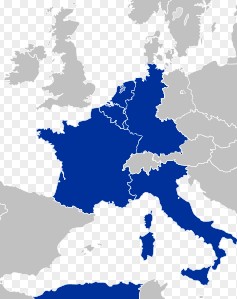
Subsequently, France limited its imperial ambition to Africa and the country’s mostly insular colonial possessions overseas. Yet, the war in Algeria (1954-1962) immediately followed into the footsteps of the Indochina debacle. It indicated that the metropolis of France itself was in the dire need of decolonization. After all, since 1848 Algeria had been an integral part of France’s territory, not a colony. Algeria featured – as an obligatory inset, alongside Corsica – on wall maps of France hanging in schools and state offices. After 1956, this colonial-style ‘regular’ administrative region of the Republic of France found its way onto the early maps of the European Communities, or the forerunner of the European Union.
In the constitutional sense French Algeria was a part of France. But, paradoxically, the vast majority of French Algeria’s indigenous inhabitants did not enjoy French citizenship. Inequality in legal status between the metropolis’s empowered citizens and subaltern colonials is one of the hallmarks of empire and imperialism. Hardly more than a tenth of the inhabitants of this North African region of France enjoyed French citizenship. On top of that, in their overwhelming majority the empowered colonials were ethnically French (or white) and practised either Catholicism or Judaism. This ethno-confessional divide deepened the existing legal cleavage between the so-called pieds-noirs (‘[Europe’s] black feet [on African soil]’) and the excluded Arabic-speaking Muslim majority.
This screaming inequity further fuelled the brutal war in Algeria. The conflict even ruined French democracy that had to be reinvented anew. In 1958, a Fifth French Republic was proclaimed, together with a new constitution. Four years later, in 1962, Paris also resigned itself to recognizing the Algerian independence. French patriots (read: unrepentant imperialists) decried the loss of an integral part of France. At the same time, Algerian patriots (read: Arabic-speaking Muslims) celebrated the expulsion of colonial settlers and imperialist overseers who had imposed on Algeria for over a century, under the pretence that the Département of Alger (Algeria) was not different from the Département of Haute-Loire.
Similarly to the French case, during the war, the Netherlands suffered the indignity of German occupation. Afterward, following France’s example, the Hague refused to accept the independence of Indonesia, which the latter had already gained under Japan’s wartime occupation. The Dutch government vowed to reconquer the Nederlands-Indië (Dutch East Indies), although in territory it was 46 times bigger than the Netherlands and seven times in the number of inhabitants. Another devastating imperialist war followed. The United States that pumped monies from the Marshall Plan for the reconstruction of Europe disliked the Dutch government’s diversion of funds for its war of re-colonization in Southeast Asia. Finally, the Dutch government had to admit the ideological and economic untenability of its imperialist position on Indonesia. In 1949, the Netherlands recognized the Indonesian independence. The war ended and the Dutch interventionist troops were withdrawn to the metropolis in Europe.
If instead of limiting the purview to the European metropolises alone, the quality and state of democracy is assessed in still colonial Britain, France or the Netherlands, including their empires, then the conclusion is obvious. Most of the three empires’ population did not live under democratic rule. Those few who were fully empowered ‘democrats’ and at the same time convinced imperialists resided in the far-away metropolis. From the safety and comfort afforded by this geographic distance and socio-political separation, convinced of their civilizational and moral superiority, the European masters enjoyed democracy ‘at home’ and arbitrarily ruled (imperare in Latin; hence, imperium ‘empire’) over the hapless multitudes of colonials (‘natives’) overseas.
In the imperialist opinion, popularly expounded until the mid-20th century, colonials ‘needed’ protection and guidance that white masters kindly and readily extended, because ‘natives’ had not yet matured sufficiently to be eligible for citizenship. To achieve the prescribed level of development colonials were expected to improve themselves by working diligently and following European colonizers’ example and orders. Anticolonial movements dubbed this unequal arrangement ‘exploitation.’ Imperialists preferred to refer to it as the West’s ‘civilizing mission.’ Aspiring ‘natives’ could ‘evolve’ (improve) themselves, until they became worthy of the status of évolué (‘evolved one’). On this basis, selected few could obtain a carte d’immatriculation (‘certificate of [political and civilizational] maturity’) that conferred on them (theoretically) full legal equality with the white masters. In 1957, in Belgian Congo with the population of 13 million, out of 50,000 évolués a mere 1,557 were holders of this certificate.
Authoritarian Iberia: Between Empire and Democracy
After World War II, the undemocratic character of their empires posed a serious ideological and economic dilemma to these metropolises that prided themselves to be advanced democracies of Western Europe. Not such qualms for Western Europe’s established autocracies. Neither Madrid nor Portugal did have to tie themselves into rhetorical and legal knots on this issue. The governing elites of Francoist Spain and António de Oliveira Salazar’s Portuguese Estado Novo did not have to spend time on such fruitless efforts to square metropolitan democracy with imperial authoritarianism. From the standpoint of ideology and governance, both Iberian metropolises were homogenously authoritarian like their overseas empires. By the turn of the 1970s, the remnants of Spain’s once worldwide maritime empire had been effectively limited to Spanish Sahara (today’s Spanish Sahara under the Moroccan occupation). Although amounting to two-thirds of the territory of Spain, the colony’s population of about 70,000 was negligible from Madrid’s perspective.
Portugal was one of postwar Europe’s poorest countries of little demographic potential, because its population of almost 9 million in 1963 was then constantly shrinking until the end of dictatorship in 1974. In 1960, Portugal’s GDP per capita in 1985 dollars amounted to a paltry US$1,800, growing slowly to US$5,000 two decades later, already under democracy that was also bringing economic fruits. In comparison, Spain fared much better, the same economic indicator stood in the country at US$3,100 in 1960 and jumped to US$7,400 in 1980. Spain developed more rapidly, thanks to tourism and Madrid’s decision to not engage in costly imperialist wars after independence was granted to Equatorial Guinea in 1968. In turn, autocratic Portugal seized on its empire as the main pivot for the reinvention of this country.
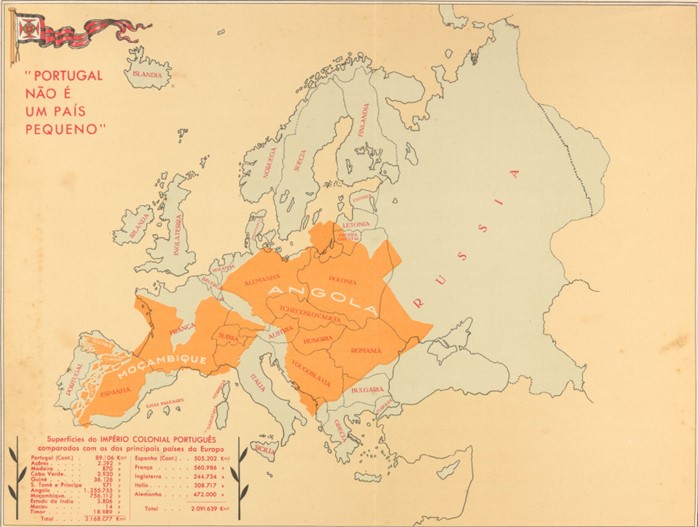
Already in the interbellum period, not burdened by destruction or military expense incurred by the two world wars, Lisbon embarked on pro-imperial propaganda. Its hallmark was the oft-reprinted map, titled Portugal não é um pais pequeno (‘Portugal is Not A Small Country’). It depicted Portugal together with its colonial possessions interposed against the map of Europe in the 1930s. In this designation, such an imperially enlarged Portugal extended from Lisbon in the west to the Polish-Soviet frontier in the east, and from southern Sweden to northern Greece. The map came in the wake of the 1933 constitution that innovatively defined Portugal as estado-nação unitário (‘unitary nation-state’) composed of Portugal and its ‘overseas provinces’ (província ultramarina). The term ‘colony’ was dropped and after 1950 the concept of ‘Portuguese Empire’ strategically disappeared from public discourse. The future belonged to tricontinental (pluricontinental) nation-state of Portugal.
Following the Great Depression, the economic outlook in Europe was bleak. To ameliorate the situation, Lisbon encouraged emigration to the country’s ‘overseas provinces’ in order to deal with unemployment and for the sake of making the unitary character of pluricontinental Portugal a socio-political reality on the ground. In 1960, Angola’s GDP per capita was half of Portugal’s, while in Mozambique it amounted to two-thirds of the home country’s indicator. What statistics did not show was the highly unequal distribution of wealth in the colonies. White settlers (colonizers) from Portugal owned most of it. In 1960, at 170,000, the Portuguese (white) settlers accounted for 3 per cent of Angola’s population. They enjoyed an opulent plantation-style lifestyle, comparable to that led by apartheid South Africa’s whites or known from the US’s antebellum South. The provincial capital of Luanda was a richer and more cosmopolitan city than Portugal’s capital of Lisbon.
What appeared to be a colonial paradise incarnated soon came tumbling down. Between 1961 and 1974, Lisbon was compelled to fight numerous brutal imperialist wars in Angola, Mozambique or Portuguese Guinea (today, Guinea Bissau) for preventing increasingly inevitable decolonization. The autocratic regime was desperate to keep the pretence of tricontinental Portugal alive. Eventually, the human, economic and political cost was too high to bear. In 1974, the Carnation Revolution toppled the authoritarian system, heralding the rise of democracy in Portugal. To the leaders and the elite, it was obvious that democracy would be a contradiction in terms if implemented only in the ‘European province’ of pluricentric Portugal. It turned out that before the dream of democracy could be realized in Portugal, first of all, the country’s remaining colonies (‘overseas provinces’) had to be granted independence.
Empires are inherently unequal in constitutional, economic, political or social sense. Hence, establishing democracy in an empire is a sheer impossibility. Having observed the Portuguese dilemma, the Spanish quickly learned the lesson. In 1975 the country’s dictator Francisco Franco died. The governing elite knew that most Spaniards wanted democracy, as enjoyed by Western European and American tourists, who had been flocking to the Spanish beaches since the 1950s. The elite decided to go with the flow of the popular will. Madrid did nothing to prevent Morocco’s seizure of Spanish Sahara. Rabat’s move spared Spain’s new democratic government a headache of deciding on how to proceed with the return of independence to the country’s last colony. The remnants of the country’s empire gone, Spain was set and ready for building a successful democracy.
Russia: Democracy or Empire?
These Portuguese who trusted in Salazar’s concept of unitary tricontinental Portugal lost most, especially if they decided to look for better life in the country’s distant ‘overseas provinces.’ Their European compatriots high on democratization and the unprecedented opportunities it brought, did not spare a thought on the Portuguese settlers stranded in the colonies-turned-independent states. These postcolonial states’ colonized-turned-free people did not want the colonizers around, either. Hardly noticed or welcomed, half a million colonizers-turned-refugees began streaming by sea or air to the home country. On arrival they were shocked to see how poor and provincial Portugal and Lisbon were in comparison to colonial Luanda. Unsurprisingly, when hit hard with the austerity measures brought about by the 2008 financial crisis, these returnees’ descendants chose to go back to booming oil-rich Angola. Portuguese businesses followed for a piece of the economic pie. In an unexpected twist of history, Angolan tycoons turned out to be financial saviors of the former metropolis, now diminished in stature and cash-strapped.
In socio-economic terms, the bicontinental Soviet empire was quite similar to its Portuguese counterpart. Many of Moscow’s ‘overland’ provinces, be it Azerbaijan, Estonia, Kazkhstan or Ukraine were richer in consumer products and the availability of decent accommodation than this empire’s Muscovian metropolis, extending from Moscow to Leningrad (St Petersburg). In the eyes of many Soviet citizens (mainly ethnic Russians, or the empire’s colonial masters), even the capital of world communism lost in competition to the ‘truly European’ cities of Lviv, Riga or Vilnius. The latter come together with their meticulously preserved old towns that boast medieval, renaissance and baroque architecture, which is so conspicuously absent in Moscow.
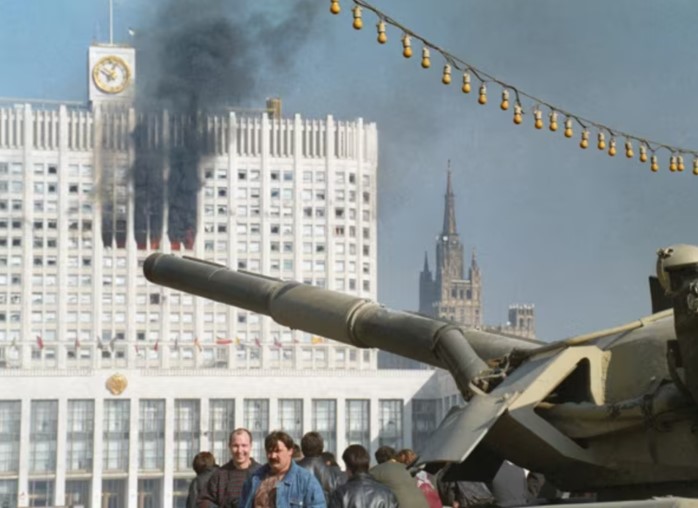
Why did democracy not strike root in post-Soviet Russia, despite genuine efforts in this direction, following the 1991 breakup of the Soviet Union? After all, President Boris Yeltsin let go of Russia’s colonies known under the euphemistic designation of ‘Soviet socialist union republics.’ However, despite this unexpected bout of decolonization, the Russian ruling elite remained relentlessly imperial in their mindset, including convinced democrats. They saw this unplanned decolonization of 1991 as a temporary (or even tactical) setback. Nothing of significance that would prevent restoring the Russian Empire, as it was at its acme, namely a tri-continental Russia, including Alaska. Second, already in 1993, Yeltsin ditched democracy altogether when he ordered the shelling of the Russian Duma (Parliament), which ‘disobeyed’ the president’s will. Third, the 1991 split of the Soviet Union at best amounted to a semi-decolonization. A quick glance at the map ascertains that as many as 21 national (autonomous) republics spot today’s Russia, accounting for a third of the country’s territory and a fifth of its inhabitants.
With the two imperialist wars of genocidal character (1991-1994, 1999-2000), Moscow suppressed the Chechen anticolonial movement for independent Ichkeria. No genuine decolonization of the neo-imperial Russian Federation would be allowed. The bloody example made Tatarstan think better about its earlier drive toward independence. The Kremlin would not have it even at the cost of levelling the Tatar capital of Kazan. The ethnically Russian settler colonies in Asia conceded and scaled down in their appeals for autonomy.

Hence, whoever succeeds Vladimir Putin on the Kremlin’s throne and whatever a political system of governance is adopted for another incarnation of ‘new Russia,’ one thing is certain. No democracy will happen in this country unless Russia undergoes full decolonization, like Portugal in 1974 or Spain in 1975. Without resigning from the ethnically non-Russian and settler (‘white’ Russian) colonies, democracy will remain just an elusive dream for the Russians. Even if a charismatic leader promises a democratic system of government to Russia and the country’s inhabitants enthusiastically embrace the project. De facto deep inequalities in legal status and opportunities that are inherent in empires would quickly prevent this yet another attempt at democracy in Russia without decolonization. In the debacle that would inevitably follow, Russian imperialists would swiftly get the upper hand, binning any hopes for democratization. Like Yeltsin’s governing coterie did after 1993 and by choosing, in 1999, as successor the unabashed imperialist, which Putin is.
Formally, all Russia’s inhabitants enjoy the same equal citizenship. But as the Orwellian norm is in empires, some are more equal than others. In Russia’s ongoing war on Ukraine, per the unit of population defined in ethnic terms, more Bashkirs die than ethnically Russian Muscovians. No democracy can be built on a foundation that in reality remains ready-made for the revival of an empire or for the maintenance of the really existing empire under the guise of a different designation. The latter, for instance, is the case of communist China. Had democrats prevailed at Tiananmen Square in 1989, no democratic China would have emerged, unless it had freed (permitted for the decolonization of) Inner Mongolia, Tibet or the Uyghurs’ homeland of Altishahr (Xinjiang).
In a nutshell, democracy and imperialism do not mix.
Prepared for the website “Ukraina moderna”. Published for the first time. The publication uses illustrations provided by the author.


