


// Cole DUTCHIK
The documentary film My Perestroika, directed and filmed by Robin Hessman, is an intimate look at the lives of five Russian classmates who came of age during the Perestroika period of Soviet history. Hessman holds a dual honors degree in Russian Language and Literature and Film from Brown University (1994) and a graduate degree with honors in film directing from the All-Russian State Institute of Cinematography (VGIK) in Moscow (1997). My Perestroika is her first feature-length documentary film, which premiered in 2010 at the Sundance Film Festival in Utah as one of several films entered into the U.S. documentary competition. Since then, it has been screened in over one hundred and fifty cities around the world including Kyiv, Ukraine, and has altogether been well received and the recipient of several awards. My Perestroika provides a snapshot of the last Soviet generation, which, through the characters’ first-person narratives, demonstrates the complexity and continually changing nature of life in post-Soviet Russia. Furthermore, the film’s visual structure suggests continuity with the past through thematic patterning.
The film follows the lives of five Muscovites – Borya and Lyuba, Ruslan, Olga and Andrei – all of whom were classmates and members of the last generation to grow up under the Soviet banner. Borya and Lyuba are married, have a son named Mark and are history teachers at school #57. Their friend Ruslan, a self-proclaimed outsider, is a musician and one of the founding members of the 1990s Russian punk rock group NAIV. Unofficially self employed, Ruslan now makes a living by playing his harmonica and banjo in public spaces. Olga, referred to by Borya as the “prettiest girl in our class,” is a single mother whose life took a tragic turn when her long-term boyfriend, a successful banker, was shot and killed ten years ago. Since then she has worked at a billiards rental company where she spends most of her time driving all over Moscow servicing tables. Like Borya, Olga still lives in the same Moscow apartment that she grew up in along with her sister and their children. Andrei, a successful businessman, manages a chain of retail stores that sell an international brand of luxury men’s shirts – relative to his classmates, Andrei has profited the most since the dissolution of the Soviet Union.
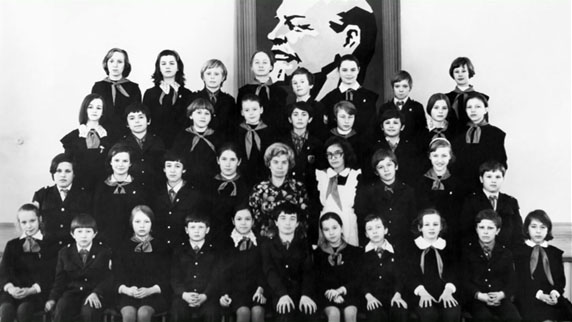
Class photograph
The film opens with propaganda footage from a Komsomol rally in 1977 and a young boy’s proclamation of thanks to Leonid Ilyich Brezhnev, “a kind friend to the young Lenin Guard,” for being able to live “in the country of Happy Childhood.” The image then cuts to Lyuba today recalling her childhood and how she was “completely satisfied with” her “beautiful Soviet reality.” “Look! It’s the ‘First of September'”! Lyuba proclaims as she, along with Borya and their son watch old 8mm home movies on their film projector. This structure is maintained throughout the film as it weaves between propaganda and documentary footage, old 8mm home movies and contemporary footage of the five characters’ lives and them recounting their impressionistic memories of the past – from their happy childhoods followed by their rebellious teenage years to their disillusionment, adjustment and continual readjustment to the fluid and complex political landscape of post-Soviet Russia.
Through its sole use of first-person narrative the film conveys a much more complex and nuanced portrait of the characters’ feelings and ideas regarding their sense of past, present and future. The characters speak for themselves. There are no “talking-head” historians or political experts to provide for an analysis. Indeed, the individual first-person perspectives brought to the film provide for a different, more personal quality. However, this is not to say that the film does not possess a point-of-view for it is through its visual structure that it gains its own perspective – a form of representation.
A frequent editing device used throughout the film is the juxtaposition of contemporary footage against propaganda and documentary footage as well as home movie clips from the characters’ childhoods. At one point we see Borya’s son, Mark, listening to music through his headphones and MP3 player. The image then cuts to old home footage of a young Borya listening to music on a record player and speaker system. Political concerns of the day are also compared as we are shown Cold War era propaganda footage of a simulated nuclear attack, which cuts to contemporary footage of a billboard in school #57 that states “Terrorism – a threat to Society,” and shows various illustrations on what to do in the event of a terrorist attack. In another example near the end of the film we see Borya at his family’s dacha talking about his child’s prospects in contemporary Russia while his son is playing badminton in the yard. The image intermittently cuts back and forth between this shot and footage of a young Borya playing badminton. The reworking of these film images in a comparative manner suggests an evolving continuity with the past – parallels – which are expressed through images that embody particular ideas such as the innocence of youth and war anxiety. This is exemplified by the film’s ending, which shows the start of a new school year celebration. The images of the characters’ children are juxtaposed against old 8mm film footage of themselves on the “First of September.”
My Perestroika’s narrow focus on the lives of five individuals and its sole reliance on their first person narrative accounts results in a personal, albeit limited perspective. The film’s point of view emerges through its construction of meaning via its visual structure. What develops is a picture that demonstrates the complexity of feeling and historical memory in post-Soviet Russia, but also a more abstract thematic continuity with the past. My Perestroika is an intellectually intriguing documentary of high quality that would be of value to anyone interested in memory studies, Russia or the Soviet Union.


