
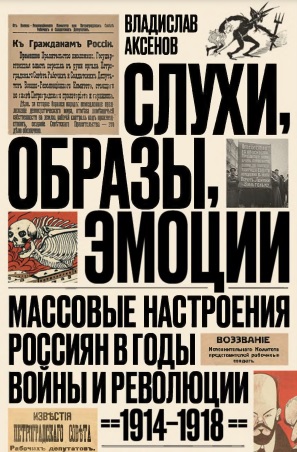
Review article: Aksenov, Vladislav, Slukhi, obrazy emotsii. Massovie nastroieniia rossiian v gody voiny in revoliutsii (1914-1918). Moscow: Novoe literaturnoe obozrenie. 2020. 992 pp.. illus.
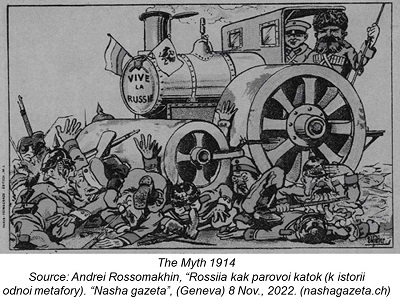
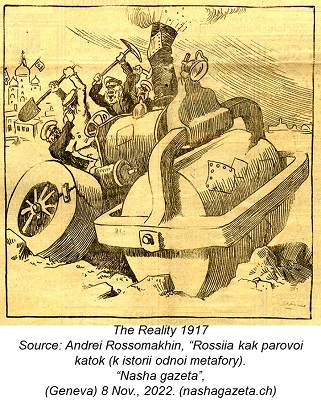
On the eve of WWI Europeans often referred to the tsarist army as the Russian Steamroller. That was notwithstanding its defeat in 1854 in the Crimea, poor performance in the Russo-Turkish War and loss against Japan in 1905. French and British leaders believed reforms had improved it after 1905, and ignored the persistent defects which their generals reported. Entente leaders thought that in a war against Germany the Steamroller would inevitably overrun it thanks to inexhaustible supplies of complacent peasants willing to die. That did not happen. The book here reviewed explains how and why the Steamroller did not function as intended and broke-down together with the society behind it. Those who follow events in Russia will invariably see parallels between what happened in 2022 and the events of 1914-17 covered in this book. US and European annalists who before 2022, like their counterparts a century ago, saw Putin’s army as a steamroller, like their counterparts then, soon realized how wrong they had been. The steamroller was not functioning and the society behind it was beginning to crumble as had happened in 1914-17. By the end of 2022, in less than a year of fighting, over 100 000 Russian troops were dead or wounded, thousands of Russians in prison for protesting, and at least 250 000 civilians had fled abroad or hid from conscription.
Aksenov specifies his subject is “Russians [Rossiany]” in the title. By this he presumably means Russians [Russkie] and Russian speakers. He makes mention of Jews and Germanophobia but otherwise only passingly mentions national issues and non Russians – although all the battles on tsarist fronts were on non-Russian territories. The author, with rare exception, grouped his documents according to socio-economic not territorial criteria. Accordingly, he produces a Russocentric analysis that does not specify which opinions moods and attitudes were common throughout the empire and which were not. Although he does not deal specifically with the Ukrainian provinces, those interested in revolutionary Ukraine should read this book that, in a single volume, provides an excellent summary description and analysis of the imperial context of Ukrainian events. The book points to the need for a similar detailed “vertical” examination of popular attitudes and moods in tsarist as well as Habsburg Ukraine before 1917 that would survey more than only national issues.
His sources include a wide range of printed sources primary and secondary, unpublished memoirs and diaries, and central police and censors’ archives. The book includes copious detail about daily life and is well illustrated. Aksenev is familiar with the related English-language literature of his subject and the associated methodological issues which he reviews in his introduction. He did not compile a bibliography. One important study he missed was Understanding the Great War (2002). This book points out that all the continental armies were equally guilty of brutality and atrocities. The French even committed them on territories they considered French –Alsace-Lorraine. They cite R. A. Reiss’s classic report on the Balkan horrors wherein he noted what was novel in 1914 was a desire to exterminate that led to troops treating civilians as they had never been treated before on an unprecedented scale [1]. In light of this, regardless of what Ukrainians, Poles, Balts or Jews might think, whether the tsar’s soldiers were any worse than their western European counterparts, with the exception of the British who committed atrocities in their colonies and not on the continent, remains to be determined. As Aksenov did not write a comparative study, he did not dwell upon this subject.
Another issue that would have enhanced the value of Aksenov’s study would have been comparative observations on differences between public moods in the British French and Russian empires. Popular discontent and cynicism was common in all the warring states whose government all practiced censorship and sponsored propaganda. Disillusionment, discontent, distrust of officialdom was probably worse and more intense in the Russian empire, but that was not why it collapsed. Similar domestic moods did not undermine the British or the French empires. What Aksenov might have explored was the role of opposition elites committed to the destruction of tsarist autocracy who exploited and stoked the cynical defeatist popular moods and opinions produced by censorship and the war. There were no analogous oppositional elites in republican France or the British constitutional monarchy – which survived the war despite revolutionary threats in 1919. Irish nationalists, it should be noted, sought secession from not the collapse of the British government.
The weakest part of the book is his claim that there were direct causal relationships between rumours and various subsequent events. Indeed, the underlying theme of the book is the importance of rumours among the populace as alternative sources of information to official news and propaganda. While sometimes rumours may have directly caused events, this is difficult to conclusively prove in every instance. The book describes popular opinions and attitudes as revealed in police informant reports, intercepted letters and memoirs. These confirm what other historians since 1991 have shown. As in western Europe mass bellicosity was rare and fleeting in August 1914. The majority of the tsar’s subjects did not share either the government’s, the monarchist’s, or the educated loyalist urban public’s patriotic views on the war and its effects. By 1916, any vestigial popular “naïve monarchism” had dissipated among the tsar’s subjects.
What Aksenov adds to our understanding of this dissipation is that it was not the result of the Rasputin affair only. Crucial were the unintended effects of official propagandist attempts to show the tsar as a “man of the people”, and his wife and daughters as committed to the common good by virtue of their volunteer work as nurses. Unexpectedly, what happened was that the many photographs the government circulated of the tsar and his family in common soldier and nurse uniforms undermined the image of the tsar as a sacred symbol of authority. As that image disintegrated, ever more people were emboldened to mock and condemn Nicholas as the man responsible for the war and all its the ensuing evils. People would deface his portraits and publicly curse the tsar in front of them. Nor did pictures of the tsarina and her daughters dressed as nurses ingratiate them with the public given the widespread opinion of nurses as dissolute officer mistresses or prostitutes. A peasant in Yeniseisk province in 1915, upon learning from newspapers the tsar had given nurses medals, concluded they got them because they had all slept with him. The medals should have been pinned “in another place” he observed [2]. The democratic “man of the people” image would have worked had Nicholas been a democratic modernizer. As he was not, the image also alienated the urban educated who condemned him as an autocrat.
The book has seven long sections: “Ideas,” “Action,” “Word,” “Text,” “Image,” “Symbol,” and “Emotion.” Each has a theme and is preceded by a summary of the relevant historiography. The first explores the patriotism of 1914 noting the word meant different things to different people. It ignores the relationship between dynastic-imperial and regional-national loyalties. The second deals with reactions to conscription. 96% of those summoned turned up, but men knew that bribes corruption and self-mutilation, would keep them out of the war, thus, far from all ever got to the front. Evasion was common, popular protest massive widespread and intense in July 1914 – including desecration of the tsar’s portraits and significant numbers of child and youth suicides.. Mobilization verged on the chaotic. Assembled recruits finding themselves without uniforms, transport or officers rioted in 42% of the empires provinces. Riots in the other 58% were simply not as massive or violent [3]. More than one pro-government rally was staged.
Section three examines rural oral culture and behaviour—without considering regional differentiation. Aksenov reviews cases brought against peasants under article 103 of the Criminal Code that covered offences against the royal family such as abuse and insults. He notes that what officials treated as sedition rebellion or disobedience, the people regarded as ritual opposition to mobilization, food shortages, the war and unprecedented violence. Peasants explained the war-time situation to themselves in terms of myths and popular religion. By 1916, public expression of contempt towards the dynasty was so commonplace the tsar ordered officials not to charge those involved so as not to enflame the hostile popular mood [4]. In 268 cases the author reviewed, sentences were light. None of the arrested got the maximum sentence of 8 years in Siberian exile. In general, Poles, Jews and Germans got higher sentences than Russians. In terms of total arrests, of 1474 cases, the Ukrainian provinces ranked 4 out of the 7 imperial regions [5]. The records show the royal family was totally discredited in the eyes of the population by 1916. By that year peasants were concerned only with finding food and commodities. They blamed the tsar for everything and imagined a better life once the Germans won. The fourth section deals with the literate urban population and shows how rumours dominated and destabilized the public sphere there because the censorship of the printed media was so strict people regarded rumours as more credible than the press. Urban dwellers subscribed to even the most absurd tales, like the existence of a tunnel from the royal palace to Berlin, and Germans traveling the country on bicycles poisoning wells. Aksenov lists the most circulated runours in the two imperial capitals [6]. Those who rejected myth and religion as superstition, yet were unable to rationally understand what was happening around them, turned to mysticism or went insane. The unbalanced presented the police with problems, who had to allot time and resources to determine which threats against the royal family originated with the psychotics and which from normal people who believed hostile anti-tsarist rumours.
The fifth section examines the circulation and reception of images (posters, lubki, postcards, cartoons), and how they contributed to the general social demoralization and disillusion. After a survey of Russian war-time avant-garde art, that since it was produced by a tiny handful of artists and seen only by a tiny handful of aficionados seems out of place in a book about mass opinion and mood, Aksenov notes the sharp decline of patriotic anti-German military motifs and concern with foreign threats in published pictorial images from the summer of 1915. As of then, they began to focus rather on domestic problems and shortages [7] – much as happened also with rumours. Artists who wanted to directly criticize the government used allegory, Aesopian language, or presented the problem they wanted to identify as happening in Germany to Germans. The sixth section examines the discreditization of imperial Orthodoxy, autocracy, and nationality that accompanied a disintegration of central administration. Popular anti-clericalism increased. Propaganda showing the tsar a “man of people” and his wife as daughters as nurses was so at odds with the popular image of the dignitas that was supposed to surround the Russian autocracy, that it backfired and instead undermined the legitimacy and authority of tsarist power. A peasant who saw a picture of the tsar with another peasant observed: “Our ruler emperor is an idiot; he has a mug [like the village idiot-drunkard]” [8]. The seventh section considers psychological aspects of the events of 1917. The author claims that rumours about most everything shared by the populace and officials alike were decisive in overthrowing the tsar and then facilitating the Bolshevik seizure of power. By 1917, secret police reports and memoirs noted that psychologically stressed people in conditions of material shortages and deprivation were apprehensive, tense and thus, inclined to fear, hate and panic– all reflected in an unprecedented rise in reported cases of mental illness, madness, and the subject matter of published satirical cartoons that appeared en masse after the tsar abdicated and censorship was abolished.
Exceptionally noteworthy in light of Putin’s invasion of Ukraine, and the horrors perpetrated by his soldiers on Ukrainian civilians, often under orders, are Aksenov’s accounts of tsarist soldiers’ treatment of civilians during the First War in section six.
In the wake of Putin’s invasion, once analysts had disabused themselves of their Russian Steamroller illusions, American strategists published a number of papers on the actual structure and tactics of his army. Among these, from April 2022, one from the US Air Force Air University explains that the Russian way of war is “particularly hellish” and that this stemmed from structural aspects of Russia and the nature of it armed forces. In garrison, we read, recruits are brutalized in the exceptionally violent hazing practice called dedovshchina. Unsurprisingly, Russian soldiers who treat each other with excessive violence, will treat enemies the same, especially if their commander designates them as Nazis and fascists. Commanders create zones in the war areas where they condone uncontrolled violence and war, organized crime, and terrorism all merge. The absence of professional long-serving NCOs contributes to the lack of discipline within small units, and a lack of accountability. When chaos and killing erupts on battlefields, consequently, there are no respected competent NCOs, or independent media for that matter, to condemn and counter it. Commanding generals, as demonstrate in Syria and Chechenya consider violence against civilians standard operating procedure. Field commanders and the rank and file reap both monetary and battlefield rewards in the wake of medieval style looting of commodities like washing machines, computers and toilets – satirized in Ukrainian cartoons depicting statues of Russian soldiers perched on washing machines or holding toilet bowls.
Aksenov cites documents recounting similar behaviour a century ago that official propaganda at the time ignored. This involved not only the issues of fear and desertion common to all armies. It included brutality towards their own civilians – behaviour in an army that as of 1916 began drafting condemned criminals, stood in stark contrast to that of German soldiers. Ukrainian peasants from Lutsk region complained in 1915: “Everything is burned to the ground and this is all done by Russian [russkie] against their own people [svoem zhe naselenniem]; these actions are a thousand time worse than those of our enemies, who as refugees have told us do not loot.” Behind the lines, in presumably Ukrainian territory, an officer wrote: “They do not rob some slant-eyed Chinese…but our native Russian [russkie] men, they rape girls and women, and, imagine, I have no sympathy for anyone or anything. To hell with them all! War is war! You chop wood The splinters fly!” Another officer asked a woman who complained to him about her raped daughter, what she expected him to do, as if “our soldiers” did not do it, the Germans would. A soldier in a letter from 1916 observed: “They say the Germans are systematically bestial. Among us it is mindless, like everything else, but purely Asian… [it all makes] Your hair stands on end….” [9]. People learned from returning soldiers of horrors, incidents of dissipation among nurses too free with their favours exaggerated by rumour, and organized prostitution behind the lines and in hospitals. None of this was reported in the official press and was much at odds with its accounts of the heroic nation bravely defending the country. That kind of unofficial circulating information, true and false, provided people with that many more reasons to distrust the government and all officialdom. This included the Red Cross – imagined as a cross between a bordello and a gang of thieves [10].
Armies reflect their societies and the tsarist army obviously included non-Russians. Among them were Ukrainians and among the Ukrainians, activists or sympathizers with the Ukrainian movement. Were Ukrainians among the perpetrators of atrocities in the Ukrainian provinces against Ukrainian peasants? Did Jewish soldiers participate in anti-Jewish pogroms? How different were rural Ukrainian peasant norms and values from the Russian? How Russian were tsarist army norms and indoctrination of recruits? These are questions Aksenov did not ask. Other historians might attempt to consult courts-martial records to answer them, but they probably will never find answers. There are no statistics on the national composition of tsarist army units. A unit named after a province did not mean its men all came from that province. We can only never forget that all men are not angels.
Regardless of how one judges Aksenov’s claims about the impact of rumour on events, the causal role of the irrational, and the abnormal psychological condition of the population during the events of 1917, his book provides an invaluable one-volume summary and description of popular moods and opinions during the war years. His failure to list which publications belonged to which of the political grouping he refers to does not substantially detract from the value of his book.
In light of what is known about developments in Putin’s Russia after the disastrous failure of his army in Ukraine and Russians’ mass flight and protest against conscription, Aksenov’s book has particular relevance. It illustrates how events on Russia’s western front in the First war and popular reaction to them, uncannily resembles what is known today about the horrors recorded in Russian occupied Ukraine, and popular reactions in Russia to Putin’s invasion. Aksenov’s numerous extended descriptions, suggest Russian society outside Moscow and Petersburg has changed little in the hundred years since 1917.
Links and Notes
[1] Stephane Audion-Rouzeau and Annette Becker’s 14-18. Understanding the Great War (2002).
[2] Aksenov, Vladislav. Slukhi, obrazy emotsii. Massovie nastroieniia rossiian v gody voiny in revoliutsii (1914-1918). Moscow: Novoe literaturnoe obozrenie. 2020. 992 pp.. illus. – P. 723.
[3] Aksenov, Vladislav. Slukhi, obrazy emotsii… – 131-132, 139 pp.
[4] Aksenov, Vladislav. Slukhi, obrazy emotsii… – P. 253.
[5] Aksenov, Vladislav. Slukhi, obrazy emotsii… – P. 268.
[6] Aksenov, Vladislav. Slukhi, obrazy emotsii… – P. 408.
[7] Aksenov, Vladislav. Slukhi, obrazy emotsii… – P. 598.
[8] Aksenov, Vladislav. Slukhi, obrazy emotsii… – P. 676.
[9] Aksenov, Vladislav. Slukhi, obrazy emotsii… – 692-700 pp.
[10] Aksenov, Vladislav. Slukhi, obrazy emotsii… – 710-720 pp.