


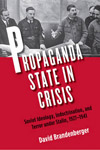
PROPAGANDA STATE IN CRISIS:
Soviet Ideology, Indoctrination, and Terror under Stalin, 1927-1941
by David Brandenberger
Yale University Press, 2011, 376 p.
The USSR is often regarded as the world’s first propaganda state. Particularly under Stalin, politically charged rhetoric and imagery dominated the press, schools, and cultural forums from literature and cinema to the fine arts. Yet party propagandists were repeatedly frustrated in their efforts to promote a coherent sense of “Soviet” identity during the interwar years. This book investigates this failure to mobilize society along communist lines by probing the secrets of the party’s ideological establishment and indoctrinational system. An exposé of systemic failure within Stalin’s ideological establishment, Propaganda State in Crisis ultimately rewrites the history of Soviet indoctrination and mass mobilization between 1927 and 1941.
Leaders of the Soviet Union, Stalin chief among them, well understood the power of art, and their response was to attempt to control and direct it in every way possible. This book examines Soviet cultural politics from the Revolution to Stalin`s death in 1953. Drawing on a wealth of newly released documents from the archives of the former Soviet Union, the book provides remarkable insight on relations between Gorky, Pasternak, Babel, Meyerhold, Shostakovich, Eisenstein, and many other intellectuals, and the Soviet leadership. Stalin`s role in directing these relations, and his literary judgments and personal biases, will astonish many.
The documents presented in this volume reflect the progression of Party control in the arts. They include decisions of the Politburo, Stalin`s correspondence with individual intellectuals, his responses to particular plays, novels, and movie scripts, petitions to leaders from intellectuals, and secret police reports on intellectuals under surveillance. Introductions, explanatory materials, and a biographical index accompany the documents.
This engrossing book explores the important role played by Stalinist cinema in legitimizing Stalinism and producing a new Soviet identity.
Evgeny Dobrenko, a leading scholar of Soviet cultural history, asserts that both Lenin and Stalin valued cinema as the most effective form of propaganda and “organization of the masses.” Dobrenko looks at Stalinist historical films and the novels from which they drew and shows that they transformed the experience and trauma of the past into a legitimizing historical narrative—the basis of a new mythology. He examines the works of the great film directors of the revolutionary period in Stalinist cinema—including Sergei Eisenstein, Vsevolod Pudovkin, Grigorii Kozintsev, Leonid Trauberg, Fridrikh Ermler, Mark Donskoi, and Mikhail Romm—and explains how they worked with time, the past, and memory to construct the Soviet political imagination.
Evgeny Dobrenko is professor in the Department of Russian and Slavic Studies, University of Nottingham. He lives in England.
Reviews
“The most impressive feature of this study is the research itself—Brandenberger’s work in the archives; second, his mastery of the vast body of published writings in English, Russian and German; third, his knowledge of relevant social science literature. . . . This allows him to trace the contours of policies and their results in greater detail and with more authority than any other work in the field.” George Enteen, Penn State University.
“What makes Propaganda State in Crisis stand out from other works on Stalinist ideology is Brandenberger’s ability to find a common thread in contemporary films, novels, party history textbooks, and internal memos that landed on Stalin’s desk. In other words, he writes the history of Stalinist ideology as cultural history, an approach that is not simply innovative, but one that brings excellent results. In his narrative we see how party intellectuals, writers, and filmmakers tried to guess, and were often able to influence, the party line, and how Stalin sometimes worked with them directly over the heads of the party’s professional ideologues. Finally, Brandenberger makes us reflect on the average Soviet person’s ideological world not just as a boring routine of political education circles, but as one that included the silver screen and widely-read novels as well. All in all, this is an outstanding contribution to literature on Stalinism,” Serhy Yekelchyk, University of Victoria


