Land and Maritime Empires
Source
The colonial character of the Russian Federation and the Soviet Union has been strenuously denied by both country’s leaders, elite and researchers. Even though the former polity and the 14 other post-Soviet nation-states (re-)emerged in 1991 because of the decolonization of the Soviet Union. Yet, in the literature on the subject, this momentous process of decolonization, which took place on the one-sixth of the planet’s land mass, is concealed through the noncommittal use of the descriptive term ‘breakup.’ It says absolutely nothing about the nature and causes of this process. In this view the Soviet Union was not decolonized, but ‘simply’ split, splintered or broke up, due to some unclear cuases.
Western partners and scholars have unthinkingly followed Moscow’s propaganda-driven and in essence mendacious opinion on this fraught political and historical issue. In their vast majority, they have also agreed with their Russian colleagues that the Russian Empire, which preceded the Soviet Union, was not any empire at all. After all, the tsarist bureaucracy never set up any imperial office and did not use the term ‘colony’ when referring to the empire’s far-flung areas inhabited by hundreds of colonized peoples. These multiple ethnic groups spoke (and sometimes wrote) a huge variety of languages and professed numerous religions.
Western observers are wed to the vision of maritime empires, as built and maintained for the past half a millennium by Western Europe’s colonial metropolises of Spain, Portugal, France or Britain. They fail to see land empires as ‘proper empires.’ Yet, the territorial vastness of Eurasia with the Arabian land bridge spanning it with Africa have yielded time and again extensive land empires since early antiquity. That was the case of Egypt, Assyria and, a bit later, of the Chinese and Roman empires. The Middle Ages in Africo-Eurasia were marked by the successive rises of Islamic, Mongol and Ottoman empires.

Source
It was only during the early modern period that Western European powers set out to win maritime empires. From their far-western peninsula of Eurasia, they had nowhere to expand overland, their access to the rest of Africo-Eurasia effectively blocked by the Ottoman and Russian empires. Western Europe’s nascent imperial powers overcame this land blockage by taking to the world’s oceans and seas. Grabbing pre-selected coastal areas of economic or strategic importance turned out cheaper and more effective than controlling and retaining land empires that come in a single ‘lump’ of contiguous territory.
In Europe, Russia is a modern exception to the maritime principle. With the employment of Western European colonial technologies, Moscow has instead pursued the conquest and construction of an empire extending over the Eurasian landmass. Western Europe’s colonial metropolises emulated the ancient Greeks in their seaborn efforts, while the Russians followed into the footsteps of the Romans, the Islamic Empire, the Mongols or the Chinese. It was these four imperial examples that decisively inspired the Russian image of what a ‘proper empire’ must be in spatial terms.
Russia’s Colonies
In the case of Western Europe’s maritime empires, the distinction between the metropolis and its colonies was easy to establish. The former was located in Western Europe, where it also functioned as a ‘normal European’ country, one among many, but most without their own overseas empires. Austria, Bohemia, Hungary, the Grand Duchy of Lithuania, the Kingdom of Two Sicilies, Prussia or Serbia belonged to this category, because they did not (successfully) construct maritime empires. On the other hand, Britain, Denmark, France, Portugal or Spain did not differ much from these early modern European polities with the sole exception of their burgeoning seaborne empires.
Source
It was the oceans that separated Western Europe’s imperial metropolises from their overseas colonies, the latter invariably located outside Europe. Yet, the situation of Russia’s colonies is different, as in most cases no vast body of water would insulate them from the European metropolis with its capital in Moscow. What has separated the Russian imperial metropolis from its colonies is the ethnoreligious difference and uninhabited or sparsely populated ‘empty, inhospitable’ and hard-to-traverse ‘ocean-like’ lands.
The founding of Muscovy at the turn of the 14th century was a half-colonial effort under the close watch of the Mongol overlords in the distant northwestern corner of their Eurasian empire. Muscovy’s Slavophone Orthodox Christians, east and north of their settlements, gradually subjugated the surrounding Baltic and Finno-Ugric ethnic groups. The Christian colonizers legitimized this conquest by the perceived ‘need’ to christianize ‘the heathens.’ A similar course of action was pursued then by the Teutonic Knights along the southeastern Baltic littoral or the Novgorod Republic in the northern areas extending between Scandinavia and the Mongol Empire (including, Muscovy).

Source
At that time Muscovy was not much different from other typical Eastern European polities, be it the Kingdom of Galicia–Volhynia, Grand Duchy of Lithuania, or Moldavia. The imperial turn arrived in the late 15th century. In 1478 Muscovy sacked Novgorod and seized the republic’s vast northern territories. In spatial terms, the republic’s area was three times larger than that of Muscovy. In the wake of this conquest, Muscovy extended from eastern Scandinavia in the west to the Urals in the east, and from the Arctic Ocean in the north to Moscow in the south.
Two years later, in 1480, emboldened Muscovy reconfirmed its independence in the successful stand-off with the Golden Horde’s armies. Subsequently, the Muscovites stopped paying the tribute to this local successor of the Mongol Empire. Meanwhile, the Novgorod Republic’s elite of merchants was exterminated, and the polity’s institutions dismantled. The Novgorod library and archive were burnt and razed to the ground. Thus, the republic’s very history was erased. In this manner, Muscovy’s first-ever settler colony was established. Muscovite boyars (nobles) replaced the republic’s proto-democratic institutions with autocracy. The largely shared Slavic language written in Cyrillic and the same religion of Orthodox Christianity facilitated Muscovy’s assimilation of Novgorod.
In the second half of the 16th century, Muscovy conquered Golden Horde’s successor states, namely, the khanates of Kazan and Astrakhan to the south and the Khanate of Sibir to the east. As in the case of Novgorod, the Turkic-speaking and Muslim elites were replaced with Muscovite boyars. The population at large were Slavophone and Orthodox or Muslim Turkic-speakers. In the latter case, they were pressed to convert to Orthodoxy, which subsequently often led to their Slavicization. Orthodox Slavophone settlers from the Muscovian metropolis followed, too, later known as Cossacks. So, the vast area – extending from the Siberian river of Ob in the northeast to the rivers Don and Volga in the southwest at their mouths flowing into the Black and Caspian Seas, respectively – was partly turned into Muscovy’s another settler colony. Partly, because to this day the Finno-Ugric-speaking Komis, Maris, Mordvins and Udmurts, alongside the Turkic-speaking Chuvashes and (Kazan) Tatars, and the Mongolic-speaking Kalmyks have preserved their ethnic identities, languages and (to a degree) original religions. On top of that, they enjoy their own (nominally) autonomous ethnic republics in present-day Russia.
In contrast, the eastward conquest of Siberia between the late 16th and the late of the 18th centuries (followed by that of Alaska at the turn of the 18th century) was a straightforward colonial enterprise. In many ways it emulated the maritime-style colonization pursued by Western Europe’s imperial metropolises, including numerous colonial genocides perpetrated against these ethnic groups, who dared to stand up to the Muscovian conquistadors. The sparsely populated areas of inhospitable Northern Asia were not separated from each other with vast bodies of water but by huge uninhabited tracts of tundra, taiga and permafrost. With the use of then unknown in these areas rifles and gunpowder Russian colonizers easily overpowered the local ethnic groups, disparagingly dubbed as инородцы inorodtsy (‘heathens’ or ‘natives’). The vastness of inhospitable empty space made travel or any projection of power time- and resource-hungry. Peaceful travel through the conquered lands from the imperial capital of St Petersburg to Kamchatka took anything between two and three years. By comparison, in the early 16th century, the first recorded circumnavigation of the Earth took Portuguese sailor Ferdinand Magellan three years.
After defeating Sweden in the Great Northern War, Muscovy transformed itself into a European-style Imperium Rossicum (Latin for ‘Russian Empire’) in 1721. At that time, the last territory gained in Europe itself was successfully turned into a Muscovian settler colony. Sweden’s sparsely populated and mainly Finno-Ugric-speaking Ingria was overhauled into the new Russian imperial capital of St Petersburg. During the 18th and 19th centuries, expansionist Russia turned into a successful and rapacious imperial power. St Petersburg conquered vast territories in Central Asia and Central Europe. Yet, none of them was turned into a new settler colony, apart from Circassia, or nowadays the Black Sea littoral region of Krasnodar Krai. All the newly-colonized areas were more densely populated in comparison to the Muscovian metropolis, and often more developed in the sense of technology and systems of governance. As a result, in most cases the peoples colonized by the Muscovites (Russians) managed to retain their cultures, languages, religions and histories.
Yet, in 1864, the Russian army exterminated the Muslim and Caucasian-speaking Circassians, while the survivors fled across the Black Sea to the Ottoman Empire. The Circassian mass extermination was then the biggest-ever colonial genocide perpetrated by a European colonial power. Only four decades later did Belgium surpass the Russian ‘achievement’ by halving Congo’s indigenous population. Slavophone Orthodox settlers who took over Circassia, including their descendants prefer not to remember about the Circassian Genocide.
Russia’s Reluctant Decolonizations
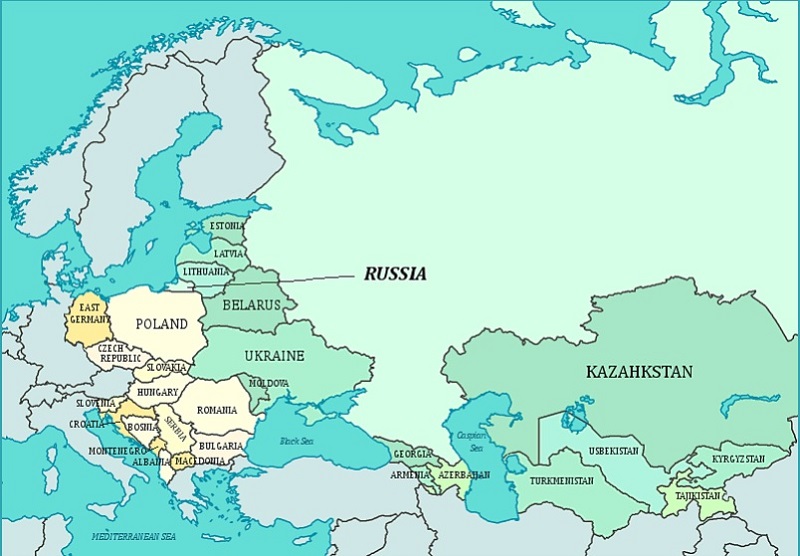
The Soviet bloc and the Soviet Union splintered
Source
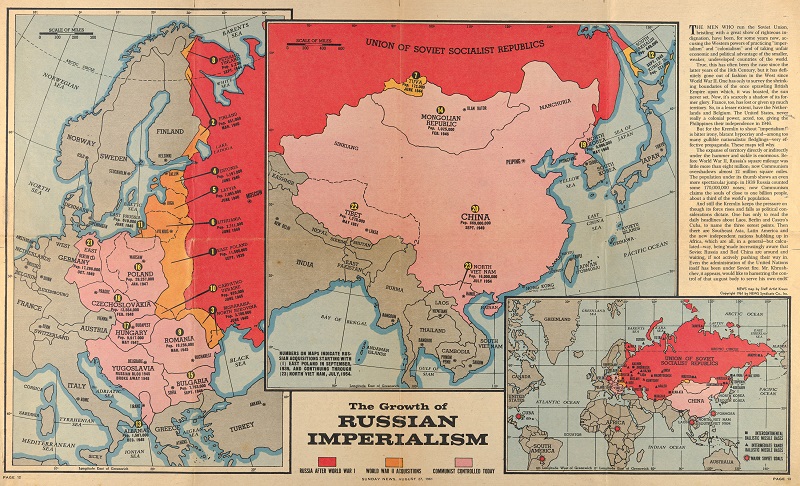
In the wake of the 1917 semi-decolonization of the collapsed Russian Empire-turned-Soviet Union, the Estonians, Finns, Latvians, Lithuanians, Moldavians (Romanians) and Poles managed to regain their freedom. It was possible thanks to the preservation of their identities and history, which prevented their Russification. The decolonization of the Soviet Union, which took place in 1991, returned freedom and their states to the Baltic nations of Estonians, Latvians, Lithuanians and also to the Moldovans (Moldavians), who had been recolonized by the Soviets during World War II. In addition, the disappearance of the Soviet Union granted independence to the Armenians, Azeris, Belarusians, Georgians, Kazakhs, Kyrgyzes, Tajiks, Turkmens, Ukrainians and Uzbeks.
However, the post-Soviet Kremlin drew the line in the course of this unexpected and unwanted post-Soviet decolonization at the cases of the (Kazan) Tatars and Chechens, who also strove for independence. The latter were re-subjugated in the two genocidal-scale wars fought between 1994 and 2001, while the former were gradually stripped of their autonomous prerogatives. Tatarstan was made into a de facto regular Russian province. This was a lesson enough for all the other ethnically non-Russian ethnic groups across today’s Russian Federation: not to dare to demand freedom or some – however gradual – form of decolonization. In Moscow’s official view, Russia is a unitary state, because it is not a colonial empire. Hence, no need for decolonization, whereas any attempts by an ethnic group to leave Russia are deemed a priori as illegal.
For instance, from the historical perspective, the situation of the Tuvans is more similar to that of the Baltic nations than to Chechnya. The Soviets grabbed the independent nation-state of Tuva only in 1944, when the West chose not to take notice, busy with fighting the Second World War. Like the Estonians or Lithuanians, the Tuvans wanted to regain their independence on the strength of their interwar (and wartime!) statehood, but the Kremlin declined to listen and no one in the West would come to the Tuvans’ succor anyway. After all, no one cared to help the Chechens, either, when the Russian army was carrying out a genocide of this nation to ensure Chechnya would not leave Russia.
Empire über alles!
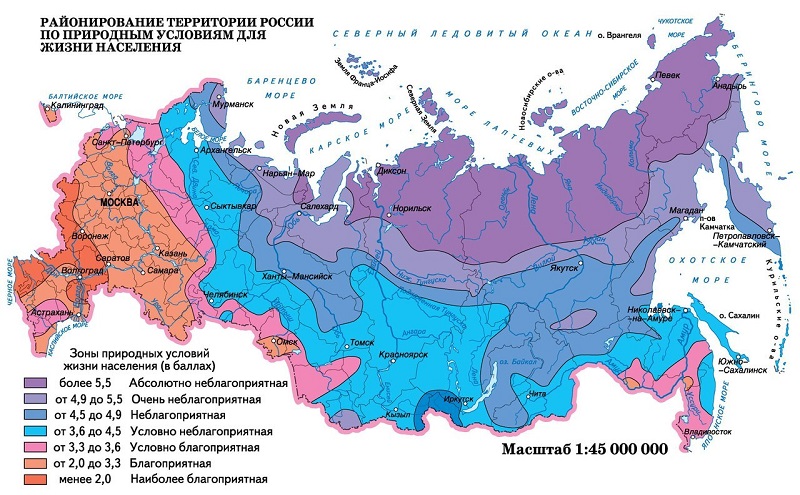
Why is Moscow so reluctant to decolonize? Why does empire remain such an attractive prospect to Russia’s elite and population at large? Structurally speaking, the Russian imperial metropolis tended to be poorer than many of its colonies, especially those located in Central Europe, the Caucasus and Central Asia. Losing such colonies meant becoming poorer for the empire’s elite. Decolonization would entail the loss of substantial revenue drawn from taxation and the exploitation of the economic resources. What is more, these colonies ensured much needed specialists and technologies not available in the imperial metropolis itself.
Source
The dilemma was like that of the late Portuguese Empire, where in the mid-20th century Angola and Mozambique were richer, technologically more advanced and socially more liberal than Portugal itself. Hence, under António de Oliveira Salazar’s fascist dictatorship the project of a tricontinental (European-African-Asian) nation-state of Portugal was announced. The goal was to hide the empire from the decolonized world’s view and to keep milking it for revenue. Only, the dictator’s death and decision to democratize Portugal in 1974 entailed letting the empire go.
The relative poverty and backwardness of the imperial metropolis explains why during World War II the Soviet Union strove to grab Finland, successfully reconquered the former tsarist empire’s colonies of Estonia, Latvia, Lithuania, Moldavia (Moldova) and Poland, and happily added to them the new undeclared colonies of Bulgaria, Czechoslovakia, East Germany, Hungary and Romania clad in the guise of the Soviet bloc. The same dynamics explains why, during the three post-Soviet decades, the resurgent Russian Federation grabbed bits and pieces of territory from Georgia, Moldova and Ukraine, de facto made Belarus into another Russian province, and now (that is, since early 2022) has been trying to conquer all of Ukraine.
The economic ‘rationale’ of the tsarist, Soviet and current Russian empire has been extractive economy, robbing the colonies irrespective of negative consequences suffered by the ‘natives.’ The imperial metropolis has grown rich on mineral and agricultural wealth drawn from the empire’s vast and hardly populated territories with the use of specialists and technologies drawn from the ‘rich’ (Western-style) colonies. In the current configuration, following the (partial) decolonization of the Soviet Union, the Russian metropolis is short of the latter type of colonies, namely, more developed and more densely populated than Russia proper (Muscovy) itself. That is why, Moscow is so intent on the swift and thorough vassalization of Belarus, conquering Ukraine and threatens to reconquer the Baltic republics of Estonia, Latvia and Lithuania, alongside the whole of Poland.
The Russian metropolis has been addicted to this imperial model of exploitative economy since the 18th century. Democracy necessitates decolonization, which is a mortal danger to the empire. That is why, despite their progressive propaganda, in early 1918 the Bolsheviks ended the short-lived democratic experiment and dispersed the Constitutional Assembly. Similarly, in post-Soviet Russia the attack of tanks on the Russian Duma (Parliament) in late 1993 spelt the end of any meaningful democracy in this country. In both cases empire won. Instead of genuine representation of the population’s will, the tsar was back, first as General Secretary (of the Communist Party of the Soviet Union), and now as President (of the Russian Federation). Recently some members of the Russian elite even seriously proposed to crown the current Russian President as Tsar.
Human Life is Cheap
The metropolis to hold as the empire’s undisputed center must enjoy full control of the effective monopoly of violence over the entire imperial territory and its inhabitants. The army, security forces and any paramilitary services, as approved by the president, are the state. When in place and fully functional, the threat of and the actual use of violence keep the empire’s three vital parts closely-knit together and in intensively productive synergy. Productive for the tsar and his imperial elite of oligarchs with their families. They number not more than 4,000, amounting to a mere 0.003 percent of Russia’s population of 145 million. This statistic translates into a steeper socio-economic pyramid than observed in tsarist Russia, where the nobility counted around 1.2 million, or a full 1 percent of the inhabitants. The Moscow-centered metropolis constitutes the top of the Russian neo-empire’s triangle of power. Meanwhile, this triangle’s two bottom ends are represented by the developed and populous colonies in the west, whereas in the east by the poor and largely uninhabited vast permafrost territories with their fabulous mineral wealth.
Violence, poverty and instability have prevented any dynamic population growth across post-Soviet Russia, while during the past century generated a deep demographic slump in the Soviet Union’s Russian metropolis. This type of imperial organization, as observed in Russia, is human lives-hungry. The Soviet system of gulag concentration and extermination camps illustrates this tendency aptly. Slave labor, enforced through repression and coercion, translated into industrial development as required and planned by the ‘Soviet tsar,’ sitting on the party’s throne in Moscow. The required swift completion of the White Sea canal or another gargantuan construction project necessitated the loss of hundreds of thousands of lives. Likewise, similar numbers of Soviet citizens rounded up and summarily executed by the shot to the back of the head ensured the stability of the ruling system and the population’s ‘unwavering loyalty’ to the Soviet tsar and the empire. Ideologically ‘saveable’ people were imprisoned by the millions so that these ‘reluctant communists’ would know how to do their best for the system in exchange for mere survival after their release from the camps. Fear and anomy coalesced into the steel backbone of the Soviet empire, resulting in the unprecedented levels of social atomization.
In the Russian empire there is no place or patience for individuals, their opinions, personal needs or character quirks. State planners and statisticians cast them in the role of pliable ‘population,’ or even in more dehumanized terms, as ‘human biomass.’ They become a mere ‘it,’ or this fertile compost of politics and economy on which the wealth of the imperial elite grows and thrives. The Soviet Union won on the eastern front in World War II by throwing unprepared millions of troops against the German armies and summarily executing those who dared to withdraw, escaping sure death at the enemy’s hands. In most cases it was not technology or tactics that gave the Soviets their military victories but the deployment of numerically overwhelming human biomass, also known in the West as ‘cannon fodder.’

Source
At present, the Kremlin uses the same ‘approach’ in the ongoing war against Ukraine. Waves of apparently ‘inexhaustible’ human biomass are thrown time and again against motivated and well-trained individuals, that is, Ukrainians who are defending their homeland. The Russians see the ongoing fighting as a ‘meat grinder’ (мясорубка miasorubka) into which draftees (чмобики chmobiki ‘draftees of the partial mobilization’), or the aforementioned ‘biomass,’ is fed. Terror and destruction against human rights and democracy. Fear and awe in preference to rule of law. Unimaginable prosperity for the few, while propaganda and lies about ‘patriotism’ for the rest, this self-reproducing biomass.
The empire run in this manner must all the time win new territories with a lot of inhabitants for the purpose of gaining more people, whom to feed into the imperial machine, so it does not stall. It is not a perpetuum mobile. Human lives are the Russian empire’s only fuel.
What a Future?
The Russian empire ensures an exquisite standard of living and lavish consumption for the unprecedentedly tiny imperial elite. They enjoy this rarefied life as quickly as possible because a new tsar on the top may end it all in no time. No time to stop and think, or to change the gear as their counterparts once did in the tricontinental Portugal in 1974. Genuine democratization would disrupt Russia’s imperial triangle of power. The colonies would go their own independent ways. In the wake of the decolonization, the metropolis would have no choice but to become a ‘normal country,’ with wealth and opportunities spread out more equitably and accountably. Perhaps, a decolonized Russia would be poorer and less successful than Russia’s former western colonies. Even some of the erstwhile Siberian colonies if governed prudently may ensure better life for their inhabitants than Moscow or St Petersburg. Hence, in a normalized Russia cut to size, the ruling class would need to follow the wishes of the citizenry.
But who among the high-flying imperial officials would like to listen to the biomass? ‘Long live the empire!’ is present-day Russia’s rapacious reply. The Russia of the tsar and his oligarchs ‘must go on.’
Prepared for the website “Ukraina moderna”. Published for the first time. The publication uses illustrations from open sources.