
Ця публікація також доступна українською мовою
The ongoing invasion of Ukraine has transformed the landscape of European migration, making Ukrainians the largest group of arriving asylum-seekers. This group is distinct by its demographic makeup – predominantly women, the elderly, and children – and its unprecedented transborder mobility. In this blog post, I add some reflections to the controversy in migration studies as regards the differential treatment of Ukrainians refugees, and propose to consider this new refugee regime as a glimpse into “Post-Dublin” Europe.
After February 2022, Ukrainians benefited from an indiscriminate reception and an expedited temporary protection process. This contrasted sharply with the challenges faced by other asylum-seekers who had to invest substantial funds in their perilous journeys, confront life-threatening risks during pushbacks, and endure protracted waiting within the legally-entrenched system of the “Fortress Europe.” In this context, the ability of Ukrainians to choose their destination and the facilitation of their access to job markets, housing, and social services may have seemed unjust, prompting questions about whether it resulted from a deliberate choice or a convergence of various factors.
Understanding facilitated transborder mobility: a unique configuration of Ukrainian citizenship within the EU
In recent debates the facilitated mobility for Ukrainians is associated solely with the Temporary Protection Directive (TPD) – a legislative tool that has been activated by the European Council in response to the Russian aggression. Nevertheless, even if this directive had not been activated, Ukrainians would have demonstrated a significantly distinct pattern of transborder mobility compared to other refugee groups. This is due to two main factors.
Firstly, since 2017, the possession of a biometric passport has granted Ukrainians intra-European mobility entitlements similar to a short-term Shengen visa. This provision – a result of a decade-long campaign by Ukraine at the European Council – was incorporated into the Ukraine-EU Association Agreement (2017) that followed the Free Trade Agreement (FTA). Consequently, Ukrainians’ ability to enter the EU predates the war, distinguishing them from asylum-seekers lacking legal travel documents, and positioning them closer to full European citizens, albeit with some notable exceptions. While the FTA facilitated the movement of goods and capital from Ukraine, it didn’t grant Ukrainians full membership in the European political community. Since 2017, Ukrainian citizenship has taken on characteristics of “semi-” or “quasi-European” status. In this capacity – that could be described as a “child-like” or “infantilized” form of EU citizenship – Ukrainians qualify for protection but find themselves excluded from active participation in decision-making processes, particularly those related to their migration status – as other groups of refugees. This issue will rise again in March 2025, when the TPD will expire.
Secondly, TPD or not, Ukrainians would still qualify for individual international protection under the EU law. The subsidiary protection, distinct from asylum, regulated by the Geneva Convention (1951) and New York Protocol, covers threats to life or person due to indiscriminate violence in the international armed conflict. For other asylum-seekers from war zones, eligibility hinges on admissibility interviews that provide or deny access to European territory. These interviews are carried out mostly in reception centers located in the border zones (Greek and Italian islands, Balkan countries). Ukrainians, due to the nature of the invasion, but especially due to their prior Schengen status, were deemed eligible by default.
“Ukrainian exceptionalism”?: between Schengen travelers and asylum seekers
After February 2022, and perhaps for the first time since the Nansen passport, Europe witnessed a wave of refugees who were not considered “illegal migrants” or “undocumented asylum seekers”, but rather legally mobile refugees, whose circulation was not restricted by their lack of visa. This resulted in a form of “refugee tourism” which merged two opposite and formerly mutually exclusive categories: the “free traveler” and the asylum-seeker. In addition, the quasi-European character of Ukrainian citizenship bypassed the Dublin regulations, which oblige to request asylum only in the country of first entry. This rule did not apply to Ukrainians (as it is the case for unaccompanied minors of all origins), precisely because their mobility was not restricted by the absence of a valid travel document. Ukraine has more than 1000 km of borders with countries of the European Union, and these borders were mostly open.
Therefore, it is important to acknowledge that the effect of “Ukrainian exceptionalism” did not arise from an unprecedented generosity on the part of European governments, but rather from a complex combination of historical contingencies, lacunas in international law and rational policy choices made in response to an influx of a new type of refugees, whose mobility European governments were not able to restrict.
This insight provides a nuanced perspective on the prevailing belief that the facilitated status of Ukrainian refugees is solely a result of the racial and religious hierarchies ingrained in the European border regime. While it does not invalidate the exclusionary and racialized nature of the “Fortress,” it highlights that Ukrainians managed to navigate it due to an interplay of factors, with their citizenship status playing a significant role, beyond considerations solely based on ethnicity, religion, or skin color.
An experiment in Europe after Dublin regulations?

In conclusion, what the Ukrainian case highlights is the importance of considering regional governmentality and historical contingency when examining the production of the refugee regimes. Rather than promoting potentially divisive notions of “Ukrainian exceptionalism”, it should be perceived as a “loophole” in the Fortress Europe, and a concrete experiment in “post-Dublin” Europe. This experiment shows the benefits of allowing asylum seekers to freely choose their country of destination, temporarily return to their country of origin and exercise their right to move within the EU, even for a limited period. Furthermore, the Ukrainian case serves as a compelling argument for former colonies to advocate for free circulation rights between their territories and the former metropolis, as a form of compensation for past exploitation and extractive practices. Such rights could safeguard their citizens during times of armed conflicts. As Ukraine progresses toward EU membership, it should actively support these negotiations, possibly taking the lead.
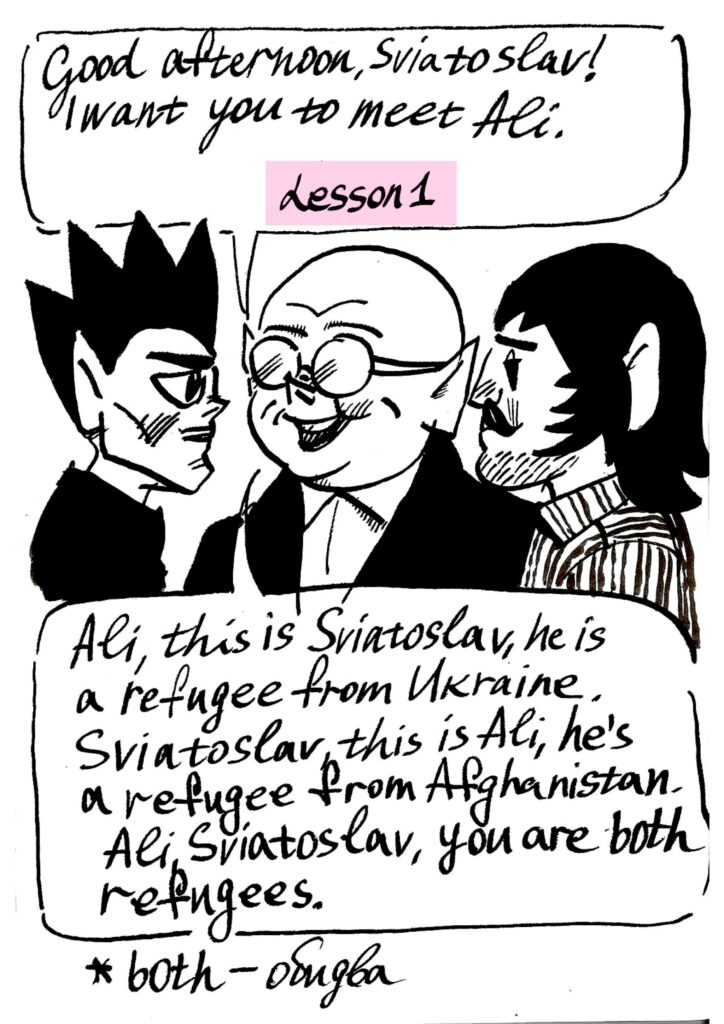
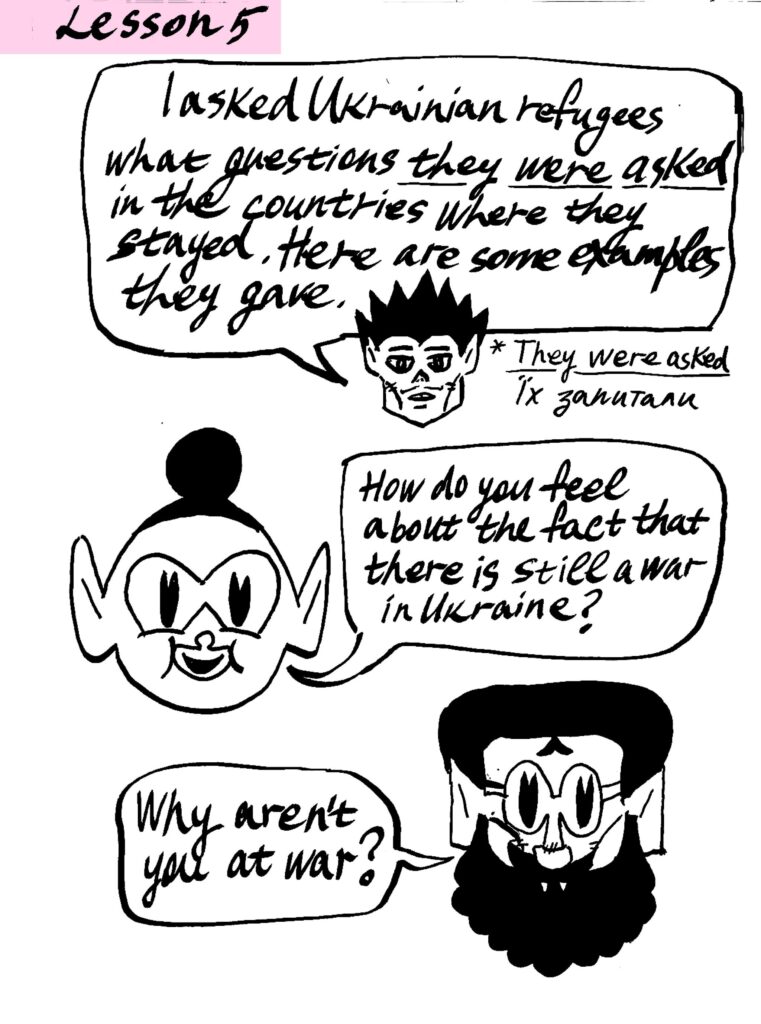
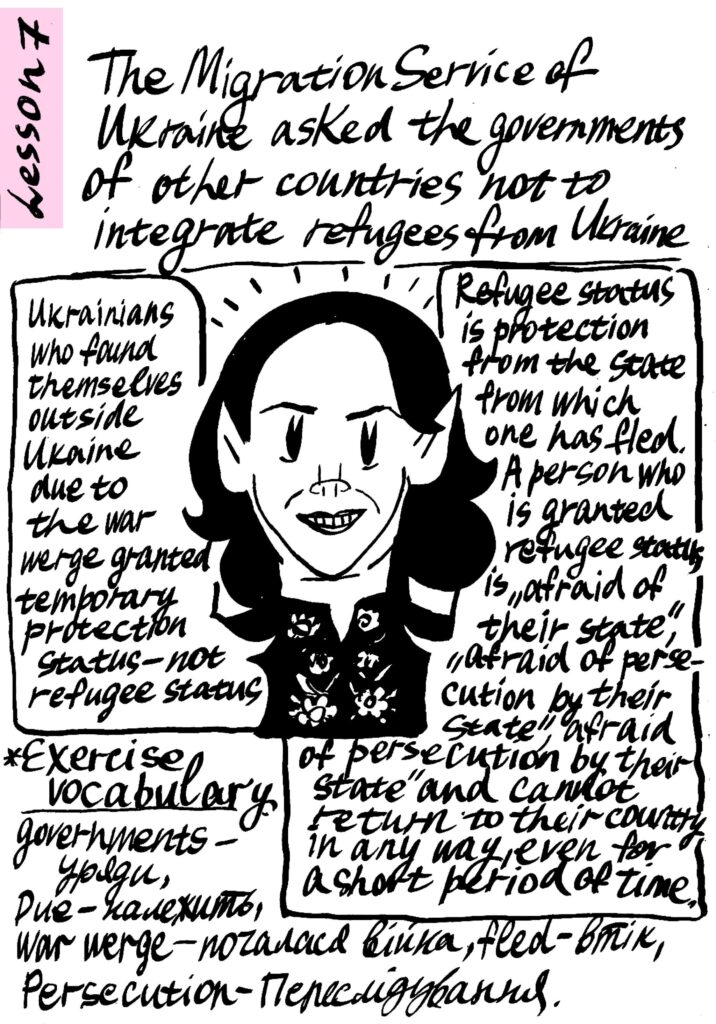
This article has been first published as part of the NCCR-On the move (University of Neuchâtel) blog series. It is illustrated by excerpts from the graphic book “English Integration Course for Ukrainian Refugees, A2” (2023) by Anatoliy Byelov, a Ukrainian artist.
Anatoliy Byelov – Ukrainian artist, graphic designer, and musician, frontman of the band “Lyudska Podoba.” Since 2024, he has been living and working in Poland. The text of the article is illustrated with fragments from his graphic book “English Integration Course for Ukrainian Refugees, A2” written during his stay in Austria after the full-scale invasion in 2022.