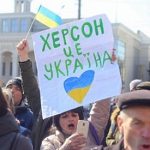

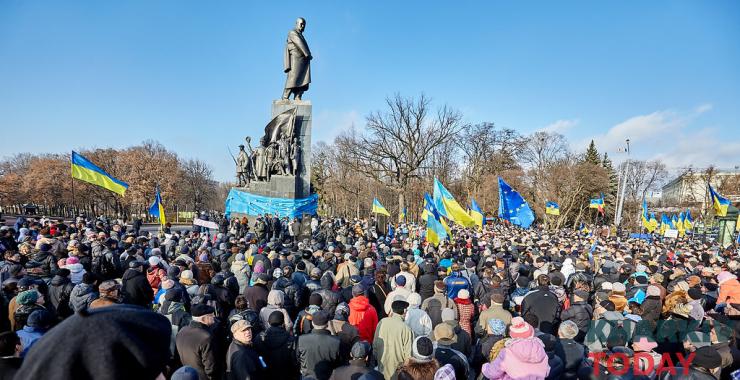
The events of “the Revolution of Dignity” (2013–2014) initiated profound pro-cesses in Ukrainian society in terms of rethinking its many identities. Who are we? Where do we come from? Where are we going? These paradigmatic questions arose for a society that had ceased to be Soviet after 1991, before it fully understood what it meant to be Ukrainian. Russia’s full-scale aggression against Ukraine on February 24, 2022, however, made reflecting on such issues more urgent. Central to this reflec-tion is the problem of understanding the cultural and historical heritage that had accreted under the longue durée of the Russian Empire’s colonial presence in Ukraine, from the second half of the eighteenth century to the early twentieth century, and the USSR’s assumption of similar ambitions of empire here from the 1920s to 1991.To illustrate the problem of the urgency of identity formation under an existential neo-colonial threat, we focus on Kharkiv, the second-largest city in Ukraine, which for a long time held the mythical status of the “capital of Ukraine”. As the capital of Soviet Ukraine, Kharkiv could be described as having been a city of migrants since the early Soviet period. The processes of modernisation in the second half of the nineteenth century, industrialisation in the 1920s and 1930s, and post-war reconstruc-tion and urbanisation in the 1970s and 1980s never ceased to attract new residents. Rural dwellers from the outskirts, engineers and other specialists, military personnel and students all moved to Kharkiv, entering the “melting pot” of historical memory, integrating into its infrastructure and developing it too. This “city on the frontier” received new residents from Left-Bank Ukraine, its South, Donbass, certain regions of Russia and elsewhere, all migrants who brought with them their family stories and memories and found a home and a life there. Many achieved professional success and a few found fame in the USSR; all of this was contributing to the city’s particular image in this period. The image of a city, of course, depends on one’s perspective: Kharkiv had been a frontier fortress in Cossack times; a provincial, industrial and educational centre in the period of Empire; and a mythologised “first capital” in the Soviet period. Moreover, the modern image of this city was continually being formed even over the last decade; this unfinished project has not ceased even now, as the city remains subject to the menace of Russian missile shelling.
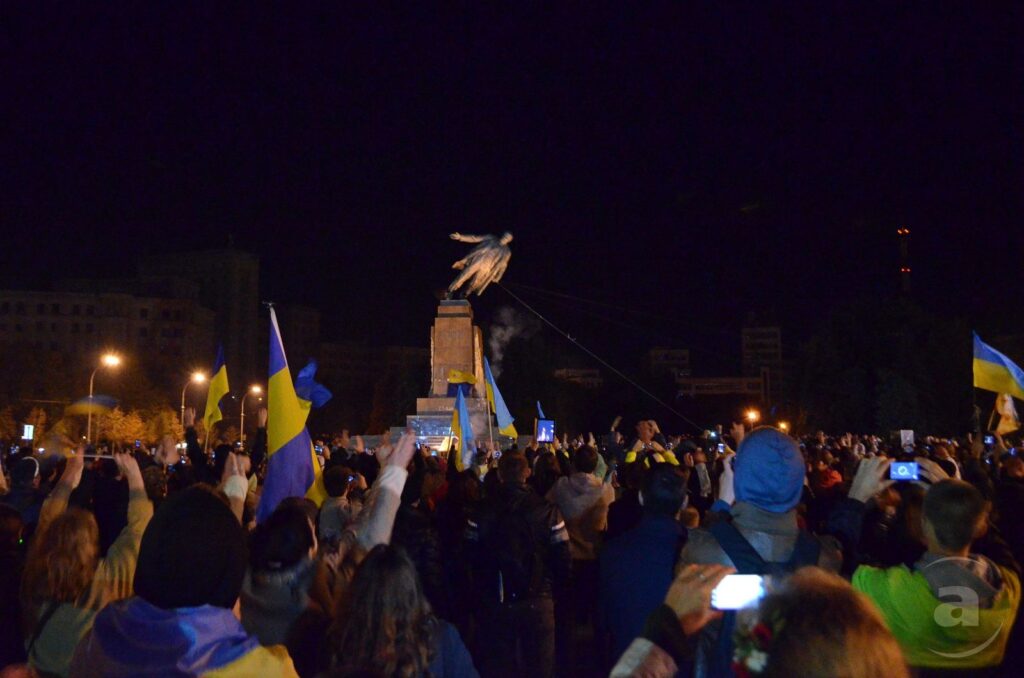
September 28, 2015. Mediaport.ua
In an attempt to confront the competing claims for what kind of Ukraine was possible, several laws were passed in Ukraine between 2014 and 2019 that condemned the crimes of the communist regime and put on the national agenda a need to rethink not only one’s own past in the twentieth century, but also the modern representa-tion of this past in the public arena [1]. These laws came to be known collectively as the “decommunisation laws”, and they had their apologists, their sceptics and their critics. The laws prohibited the use of Soviet symbols; the hammer and sickle, the Soviet star, the toponymical usage of names of historical figures who had once held state and party positions, and they expanded access to archival documents from the Soviet era, among other initiatives. The main promoter of these changes in law was the Ukrainian Institute of National Remembrance, the central body of executive power. The Institute’s vision of the past has held that the seventy-year history of Ukrainian lands within the USSR has been one of “Soviet occupation”, a conclusion that replicates a gradual shift in historical politics to conflate anything “Soviet” with everything “Russian” and, by association, “foreign” and “hostile”. This conflation comprised all public symbols, including street names and monuments. Thus what had been Soviet became read as something imposed from outside and against the will of Ukrainians. Such an interpretation, of course, was based on an appeal to the final defeat of the short-lived Ukrainian People’s Republic in 1921 by the Russian Bolshevik Red Army and the occupation of West-ern Ukrainian lands (formerly the Polish Eastern Borderlands) in 1939 by the Red Army. The practical manifestations of this tendency to meld the “Soviet” and the “Russian” could be seen in the policy of mass renaming of toponyms in populated areas of Ukraine, the demolition of monuments of Soviet figures, and the erasure or removal of communist symbols from building facades in public spaces. Following on from the eradication of Stalinist monuments from the 1960s (more about that later), for instance, Lenin’s turn would come when people sought more examples of this “Soviet imposition” to destroy, all of which generally outlines the features of decommunisation as a process. Within the framework of this policy, then, this so-called “Leninopad” began as a mass demolition of monuments to Vladimir Lenin in Ukrainian cities and towns, one that recalled the 1950s Soviet de-Stalinisation that had brought so many of Lenin’s statues to Ukraine to replace Stalin’s many memorials. While initially a grassroots movement, instigated by certain people in villages and towns who were enthusiastically destroying monuments, the Leninopad gradually became a (reasonably controlled) top-down process.

Photo by Konstantin Nemichev. Suspilʹne Kharkiv
The monument cannot be preserved/be dismantled
Monuments to Vladimir I. Lenin had been erected in almost every city of Ukraine in the 1960s, ‘70s and ‘80s, and stemmed from changes in the historical policy of the USSR that rolled out a process of de-Stalinising Soviet society in the wake of the Soviet dictator’s death. Rejecting the cult of Josef Stalin, Soviet authorities promul-gated a new mythos, through the image of Lenin and the saga of “the Great Patriotic War” (1941–1945). It is significant that the initiators of such a commemoration were often representatives in local authorities who were demonstrating party loyalty [2]. Such is the drama of history that in the 1990s, at the beginning of Ukraine’s independence, that a similar process was undertaken to dismantle these newer monuments to Lenin, mainly in the West of the country at first. Across the disintegrating Soviet bloc, comparable erasures of memorials took place, in the Baltic countries and beyond, spurred on by the Velvet Revolutions in the late 1980s and early 1990s. During “the Revolution of Dignity”, this process took place in the cities of the Centre, South, and East of Ukraine. This effacement often took on a sponta-neous character when public activists decided to dismantle these objects on their own. Such monuments were typically not governed by any city authorities, were not municipal property and were not included in the register of national monuments. In Kharkiv, a monument to Lenin was located in the centre of the square from 1963–2014, and was the site for several memorial moments in modern Ukrainian history. It is noteworthy that it was only included in the State Register of Immovable Monuments [3] in 2013, while in the city’s promotional video for the Euro 2012 Football Championship bid, it was completely erased from the footage. In 2014, too, the area around the monument in Kharkiv became a site of confronta-tion between “pro-Maidan” and “anti-Maidan” forces. After the demolition of the Lenin monument, a cross was installed on the pedestal in its place, and by 2019, a fountain finally replaced the monument. The practice of “Leninopad”, however, was unevenly implemented, as seen, for example, in the continuing presence of the figure of the Soviet apparatchik, Mykola Skrypnyk, in the public space of Kharkiv. Skrypnyk, who belonged to the top party and state leadership of the Ukrainian SSR (and had been the head of the Bolshevik government in Ukraine, and the People’s Commissar [Minister] of Education), had pursued the so-called “Ukrainisation” policy during the 1920s and 1930s, and had committed suicide against the back-ground of Stalinist repressions.The most powerful conflict of memories from 2014 arose around the statue of Georgi Zhukov, the Soviet military figure who became famous as the Soviet “Marshal of Victory”. Facing a post-Soviet ideological vacuum in the early 1990s, city elites united the community around the more comprehensible and familiar historical myth of the Great Patriotic War with Zhukov as its figurehead. In particular, the bust of Zhukov was installed in the city’s residential area, and the avenue and the metro station were renamed in his honour, while a second bust was also installed in the lobby of the metro station. Against the background of “the Revolution of Dignity” and decommunisation, there was a reinterpretation of the image of Zhukov from “the Marshal of Victory” to a “bloody executioner who did not value the lives of soldiers” [4]; the metro station was renamed in 2016, and the bust was covered with a false wall. A group of activists tried several times to dismantle the bust on the avenue and petitioned to rename the avenue in honour of Petro Hrygorenko, a human rights activist and member of the Moscow and Ukrainian Helsinki groups who had advocated for the rights of the Crimean Tatars. However, the city authorities were in no hurry. In the end, after several appeals to the court, Petro Hrygorenko Avenue received its current name. The monument, however, remained until the spring of 2022, until – even subject to the conditions of war – the memorial was dismantled by representatives of the Ukrainian military forma-tion and taken to an unknown destination. Under martial law, the city authorities commented that their position on the incident was that it displayed “inappropriate timing” and left it to the community to decide the monument’s fate after the end of hostilities. Kharkiv’s attempts at rethinking history can thus be characterised as uneven or fluid, as many actors and stakeholders tentatively have probed the limits and requirements of what may or may not be remembered.
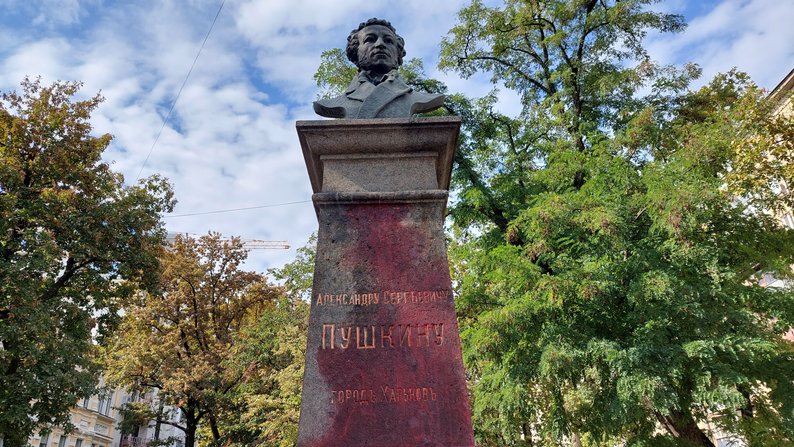
Photo by Suspilne Kharkiv
Decommunisation Kharkiv-style is also notably prone to “neutralising” Soviet toponyms, where the old name is kept, but with a new meaning invented for it. Shevchenkivskyi district provides an example. There is a lane, these past two hundred years, in the central downtown area called Iarmarochnyi. At one point, around 1850, its name was changed to Monastyrskyi. In the early 1920s, the Bolsheviks renamed it Spartakovskyi, its namesake recalling the Spartakusbund – a German league of Marxists. Then in 2016, decommunisation came and the city council chose to ignore the pre-revolutionary toponyms (Iarmarochnyi and Monastyrskyi), finding instead a new namesake for the lane. So it was “renamed” Spartakovskyi, to commemorate Spartacus, a leader in the Third Servile War. Neither the Thracian gladiator nor the German Communist league, however, are in any way connected to Kharkiv. Still, the “decommunisers” were appeased, even though nothing had changed, which goes some way to demonstrating how difficult a “rational” policy of re-remembrance can be. According to Mariya Takhtaulova’s calculations, 268 urban names, seven administrative districts and six metro stations were renamed in the city [5]. Fundamentally new names of toponyms have also appeared as well, dedicated to the heroes of the social activists who died during “the Revolution of Dignity” in Kyiv in 2014 and known as the Heavenly Hundred. Other toponyms remember Ukrainian soldiers who died during the Anti-Terrorist Operation (now The Joint Forces Operation, military operations in Donbas and Luhansk region against separatists 2014–2019). As a result of the current war, with an increase in the number of fallen defenders of Ukraine, this trend toward renaming is becoming increasingly relevant.

“Is Pushkin to blame that Putin was born?”
The current full-scale Russian aggression against Ukraine has turned the page in the reinterpretation of historical heritage. The processes of decommunisation received a new, more powerful impulse, transforming it into a broader trend – decolonisation understood now as de-Russification. De-Russifying or decolonising Ukrainian local public spaces, in Kharkiv in particular, raises important questions of understanding regarding the origin of the modern citizenry of Ukraine and its cities in the South and East of Ukraine. Such cities as Dnipro, Zaporizhzhya, Mykolaiv, Kherson, Odessa, Donetsk, Luhansk, for instance, all developed in line with Russian Imperial policy, from the second half of the eighteenth century to the beginning of the twentieth century and the rise of the USSR. In fact, the infrastructure and public spaces of these cities were created from scratch precisely within that timeframe. As we have seen, according to some recent interpretations, all Russian imperial and Soviet symbols must be read as foreign, that in fact these Ukrainian cities are without cultural herit-age, either because any extant Russian/Soviet public culture suppresses Ukrainian heritage, or because Ukrainian cultural heritage is inescapably wedded, for better or for worse, to this colonial imposition of “high” cultural elements from elsewhere. This ambivalence towards the symbolic artefacts of Russification has opened up a wide arena for discussions about what image, what stable symbolic face, the region and the city of Kharkiv deserve.
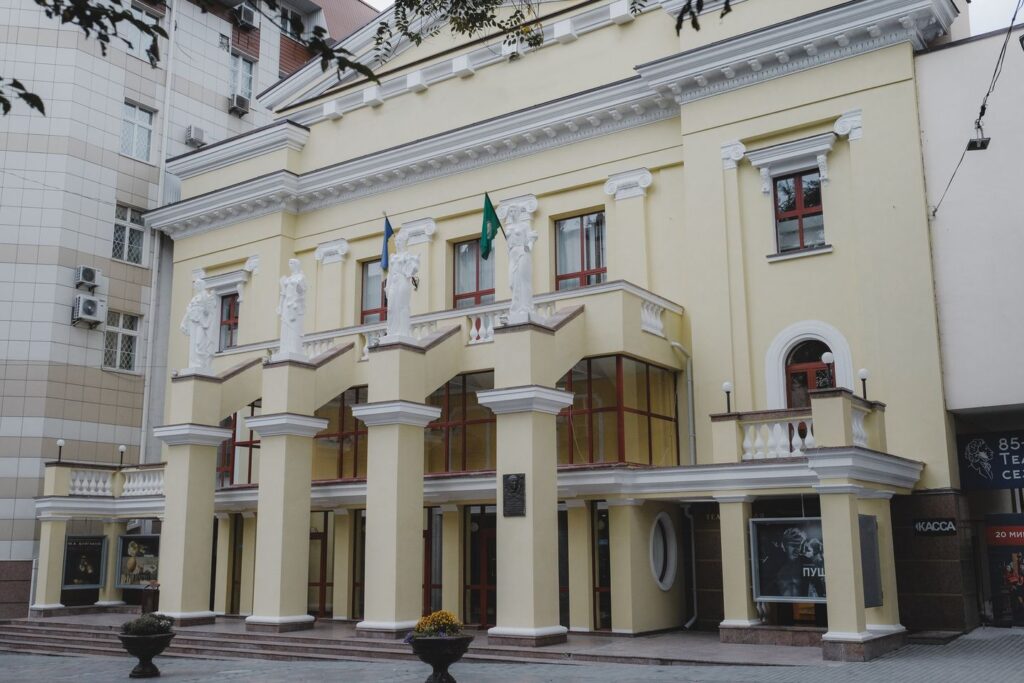
What is called “decolonisation”, then, in public discourse, revolves around the erasure of Russian culture and its representatives, in particular the Russian poet Alexander Pushkin, the writer Leo Tolstoy, and the writer and playwright Mikhail Bulgakov. However, any tour of Ukrainian cities would, until recently, have yielded a rogues’ gallery of other such Russian “exemplars” lionised in concrete or cast form. Supporters of this direction of “decolonisation” argue that the Russian Empire, and later the USSR, both tried to remake Ukraine in their own image. Monuments to Pushkin were the most common imperial addition to many Ukrainian cities, and were erected not only during the period of the Russian Empire, but also during the Soviet era; Kharkiv was no exception in this.2 In 2022, there was a wave of “Push-kinopads” in Ukrainian cities (evoking the former “Leninopads” in character and intent), when proactive figures from civic society and from the city government [6] sought to remove the many monuments. In Kharkiv, the monu-ment was dismantled by the city’s public services on November 9, 2022. Here we can observe the reaction of the city elite to a powerful public demand; if, in the spring of 2022, they did not pay attention to the egregious bust of Zhukov, saying the problems of urban toponymy were being addressed “at the wrong time”, then later in the autumn, the city leaders themselves initiated the process of dismantling Pushkin’s monument. We do not know whether the opinion of the city leaders has changed, but we can state that public opinion has changed, becoming so powerful that it has become impossible to ignore it. Passionate “battles” for the recoding of urban space continued around Kharkiv’s Academic Russian Drama Theatre as well, also named after Pushkin. The council has several times looked for and found vari-ous reasons not to change the name, and even when it came to taking a decision, the regional council deputies failed to vote [7]. Kharkiv residents then created a petition addressed to President Volodymyr Zelensky, urging his interven-tion in the situation and, as a result, on December 24, 2022, this theatre changed its name to “Kharkiv Academic Drama Theatre”.
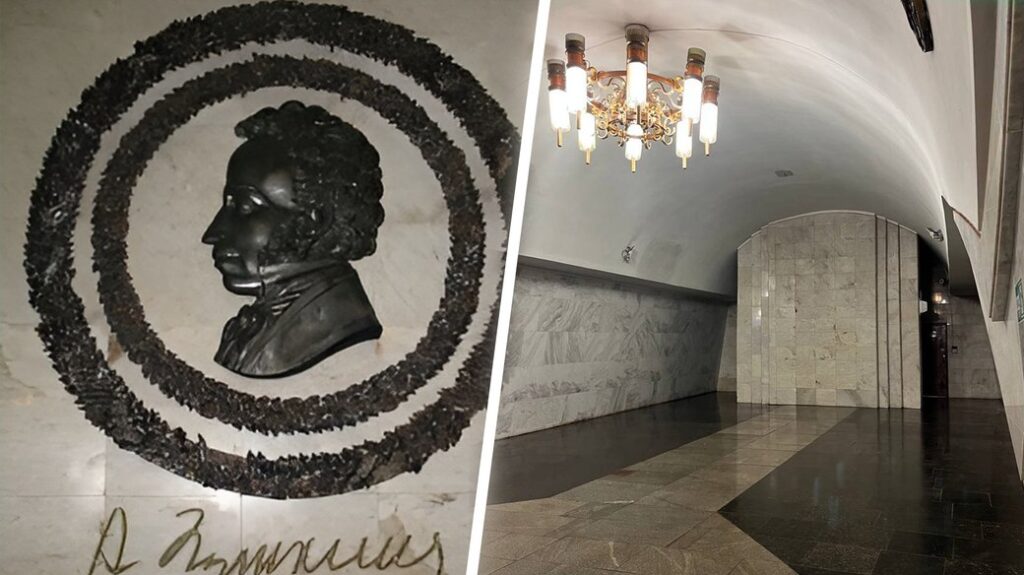
Photo Decolonization. Ukraine by Maxim Tsvelikh. Suspilʹne
On January 23, 2024, Russians fired three times at civilian infrastructure and residential areas in Kharkiv. Dozens of people were killed and injured, and hundreds of buildings were damaged. On Pushkinska Street, the building of the National Academy of Legal Sciences of Ukraine and the dormitory of the Yaroslav Mudryi National Law University, as well as residential buildings, were damaged. These events prompted the city authorities to decide on a large-scale renaming of city streets. On January 26, 2024, an extraordinary session of the Kharkiv City Council decided to rename 65 streets in the city. Among them, Pushkinskaya Street was renamed. It now bears the name of Hryhorii Skovoroda, a prominent Ukrainian philosopher and poet of the 18th century. This symbolic action is aimed at demonstrating the decisive separation of the Ukrainian city of Kharkiv from Russian culture. It should be noted that the historical name of the street was German.
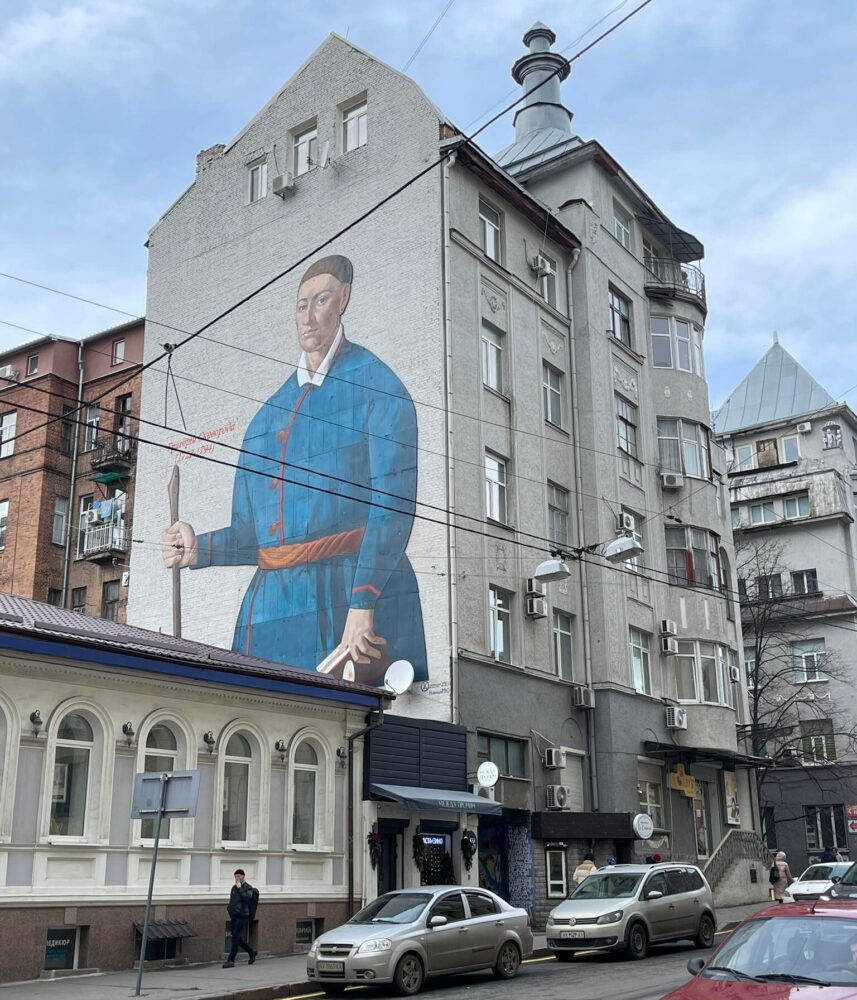
Photo by Anastasia Khudyakova. Kharkiv Times
Instead of conclusions
The Revolution of Dignity”, which initiated the process of decommunisation from 2014–2019, raised this issue of how we might distinguish the face and image of a city through (updating) toponyms and monuments. Although such updating was not carried out systematically in Kharkiv, changes in the city space did become noticeable. Implementing a process of renaming, the authorities followed several strategies: to return urban toponymy to pre-Soviet names, i.e. to those names from the time of the Russian Empire; to search for new meanings in old Soviet names (in most cases unsuccessfully, whereupon these objects were renamed anyway); to formulate new names (figures of Soviet science and culture, who were in some way related to Kharkiv); and to include new heroes in the toponymic map of the city, such as heroes of the Heavenly Hundred and servicemen who died in the anti-terrorist operation. After the start of decommunisation and with the beginning of the Russian attack on Ukraine, naming and commemorative practices concerning specifically Ukrainian historical figures who better represent Kharkiv as the core of the Ukrainian national project, began to appear in the city. Powerful examples include a monument to Ivan Sirko and Petro Sahaidachny, seventeenth-century Cossack leaders; murals depicting Taras Shevchenko, a Ukrainian poet, artist, and central figure of the nineteenth-century Ukrainian national revival; and Hryhorii Skovoroda, an eighteenth-century Ukrainian poet and philosopher.The full-scale invasion of Ukraine by Russia in 2022 has further activated Ukrainian society, and in particular the public of Kharkiv, who have raised the issue of how to decolonise the city’s urban space. They have queried how, too, to free the city from symbolic connections with Russia, by dismantling, for instance, visible symbols that could be interpreted as Soviet or imperial ciphers. Clearly, war as an extreme experience radicalises society and leave little room for nuance. Under martial law, while real missile attacks destroy the city space and its infrastructure, public opinion is becoming aimed at “demonising” the image of the enemy, to create a “natural” distancing from everything related to the aggressor. This impels us to discuss more explicitly how to read and understand the palimpsest of colonial legacies that have impacted Ukraine. Is there any rhetorical space for us to ask questions about Soviet cultural heritage as one of the elements in the formation of Ukraine’s own mature narrative? Is there a narrative that could correspond to the self-representation of Ukraine as a modern European state, one that understands the role of its complex history as takes its place in the community of contemporary nations?
The publication uses photos provided by the Authors.
This text is an adapted version of the article: Zaharchenko Yevhen, Roman Liubavskyi. The cultural space of the city on the frontier: Kharkiv during decommunization and the war // Etnografia Polska, vol. 67, no. 1–2, 2023, p. 219-223. Reprinted with the permission of the volume editors.
References
- Per Anders Rudling, Christopher Gilly 2015, Laws 2558 and 2538-1: On Critical Inquiry, the Holocaust, and Academic Freedom in Ukraine (accessed 15.02.2023).
- Gayday Oleksandra 2018, Kamianyi hist. Lenin y Tsentralnii Ukraini, K.I.C, Kyiv.
- Reyestr pam’yatok kul’turnoyi spadshchyny. Kharkivs’ka oblast’ (accessed 15.02.2023).
- Salimonovych Larysa 2019, Kaput to Zhukov: How the Monument to the Bloody Marshal was Demolished in Kharkiv (accessed 07.11.2023).
- Takhtaulova Mariya 2017, Kharkivs’ka toponimika: etapy dekomunizatsiyi, Misto. Istoriya. Kul’tura. Suspil’stvo, no. 1, p. 149.
- Rudenko Yevhen 2022, Special Operation “Derussification”. Interview with Vakhtang Kipiani, Editor-in-Chief of Historical Trut (accessed 07.11.2023).
- Kotubey Olesya 2022, Both the “Russian” and “Pushkin” Theaters Were Left: Kharkiv Regional Council Refuses to Rename Drama Theater (accessed 07.11.2023).