The Role of Nazi Propaganda in Galvanizing Germany’s Eastern European Expansion
The Second World War is one of the most tragic episodes in the history of mankind. But how did it happen that the Germans, who suffered quite a bit during the First World War and throughout the 1920s and 1930s were afraid of a new war, unleashed another World War? There is nothing surprising in the fact that the main culprit here is German propaganda. Many mistakenly believe that the Germans wanted war, wanted revenge, and that Adolf Hitler simply led the revanchist aspirations of those who longed for this war and led them to it. However, this was fundamentally not the case.
In fact, everything was more complicated and much more interesting. In analyzing the origins of this issue, it is necessary to jump ahead somewhat in the chronology. For example, Hermann Goering, being already a prisoner in Nuremberg, shared with American officer, psychologist, and translator psychologist Dr. G.M. Gilbert some thoughts about the war.
Göring:
Why, of course, the people don’t want war. Why would some poor slob on a farm want to risk his life in a war when the best that he can get out of it is to come back to his farm in one piece? Naturally, the common people don’t want war; neither in Russia nor in England nor in America, nor for that matter in Germany. That is understood. But, after all, it is the leaders of the country who determine the policy and it is always a simple matter to drag the people along, whether it is a democracy or a fascist dictatorship or a Parliament or a Communist dictatorship.
Dr. Gilbert:
There is one difference. In a democracy, the people have some say in the matter through their elected representatives, and in the United States only Congress can declare wars.
Göring:
Oh, that is all well and good, but, voice or no voice, the people can always be brought to the bidding of the leaders. That is easy. All you have to do is tell them they are being attacked and denounce the pacifists for lack of patriotism and exposing the country to danger. It works the same way in any country. [1]
Thus, the German government of the 1930s actively explained to its citizens why war was vital for Germany. First, in all of the pre-war years, starting in 1936 and ending in 1939, the mass media actively prodded the population of Nazi Germany that Britain was surrounding their country by creating its own vassal states around Germany and turning these very states into anti-German satellites of British imperialism. This was, of course, primarily about Poland. Thus, in the article “Warum und wofür?“, which was intended primarily to explain to the soldiers of the Wehrmacht the causes of the war, the following explanation was given:
Because we were forced into it by England and its Polish friends.
If the enemy had not begun the fight now, they would have within two or three years. England and France began the war in 1939 because they feared that in two or three years Germany would be militarily stronger and harder to defeat. The deepest roots of this war are in England’s old claim to rule the world, and Europe in particular. Although its homeland is relatively small, England has understood how to cleverly exploit others to expand its possessions.
The English wanted this war in the crazy hope that it was their last chance to stop Germany’s growing strength. They passionately avoided doing anything that might have prevented war. Rather than encouraging Poland to accept the Führer’s generous proposals to resolve the situation, they encouraged it to let the deadline pass, thereby providing a reason for war. The Führer felt obliged to strike back only after Polish troops had crossed the German border at several places. The German fight is a defensive fight. We fight because we were forced to fight by the insults and demands against us, because of the brutal suppression of ethnic Germans in Poland, and because of the open announcements that they would do everything in their power to strangle National Socialist Germany through military or economic means.[2]
As an explanation to the soldiers of the Wehrmacht as to why they needed to fight in the war with Poland, which was incomprehensible to many Germans at the time of 1939, the article provided the following:
What are we fighting for?
We are fighting for our most valuable possession: our freedom. We are fighting for our land and our skies. We are fighting so that our children will not be slaves of foreign rulers. That is in no way an exaggeration or empty phrase. We know the English. We know about Versailles, about the colonies England stole from us, about the Ruhr, about Golzheimer Heath, about the starvation blockade. We know that we will be slaves if we do not win, and we know that the goal of England’s policy of encirclement is to subject Germany to its will. We know what that means. We all remember the days when Allied inspectors wandered around Germany. We are fighting for Germany’s freedom and for Germany’s right to be a people that has all it needs to preserve its national existence. The Führer made unprecedented offers for peace and understanding to those who are now fighting against Germany. His attempts were scornfully rejected because they wanted this fight.[3]
For a more complete understanding of the situation, it is important to understand the historical context of that time in Europe in the 1930s. Britain and France naturally and justifiably feared the rapidly growing military power of Nazi Germany. Germany at that juncture dominated the population in Central Europe and spent significant funding on rearmament. Therefore, Britain and France sought to protect themselves by securing alliances with the states of Eastern Europe – with Czechoslovakia and Poland in the first place, as these states had close contact with Germany. And these alliances were indeed aimed at containing Germany. All of this, in turn, only let loose of German propaganda even more, giving a premise to declare that Germany was fighting not so much against Poland, but rather against England and British imperialism. Thus, Joseph Goebbels in his article “Englands Schuld” noted,
It is a major error to assume that England’s plutocrats slipped into the war against their will or even against their intentions. The opposite is true. The English warmongers wanted war and used all the resources at their disposal over the years to bring it about. They surely were not surprised by the war. English plutocracy had no goal other than to unleash war against Germany at the right moment, and this since Germany first began to seek once again to be a world power. Poland really had little to do with the outbreak of war between the Reich and England. It was only a means to an end. England did not support the Polish government out of principle or for humanitarian reasons. That is clear from the fact that England gave Poland no help of any kind whatsoever when the war began. [4]
In addition to the fact that the German propaganda machine tirelessly accused England of starting the war, the German press also emphasized that Hitler himself, being a veteran of the First World War, always wanted to resolve the issue exclusively peacefully. He, apparently, always kindly offered the world community various peaceful disarmament initiatives and insisted on a peaceful settlement of the “Volksdeutsche Mittelstelle” issue. After all, this hero of the First World War knew and remembered all of the horrors of this very war like no one else. Such a person was a priori incapable of wishing for a new war, but only the French and the British wanted it.
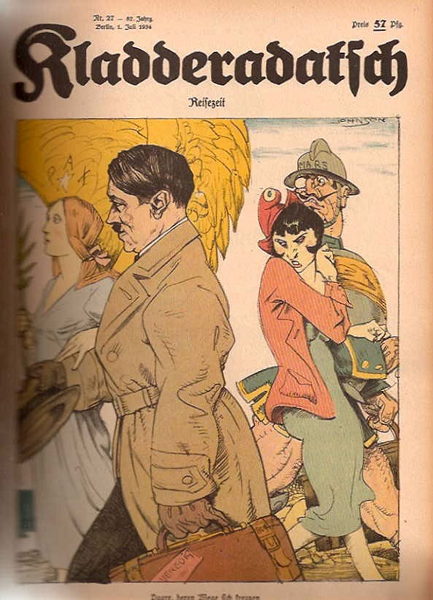
In this harmonious picture of German propaganda, the cornerstone was the abovementioned problem of “Volksdeutsche“, which was the most traumatic for German society since the defeat of Germany in the First World War. A huge number of ethnic Germans remained outside Germany after the collapse of the German Empire in 1918. To understand the scale of this historical trauma, the collapse of the Soviet Union in 1991 with the simultaneous loss of millions of its citizens became a similarly traumatic situation for the Soviet people.
More than that, our people began to restore its national life in 1939, beginning a great effort finally to throw off the chains of constraint and slavery and to once again take our place as a great power after our deep fall [after 1918]. When the diligent historians investigate this year, the worries and difficulties we all had will be forgotten; the sacrifices will appear in a milder and more becoming light, the tears shed will be concealed, and the blood that has been shed will be the cement that forever holds our Reich together.[5]
Thus, after the Sudetenland of Czechoslovakia was transferred to Germany (as a result of the Munich Agreement of 1938), which at that time was predominantly inhabited by ethnic Germans (at least the German side insisted on this), Nazi Germany defiantly violated this agreement and invaded the rest of Czechoslovakia, namely the regions of Bohemia and Moravia. Such a treacherous action simply had to be somehow justified in the eyes of ordinary German citizens. And German propaganda immediately justified the need for such actions referring to the oppression of ethnic Germans in Czechoslovakia. Joseph Goebbels, in his New Year’s address to the German people in December 1939, noted,
On 13 February, the ethnic Germans in Bohemia and Moravia made it clear that their legal, economic, and social situation in the former Czechoslovakia had not become better since the solution of the Sudeten problem but had in fact worsened.
On 22 February, the Slovakians called for independence. At the beginning of March, there were severe persecutions of Germans in Prague, Brünn, and other cities in Bohemia and Moravia. On 8 March, the Carpathian-Ukrainian government in Prague protested against the appointment of a Czech general as Carpathian-Ukrainian interior minister.
On 10 March, the Czech government deposed the Slovakian government, and the persecution of Germans in Bohemia and Moravia intensified. It was clear that the time had come to settle the problems in these areas, which had been cultivated by Germans for centuries.
On 13 March, the Slovakian leader Tiso visited the Führer, and on 14 March, the Czech President Dr. Hacha placed the fate of Bohemia and Moravia in the hands of the Führer.[6]
In a similar way, German propaganda was geared toward ethnic Germans on the territory of Poland. In the 1930s there were large German enclaves and, for example, Gdansk (known as The Free City of Danzig), which formally did not belong to the Polish state, but was under the strong influence of the Polish authorities:
On 31 March, soon after the establishment of the Protectorate of Bohemia and Moravia, London hate papers printed lies about German troops gathering on the Polish border. Chamberlain reported to the House of Commons on English-Polish negotiations and gave a formal declaration of British support to Poland. The London warmongering clique thus gave Warsaw the freedom to act, in the secret wish that Warsaw would begin the conflict that the London plutocrats needed in order to begin their long desired and carefully prepared military measures against the Reich. The government in Warsaw understood. Beginning in April, terror and persecution of ethnic Germans climbed beyond the previous normal and tolerable level.
On 13 April, severe anti-German persecutions occurred on the Danzig border. The terrorist attacks on Germans rose throughout Poland after Germany began its efforts to improve relations. German consulates reported countless persecutions every day to Berlin. On 8 May, 300 ethnic Germans were expelled from Neutomischel County. The German theater was closed in Bromberg on 9 May. Two Germans were killed by Poles in Lodsch on 15 May. A Danzig citizen was killed by Poles in Kalthof on 21 May.[7]
Such statements in the public sphere of German society in the 1930s were an integral part of Nazi propaganda designed to demonise foreign powers, particularly Britain, whose government was described as a “warmongering clique” conspiring against the Reich. This narrative was designed to shift responsibility for the war from Germany to external actors. Indeed, the British government’s guarantee of support to Poland in early 1939 was portrayed not as an act of self-defence against Hitler’s expansionist designs, but as a strategic move to provoke war. By distorting genuine diplomatic overtures, Nazi propaganda characterised Britain as an imperialist power seeking to manipulate Poland for its own long-term purposes against Germany.

Meanwhile, stories of persecution of ethnic Germans in Poland literally overwhelmed the German population. Reports of “terror and persecution” were widely circulated, reinforcing the notion that Germans outside the Reich were under constant threat. Incidents – often exaggerated or entirely fabricated – were highlighted as evidence of mass violence, thereby making military intervention a legitimate protector. In this way, at least, Germany could argue that it had been invaded, so it was not invading anyone, it was just defending its people, as if they needed a saviour.
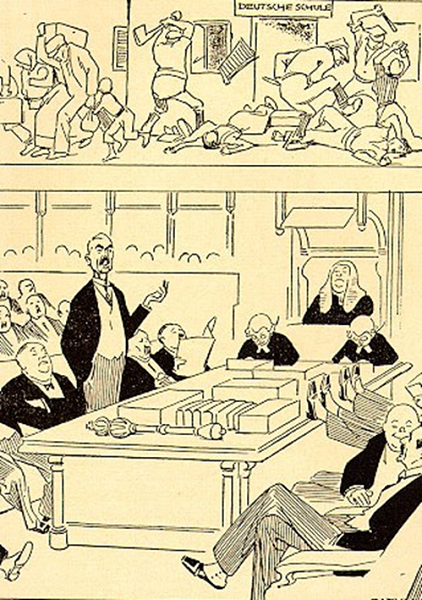
Thus, Nazi propaganda actively inspired German citizens with the radical idea that Western countries, represented by England and France, by and large did not care about the problems and suffering of ethnic Germans in the territories of Czechoslovakia and Poland. And it no longer made much sense for the Germans to continue trying to negotiate peacefully but was critically necessary to solve the existing problems on their own:
And how badly they treated that Germany!
Who still has complete memories of the history of that time: the horrible collapse of 1918, the tragic occurrences of 1919, and then all the years of domestic economic deterioration, the ongoing enslavement and impoverishment of our people, and most of all the complete hopelessness! Today, still, it is unsettling to think of that time, when a great nation slowly lost trust not just in itself, but in any sort of worldly justice.
During this whole time, democratic Germany hoped, begged, and protested in vain. The international financial sector stayed brutally inconsiderate and squeezed as much as it could out of our people; the statesmen of the Allied nations remained hardhearted. It was mercilessly said, on the contrary, that 20 million Germans were too many. No one listened to the wretchedness of our unemployed, no one cared about the ruin of our agriculture or industry, not even of our trade. We remember this silencing of traffic that occurred at this time in the German Reich.
At this time, when all hope was gone, when begging was proved to be futile, when protesting did not lead to victory: it was at this time that the National Socialist movement was created from one basic insight—the insight that one is not allowed to hope in this world, nor beg, nor lower oneself by protesting. Instead, one needs to help oneself![8]
It is also worth considering the fact that Hitler himself wrote in his magnum opus “Mein Kampf” that “Germany required Lebensraum [living space] in the East in order to survive…” [9]. All of these facts, in turn, formed a very specific request for radical action in German society, and when Hitler formulated the goals of the war with Poland in his speech to the Reichstag on September 1, 1939, the German public applauded:
For months we have been suffering under the torture of a problem which the Versailles Diktat created—a problem which has deteriorated until it becomes intolerable for us. Danzig was and is a German city. The Corridor was and is German. Both these territories owe their cultural development exclusively to the German people. Danzig was separated from us; the Corridor was annexed by Poland. As in other German territories of the East, all German minorities living there have been ill-treated in the most distressing manner. More than 1,000,000 people of German blood had in the years 1919-1920 to leave their homeland.
…
I am determined to solve (1) the Danzig question; (2) the question of the Corridor; and (3) to see to it that a change is made in the relationship between Germany and Poland that shall ensure a peaceful co-existence. In this, I am resolved to continue to fight until either the present Polish government is willing to bring about this change or until another Polish government is ready to do so. I am resolved to remove from the German frontiers the element of uncertainty, the everlasting atmosphere of conditions resembling civil war. I will see to it that in the East there is, on the frontier, a peace precisely similar to that on our other frontiers.[10]
Special attention should be paid to the fact that contemporaneous German propaganda emphasized that Nazi Germany was not the first to launch a military campaign against Poland and accused the Polish government of a treacherous attack on Germany. This narrative was based on the notorious scandalous incident of the staging of an attack by Polish saboteurs on a German radio station in the city of Gleiwitz (now Gliwice) to spread Polish anti-German propaganda with the help of this radio station. This staged event was carried out by SS-bodies on August 31, 1939, as part of the large-scale Operation Himmler.
Operation Himmler itself, developed by the special services of Nazi Germany and conducted immediately before the invasion of Poland by the Wehrmacht, as a “false-flag” operation was designed to discredit the Polish Republic, to create an idea of Polish aggression against Nazi Germany, and thus to create a pretext for Germany’s attack on Poland. It was these events that served as a formal reason for further military aggression, and this aggression for Germany was allegedly defensive.
It is also important to note here that German propaganda was in no hurry to call the military aggression against the Polish Republic a “war”, insisting on the maximum humanity of German soldiers during the military operation Fall Weiss (1939). As the führer said in his speech to the Reichstag on 1 September 1939,
I do not want to wage war against women and children. I have given my Luftwaffe the order to limit their attacks to military targets.[11]
In order to show not only the German people but the whole world that Adolf Hitler stood by his principles, on 19 September 1939, in the Artushof in the liberated city of Danzig, he repeated the statement:
I have given the German Luftwaffe the order to fight this war humanely, which means that they will attack only fighting troops.[12]
Thus, the blame for the possible civilian casualties of the Polish Republic during the military operation was placed, oddly enough, on the Polish government. For example, when the Polish government decided to defend Warsaw to the end, Hitler reacted to this with a speech on October 6, 1939, in front of the Reichstag with the following words:
Out of pity for women and children, I have offered the rulers of Warsaw the opportunity to at least allow the civilian population to leave the city.
I declared a truce, guaranteed the necessary escape routes, and we all waited in vain for a parliamentarian, just as we waited in vain at the end of August for a Polish negotiator. The proud Polish city commander did not even grace us with an answer. I extended the truce and ordered our bombers and heavy artillery to attack only clear military targets. I repeated my offer, but it was in vain!
I therefore offered not to attack an entire section of the city, Praga, reserving it for the civilian population to give them the opportunity to go there. This proposal, too, met with Polish contempt.[13]

In fact, the army of the Polish Republic was actually defeated in two weeks of the joint military operation “Fall Weiss”, as German propaganda solemnly informed German citizens. Consequently, the propaganda narrative began to steadily evolve from a military operation aimed at protecting ethnic Germans in Polish territories to a global ideological confrontation between German national Socialism, on the one hand, and French-British imperialism, on the other. And this story became even simpler for the German propaganda machine, since de jure and de facto, on September 3, 1939, fulfilling their obligations to Poland, Great Britain and France declared war on Germany after the German invasion of Poland. Nazi Germany did not declare war on France and Great Britain. Moreover, in his September 1939 speech, Hitler stated the following:
When statesmen in the West declare that this affects their interests, I can only regret such a declaration. It cannot for a moment make me hesitate to fulfill my duty. What more is wanted? I have solemnly assured them, and I repeat it, that we ask nothing of those Western States and never will ask anything. I have declared that the frontier between France and Germany is a final one. I have repeatedly offered friendship and, if necessary, the closest co-operation to Britain, but this cannot be offered from one side only. It must find response on the other side.
Germany has no interests in the West, and our western wall is for all time the frontier of the Reich on the west. Moreover, we have no aims of any kind there for the future. With this assurance, we are in solemn earnest, and as long as others do not violate their neutrality, we will likewise take every care to respect it. [14]
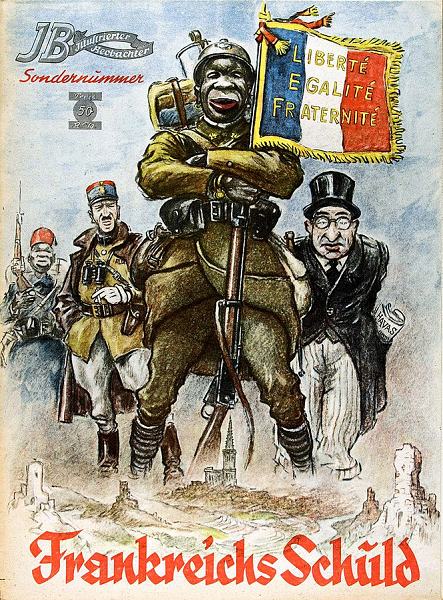
Consequently, according to German propaganda, it was France and Great Britain who not only did not want the cessation of hostilities, but on the contrary escalated the conflict. Moreover, the Western countries called the final goal of the declared war on Germany the destruction of National Socialism and Hitlerism. This is what became the strongest trump card in the hands of German propaganda for transferring the ethnic issue into the mainstream of global ideological confrontation. Now the German press literally intimidated German society with the fact that the British and French seriously intended to come back to the homes of ordinary German citizens with the idea of rebuilding German society in the way that they considered right, literally parasitizing the historical trauma of the severe defeat of the German Empire in 1918, when the further existence of the German state was questioned by the victors.
German propaganda demonized Great Britain especially fiercely. England was accused, in particular, of fighting with “foreign hands“:
So, when Chamberlain says that England wants to destroy Hitlerism in this war, he is in one sense incorrect. But in another sense, he is speaking the truth. England does want to destroy Hitlerism. It sees Hitlerism as the present internal state of the Reich, which is a thorn in the eye of English plutocracy. [15]
That is why England declared war on Germany. Since it was accustomed to letting others fight its wars, it looked to the European continent to find those ready to fight for England’s interests. France was ready to take on this degrading duty since the same kind of people ruled France. They too were ready for war out of egoistic reasons. Western European democracy is really only a Western European plutocracy that rules the world. It declared war on German socialism because it endangered their capitalist interests. [16]
A parallel theme in Nazi rhetoric was the attack on France, which was portrayed as a willing accomplice to British interests. The claim that France had gone to war for ‘selfish reasons’ reinforced the idea that Germany was surrounded by morally corrupt and self-serving enemies. By suggesting that France’s leadership was controlled by the same elite as Britain’s, Nazi propagandists sought to delegitimize France’s role in the conflict and portray Germany as a nation resisting foreign oppression.
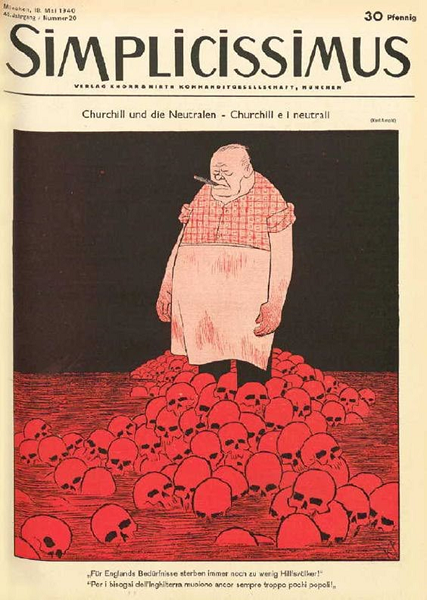
While France was still at war with Nazi Germany, and the French army was not defeated, German propaganda actively pointed out that Great Britain was fighting to the last Frenchman and also promoted the notorious anti-war French political slogan “Why Die for Danzig?” (Pourquoi mourir pour Dantzig?).
Among other things, the German propaganda machine actively ridiculed French and British counterpropaganda and launched a real war using information fakes, the main purpose of which was to prepare the Germans to fight the propaganda of the Allies. The plan was to “innoculate” German citizens so that they would doubt the reliability of any third-party information and would not believe the claims of atrocities committed by the Wehrmacht and the SS during the war:
French and British politicians did not recognize that a decisive military defeat in France remained a possibility. Thus, the rupture of June 1940 was all the more bitter for being unforeseen.
As the debacle unfolded and the Dunkirk evacuation by the British commenced, the image of Britannia “fighting to the last Frenchman” ceased to be a cynical jibe between friends and allies. It became the twisted, treachery-tainted undercurrent to an ugly new bout of cross-Channel xenophobia, one with a ferocity—and with bloody and tragic consequences…[17]
In this way, the image of an external enemy was cultivated more and more in the minds of German society, an enemy that deliberately presented to the world both the everyday life of German society and the governmental structure of Nazi Germany as barbaric, cruel and inhuman.
And yet another campaign of lies collapses miserably. Once again, the world can see how the English Ministry of Lies and its accomplices work. The truth once again shines through the worst of the foreign lies.
Germany is no paradise, because there is no such thing as paradise on earth, and there never will be. We Germans are like everyone else, we make mistakes, there are a few unreliable people, and we have occasional difficulties which we have not completely overcome—but, and this is the important thing: Things are a thousand times better here. Things are more honest and fair here than anywhere in the entire world.
Since we know that, and since we also know that we are strong and have nothing to fear, we know what to think of the lies of the press and radio of our foreign opponents, which are the best proof of their weakness. [18]
In addition, the German propaganda of the 1930s systematically appealed to history, pointing out to the German public that it was Great Britain that had been actively expanding through force, wars, and the colonization of peoples throughout its history; France was also actively expanding with force at the time, and even the United States expanded its territories by force:
Over a period of 300 years, they have subjugated about 40 million km of earth;
of course not because of egoism, not because they love to have power or gain riches or self-indulgence, no, quite on the contrary—this all happened as part of God’s mandate and in the name of religion. Indeed, Britain did not want to be the sole champion of God, so it always invited others to come join this noble fight. It did not even try to carry the main burden alone; if you are doing work mandated by God like this, allies can always be sought.
This is the same thing they do today. And it has, as just said, been richly rewarding for Britain. Forty million km, and British history is a ceaseless row of rapes, of extortions, of tyrannical abuse, of subjugation, of pillage. There are many things that would be unthinkable in any other state and in any other people. War was declared for everything. War was waged to increase trade. War was waged to get other peoples addicted to opium. War was also waged, when necessary, to win gold mines, to attain power over diamond mines.[19]
Germany, on the contrary, since the time of the Holy Roman Empire, had relentlessly lost territories and people since its defeat in the Eighty Years’ War. Thus, propaganda consolidated in the minds of ordinary German citizens a resentment that was based on the opposition of peaceful Germans seeking to preserve their historical homeland against treacherous Western neighbours who were eager to expand their zones of influence by barbaric force, slandering Germany and accusing the German people of their own sins[20]:
The American press has the noble right to complain about Europe. It makes vigorous use of this right, particularly when Germany is involved. National Socialist Germany is a thorn in its eye.[21]
It is also necessary to understand that historical revanchism was very popular in German society in the 1930s. The most important topic was the feeling of betrayal at the hands of Western countries, as the Germans quite justifiably believed that they had not been honestly defeated on the battlefield in the First World War but had been brazenly deceived. After all, American president Woodrow Wilson promised Germany a just peace, instead of which the Germans received the humiliating Versailles Peace Treaty and more than a decade of crises and hardships. The closest event in terms of effect on society in modern history can quite rightly be considered the defeat of the Soviet Union in the Cold War. Moreover, for German society, the Treaty of Versailles was not only a national humiliation, but also a tragedy of the splitting of the nation, creating the “Volksdeutsche Mittelstelle” issue (mentioned earlier on several occasions), where ethnic Germans came to be national minorities in Poland, Czechoslovakia, France, and so on.
When it came to the aggravation of relations between Nazi Germany and the Soviet Union, German propaganda did not deviate and presented the military confrontation with the Soviet Union as another round in Germany’s war against British imperialism. Moreover, from the end of 1939, German propaganda from time to time grumbled that Great Britain did not abandon futile attempts to aggravate strong Soviet-German relations and involve the Soviet Russia in a war against Germany:
We are experiencing now what happened then: the old states were dissolved without even asking their peoples’ opinion. Nations were neither consulted nor given a choice as their borders were redrawn, and historical entities—both political and economic—were dismantled. What had been built over centuries was replaced by artificial constructs imposed by those who viewed European history with arrogance.
Without regard for self-determination, Europe was carved up, states were dissolved, and peoples were stripped of their rights. The so-called winners ensured their dominance by rendering others powerless. Disarmament was abandoned, and an arms race resumed, with the disarmed left defenseless.
Economic destruction followed. Reparations crippled both the vanquished and the victors. Nowhere was the suffering greater than in Germany, where mass unemployment nearly ruined the nation. Culture was not nurtured but ridiculed, religion was sidelined, and morality was forgotten.
In those 15 years, no one in Britain spoke of Christian mercy or compassion. Their guiding text was not the Bible but the Treaty of Versailles—a document of 448 articles that imposed burdens, obligations, and blackmail on Germany. This oppressive treaty was enforced by the League of Nations, not as a union of free nations, but as a tool to uphold the most unjust of agreements, one that had been dictated rather than negotiated.[22]
Later, Hitler justified the need for a preventive war against the Soviet Union in his speech to the Reichstag on June 22, 1941:
Immediately after this enterprise collapsed, there was a new increase in Russian troops along the German eastern border. Increasing numbers of tank and parachute divisions threatened the German border. The German army and homeland knew that until a few weeks ago, there was not a single German tank or motorized division stationed on our eastern border.
If anyone needed final proof of the carefully hidden coalition between England and Soviet Russia, the conflict in Yugoslavia provided it. While I was making a last attempt to keep peace in the Balkans, and in agreement with the Duce invited Yugoslavia to join the Three Power Pact, England and Soviet Russia organized a coup that toppled the government that was ready for such an agreement.
…
Today, about 160 Russian divisions stand at our border. There have been steady border violations for weeks, not only on our border but in the far north and also in Romania. Russian pilots make a habit of ignoring the border, perhaps to show us that they already feel as if they are in control. During the night of 17-18 June, Russian patrols again crossed the German border and could only be repelled after a long battle.
Now the hour has come when it is necessary to respond to this plot by Jewish-Anglo-Saxon warmongers and the Jewish rulers of Moscow’s Bolshevist headquarters.[23]
Even in this case, the Anglophobic narrative of the German propaganda machine remained unchanged, pointing out to the German public that Germany was fighting not against the Russian people but against a Jewish-Bolshevik government, that went along with the British plutocrats and literally stabbed the German people in the back, whereas the führer was now striving to liberate the peoples of Soviet Russia from Bolshevik oppression. For such purposes, as we know today, the SS actively developed and supported Ukrainian, Belarusian, Finnish, and other nationalisms in the territories controlled by the Soviet Union in the early years of the war. Moreover, the work of German propaganda within the local population in the territories occupied by Nazi Germany also amounted to stories relating how the Western allies, represented by Great Britain, France, and the United States, were constantly deceiving the Soviet leadership, and Stalin [24], in particular.
Thus, for several years, Nazi propaganda planted in the minds of ordinary German citizens the persistent image that the war began through the fault of Great Britain, which forced various East Slavic states to oppress ethnic Germans in their territories so as to ultimately thwart any possibility of Germany’s revival following a heavy defeat in the First World War. Hitler, on the other hand, was shown as protecting ethnic Germans from oppression, but since peaceful solutions to the problem were viable, he simply was forced to launch certain military operations to protect ethnic Germans, first in Czechoslovakia and then in Poland, solely in response to the outright provocations and treacherous cruelty of these specific Eastern Slavic states.
Moreover, the narrative continued, Britain and France, in turn, defiantly abandoned all Hitler’s peace initiatives and adopted an undisguised policy of consistent escalation of war and Germanophobia, declaring war on Nazi Germany. The Soviet Union was apparently planning to stab its ally Germany in the back and attack first, succumbing to the persuasions of the British plutocrats, since it was also led by the Jewish lobby. Germany was presented as being forced to wage this war for the freedom and future of German citizens, using the most humane methods and striking exclusively at strategic enemy targets. And civilians in the course of these actions on the territories of other countries suffered solely on account of the enemies of Germany, who seemingly wanted to achieve the destruction of National Socialism and Hitlerism at any cost.
Consequently, within the framework of the above-described narrative of German propaganda, any German citizen who opposed the actions of Nazi Germany, automatically became a traitor and an enemy of the German people. After all, Hitler himself, according to the assurances of German propaganda, all the time sought a peaceful end to the war, but exclusively on terms vital to Germany and the German people; any other conclusion of the war was in the hands of British imperialism, and this would inevitably lead to the death of Germany at the hands of the Jewish imperialist lobby:
Jewry has had two centers in recent decades: New York and Moscow, London, Paris, Prague, Warsaw, Geneva, and other Jewish centers were of secondary importance. In Moscow the Jew ruled with GPU methods: murder and the most blatant exploitation. In New York, he used his financial strength. To win over America for the Jewish war against Germany, Jewry infiltrated plutocratic circles. They believed that they had finished off Europe for good through the Treaty of Versailles, since they had defeated Germany, the heart and soul of the continent, once and for all. They believed they had eliminated it as a factor.
The plutocrats wanted to inherit the wealth of our ancient part of the world. They thought the time had come when for a few dollars they could buy all the European culture that had had been built with so much effort and sacrifice over a time span of 4500 years. Who could stop them? The American newcomers were already imagining themselves in possession of our splendid and immortal cultural values. In a few years everything would be forgotten and everything would be Americanized. That is what these cultural ignoramuses thought, who themselves have no culture or traditions.[25]
To summarise: The Nazi propaganda apparatus, meticulously orchestrated by Joseph Goebbels and the wider state-controlled media, played a crucial role in constructing a distorted but internally coherent ideological framework that rationalised Germany’s expansionist policies in Eastern Europe. Through a complex blend of historical revisionism, revanchist rhetoric and the manipulation of public fears, the Nazi regime successfully mobilised mass support for its aggressive foreign policy while absolving itself of blame for the outbreak of the Second World War. The grand narrative crafted by the regime was based on a dual strategy: first, the deliberate mythologisation of Germany as a victim of foreign conspiracy and systemic persecution following the Treaty of Versailles; and second, the systematic demonisation of external actors – notably Britain, France, Poland and later the Soviet Union – as imperialist aggressors intent on subjugating the German people.
Central to this propaganda was the fabrication of a defensive war – an existential struggle in which Germany was portrayed not as the aggressor but as the besieged party, forced to take pre-emptive action against an invading enemy. This ideological sleight of hand was particularly evident in the way German military actions were framed in relation to Poland. By exploiting allegations of atrocities against ethnic Germans and portraying Poland as a British pawn engaged in systematic oppression, Nazi propaganda transformed a calculated act of aggression into a necessary intervention to protect national kin. This rhetorical strategy mirrors the manipulation of ethnic and historical narratives in post-Soviet spaces, where revanchist policies are often justified on the pretext of defending ethnic compatriots from alleged persecution, reinforcing the notion of ‘historical justice’ as a pretext for geopolitical assertion.
Other parallels can be drawn with the role of state-controlled media in creating enemy images and manufacturing consent for military intervention. Just as Nazi propaganda portrayed Britain as the true architect of war – an imperialist power maneuvering weaker states to provoke conflict – contemporary propaganda in certain post-Soviet states employs similar narratives, attributing geopolitical instability to Western interventionism and positioning the state as the victim of foreign conspiracies. This pattern of psychological warfare, in which external forces are blamed for internal crises or military escalations, reflects a timeless method of authoritarian control that was effectively pioneered and refined under the Nazi regime.
Another crucial aspect of Nazi propaganda was its adaptive nature – how it recalibrated its messages in response to changing political and military circumstances. As the war progressed, the ideological justification for expansion shifted from a focus on national grievances to a broader, civilizational struggle against Bolshevism, a theme that resonates strongly with the ideological pivot in contemporary narratives of post-Soviet geopolitical conflict. The framing of Operation Barbarossa as a pre-emptive strike against an inevitable Soviet attack was not merely a strategic deception; it was an epistemological restructuring of reality that reinforced an irreversible trajectory towards war. This approach, which recasts aggression as a defensive necessity, has been similarly deployed in modern conflicts, where military escalation is framed as a last resort against an existential threat manufactured by external actors.
Beyond the external justifications for war, Nazi propaganda also developed a sophisticated internal mechanism of ideological conformity, ensuring that any deviation from the state-prescribed narratives was equated with treason. The concept of total ideological mobilization, in which the public sphere was inundated with uniform messages that brooked no opposition, is strikingly reminiscent of contemporary authoritarian states that use information warfare to delegitimize dissent, stifle independent thought and promote unquestioning loyalty to the state leadership. In both cases, the weaponization of mass media functions not only as a means of persuasion, but also as a fundamental pillar of social control, conditioning the population to accept war as an inevitable, even righteous, course of action.
Ultimately, Nazi propaganda not only manufactured public consent – it constructed an alternative epistemic reality in which war was not a choice but a historical imperative. This distortion of historical grievances, the fabrication of existential threats, and the strategic manipulation of nationalist sentiment remain hallmarks of propaganda-driven political systems today. The case of Nazi Germany serves as a critical study of the power of controlled narratives to reconfigure public consciousness, demonstrating how media monopolization, ideological absolutism and enemy construction can create a self-perpetuating cycle of aggression justified by myths of victimhood and moral superiority.
The enduring legacy of Nazi propaganda extends far beyond the confines of the Second World War. It offers a cautionary paradigm for understanding contemporary geopolitical discourse, particularly in regions where historical trauma, national identity and revanchist ambitions are exploited to provide ideological legitimacy for expansionist policies. As seen in certain post-Soviet contexts, where past grievances are selectively weaponized to justify military action and suppress dissent, the Nazi model of propaganda provides a chilling reminder of how the past can be repurposed to serve the interests of authoritarianism. By recognizing these patterns and analyzing their mechanisms, scholars and policymakers can better confront the continuing threat of information warfare as a catalyst for conflict in the modern era.
Notes and Bibliography
- Dr. G.M. Gilbert 1976 “The Memory of Jusce“
- “Warum und wofür?”, Die Wehrmacht, 3 (1939, Nr. 19), p. 2.
- Ibid.
- “Englands Schuld,” Illustrierter Beobachter, Sondernummer “Englands Schuld,” p. 14.
- “Jahreswechsel 1939/40. Sylvesteransprache an das deutsche Volk,” Die Zeit ohne Beispiel (Munich: Zentralverlag der NSDAP, 1941), pp. 229-239.
- Ibid.
- Ibid.
- Adolf Hitler – Speech at the Berlin Sportspalast, January 30, 1940.
- Hitler, Adolf. 1925. Mein Kampf. Translated by Ralph Manheim. Boston: Houghton Mifflin, 1999.
- Address by Adolf Hitler – September 1, 1939.
- Ibid.
- Toni Winkelnkemper, Der Großangriff auf Köln. Ein Beispiel (Berlin: Franz Eher, 1942).
- Ibid.
- Address by Adolf Hitler – September 1, 1939.
- “Englands Schuld,” Illustrierter Beobachter, Sondernummer “Englands Schuld,” p. 14.
- Ibid.
- Alexander, Martin S. “Fighting to the Last Frenchman” ? Reflections on the BEF Deployment to France and the Strains in the Franco-British Alliance, 1939-40. Division of Human Studies, Alfred University. Historical reflections, 1996-01, Vol.22 (1), p. 262.
- Ernst Herbert Lehmann, Wie sie lügen: Beweise feindlicher Hetzpropaganda (Nibelungen-Verlag, 1939/1940), p. 40.
- Adolf Hitler – Speech at the Berlin Sportspalast, January 30, 1940.
- “Frankreichs Schuld.” 1940. Illustrierter Beobachter, Sondernummer “Frankreichs Schuld”, 48. Accessed February 6, 2025.
- “Was will eigentlich Amerika,” Die Zeit ohne Beispiel (Munich: Zentralverlag der NSDAP., 1941), pp. 24-30.
- Adolf Hitler – Speech at the Berlin Sportspalast, January 30, 1940.
- “Der Führer an das deutsche Volk 22. Juni 1941,” in Philipp Bouhler (ed.), Der großdeutsche Freiheitskampf. Reden Adolf Hitlers, vol. 3 (Munich: Franz Eher, 1942), pp. 51-61.
- Bormotova, A. R. 2014. “Foreign Policy Materials of German Occupation Newspapers as a Means of Propaganda and Agitation in 1941-1943 (Based on Materials from the Kursk Region).” Scientific Notes: Electronic Scientific Journal of Kursk State University, no. 3 (31). Accessed February 6, 2025.
- Robert Ley, Roosevelt verrät Amerika! (Berlin: Verlag der Deutschen Arbeitsfront, 1942).
—————————————————————————————
- “Address to the Reichstag, September 1, 1939.” Accessed February 6, 2025.
- Alexander, Martin S. 1996. “Fighting to the Last Frenchman? Reflections on the BEF Deployment to France and the Strains in the Franco-British Alliance, 1939-40.” Historical Reflections 22 (1): 262.
- Bormotova, A. R. 2014. “Foreign Policy Materials of German Occupation Newspapers as a Means of Propaganda and Agitation in 1941-1943 (Based on Materials from the Kursk Region).” Scientific Notes: Electronic Scientific Journal of Kursk State University, no. 3 (31). Accessed February 6, 2025.
- Bouhler, Philipp, ed. 1942. Der großdeutsche Freiheitskampf. Reden Adolf Hitlers. Vol. 3. Munich: Franz Eher Verlag. Accessed February 6, 2025.
- Gilbert, G. M. 1976. The Memory of Justice. New York: Pantheon Books.
- Hitler, Adolf. 1925. Mein Kampf. Translated by Ralph Manheim. Boston: Houghton Mifflin, 1999.
- Ley, Robert. 1942. Roosevelt Verrät Amerika! Berlin: Verlag der Deutschen Arbeitsfront. Accessed February 6, 2025.
- “Englands Schuld.” 1940. Illustrierter Beobachter, Sondernummer “Englands Schuld,” 14. Accessed February 6, 2025.
- “Frankreichs Schuld.” 1940. Illustrierter Beobachter, Sondernummer “Frankreichs Schuld”, 48. Accessed February 6, 2025.
- “Jahreswechsel 1939/40. Sylvesteransprache an das deutsche Volk.” 1941. Die Zeit ohne Beispiel. Munich: Zentralverlag der NSDAP. Accessed February 6, 2025.
- Lehmann, Ernst Herbert. 1939/1940. Wie Sie Lügen: Beweise Feindlicher Hetzpropaganda. Berlin: Nibelungen-Verlag. Accessed February 6, 2025.
- “Speech at the Berlin Sportspalast, January 30, 1940.” Accessed February 6, 2025.
- “Warum und wofür?” 1939. Die Wehrmacht, no. 19, p. 2. Accessed February 6, 2025.
- “Was will eigentlich Amerika?” 1941. Die Zeit ohne Beispiel. Munich: Zentralverlag der NSDAP. Accessed February 6, 2025.
- Winkelnkemper, Toni. 1942. Der Großangriff auf Köln. Ein Beispiel. Berlin: Franz Eher Verlag. Accessed February 6, 2025.