


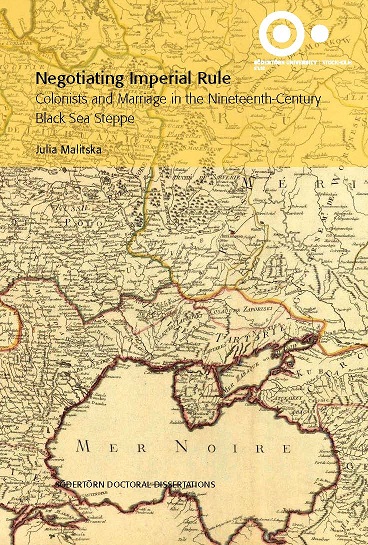
 Julia Malitska. Negotiating Imperial Rule: Colonists and Marriage in the Nineteenth-century Black Sea Steppe. Huddinge: Södertörns högskola, 2017. – 392 p.
After falling under the power of the Russian Crown, the Northern Black Sea steppe from the end of eighteenth century crystallized as the Russian government’s prime venue for socioeconomic and sociocultural reinvention and colonization. Vast ethnic, sociocultural and even ecological changes followed. Present study is preoccupied with the marriage of the immigrant population from the German lands who came to the region in the course of its state orchestrated colonization, and was officially categorized as “German colonists.” The book illuminates the multiple ways in which marriage and household formation among the colonists was instrumentalized by the imperial politics in the Northern Black Sea steppe, and conditioned by socioeconomic rationality of its colonization. Marriage formation and dissolution among the colonists were gradually absorbed into the competencies of the colonial vertical power. Intending to control colonist marriage and household formation through the introduced marriage regime, the Russian government and its regional representatives lacked the actual means to exert this control at the local level. On the ground, however, imperial politics was mediated by the people it targeted, and by the functionaries tasked with its implementation. As the study reveals, the paramount importance was given to functional households and sustainable farms based on non-conflictual relations between parties. Situated on the crossroads of state, church, community, and personal interests, colonist marriage engendered clashes between secular and ecclesiastical bodies over the supremacy over it. The interplay of colonization as politics, and colonization as an imperial situationwith respect to the marriage of the German colonists is explored in this book by concentrating on both norms and practices. Another important consideration is the ways gender and colonization constructed and determined one another reciprocally, both in legal norms and in actual practices. Secret divorces and unauthorized marriages, open and hidden defiance, imitations and unruliness, refashioning of rituals and discourses, and desertions – a number of strategies and performances which challenged and negotiated the marriage regime in the region, were scholarly examined for the first time in this book.
Contents
Chapter I. Introduction
1.1. Objectives and Scope of the Research
1.2. Disposition
1.3. Main Concepts of the Study
1.4. Living and Making the Empire: People of the Study
1.5. Theory and Method
1.5.1. Microhistory
1.5.2. Regional, (Trans)National and Situational
1.5.3. The Paradigm of Russia’s Imperial Statehood
1.5.4. Imperial Legal Regimes and Intersectionality, Gender and Patriarchy
1.6. Related Research
1.7. Sources of the Study
1.7.1. The Colonial Archive
1.7.2. Published Sources
Chapter II. Empire’s Embrace: The Northern Black Sea Steppe and its Inhabitants
2.1. Under the Russian Crown: The Northern Black Sea Steppe, and its Old and New Inhabitants
2.2. In Need of Good Subjects: Immigrants in the Steppe
2.3. In Need of Better Subjects
2.4. Concluding Discussion
Chapter III. Guardians of Good Morals and Economic Welfare: Clerks and Clerics in the Steppe
3.1. Old Men, New Laws: Autocracy and Judiciary in the Russian Empire
3.2. Gatekeepers: the Administration for the Colonists
3.3. Saviours of Not Only Bodies and Souls: Clergymen in the Steppe
3.3.1. The “Foreign” Confessions in the Imperial Matrix
3.3.2. “For God’s Sake, Let’s Think about the Clergymen”
3.3.3. Busy Weekdays of the Clerics
3.4. Concluding Discussion
Chapter IV. The Golden Cage: Colonist Status and Marriage Eligibility
4.1. Subjects of the Empire, Objects of Governance: Legal Grounds of the Colonists
4.1.1. Land and the Colonists’ Duties
4.1.2. Financial Aid from the State
4.1.3. Voting Rights
4.2. Bringing Order to the Family
4.3. Governing the Colonists, Controlling Their Marriages
4.4. Married to the Empire: Bureaucratization of the Colonist Marriage
4.4.1. Time to Marry?
4.5. Concluding Discussion
Chapter V. Locking in By Locking Out: Marriage and Border Crossing
5.1. Marriages of the Colonists
5.2. Gates to Recognition: Marriages of Colonist Females and Non-Colonist Males
5.3. Changing Social Identity: Marriages between Colonist Females and Non-Colonist Males
5.4. Bringing Immediate Benefits: Marriages of Colonist Males with Non-Colonist Females
5.5. Reconciliation or Reclamation: Religious Servitors and the Marriage Regime
5.6. (Non)Marriage Regime and Love Affairs of the Colonists
5.7. Concluding Discussion
Chapter VI. Conforming to the Norms, Struggling with Practices: Broken Marriages and Divorces among the Colonists
6.1. In the Orthodox Paradigm: Divorce of Roman Catholics and Lutherans in the Russian Empire
6.1.1. The Russian Orthodox Framework
6.1.2. Lutherans of the Empire and Divorce
6.1.3. Roman Catholics of the Empire and Divorce
6.2. Institutionalization of the Colonist Divorce: Bureaucratization without Bureaucrats
6.3. Causes of Marital Breakdowns. Deserting and Abandoned Spouses
6.4. Divorces
6.4.1. Free from Delusion, and “Sectarian” Marriage
6.4.2. Doomed to Fail from the Start
6.4.3. Impotence
6.5. Divorce Simply: Economic Feasibility versus Civil Proceedings
6.6. Confusion and Delays in Divorce Procedure among Lutherans
6.7. The Power of Actors, the Actors-in-Power: Clergy vis-à-vis Clerks
6.8. Narratives of Marriage Breakdown and Divorce of the Colonists
6.9. The Paradigm of the Colonist Marriage Breakdown: Concluding Discussion
Chapter VII. Situational in the Empire, Imperial in a Situation: Final Discussion
_____________________________
Julia Malitska, PH.D. in History (Södertörn University, 2017), works as a project researcher at the School of Historical and Contemporary Studies and coordinator at the Centre for Baltic and East European Studies at Södertörn University (Sweden). She has got the Candidate of Sciences Degree in History (2010) at the Oles Honchar Dnipro National University (Ukraine). Among other contributions, she is an author and co-editor (with Piotr Wawrzeniuk) of the book The Lost Swedish Tribe: Reapproaching the History of Gammalsvenskby in Ukraine(Huddinge: Södertörn University, 2014). Her sphere of interest covers imperial and (post)colonial studies, social history of Central and Eastern Europe, the history of medicine and consumption.


