Last fall I had the honor of giving the 2025 Toronto Annual Ukrainian Famine Lecture. And in preparing that lecture, on the Holodomor’s past and present relevance, three ancient and yet timeless maxims came to mind. The first was an old Japanese Buddhist saying: “See no evil, hear no evil, speak no evil.” The second from king Solomon: “There is no new thing under the sun.” And the third from my king Jesus Christ: “Therefore speak I to them in parables.”
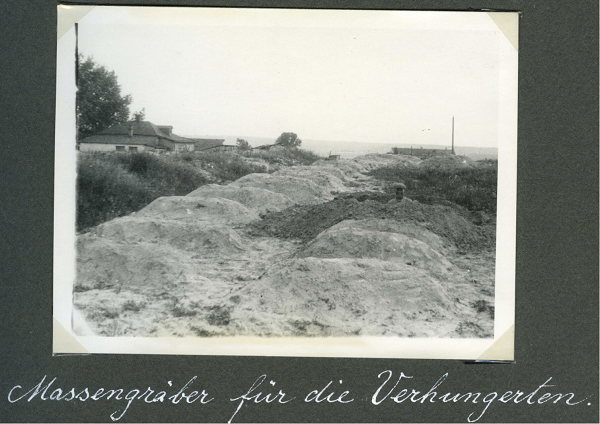
With these in mind, I wanted to briefly address before an interested audience then and now a core, underlying question in my research: How to Hide a Famine, or, Holodomor as History and Heuristic (“a method to solve problems”). Because what the mass forced starvation of Ukrainians in the early 1930s by the Stalinist regime, or Holodomor, presents is a method for mass murder in the mass media age. Stalin faced a problem, which was a people. “The main issue now is Ukraine” he wrote in August 1932, “matters there are extremely bad.” By this he did not mean, of course, the horrific famine of which his own hand-picked henchmen in the Ukrainian Communist party were warning. Rather he meant the warnings themselves. “If we do not correct the situation in Ukraine immediately,” he countered, “we could lose Ukraine.” And so he sent the order: “Set yourself the goal of turning Ukraine into a fortress of the USSR, a real model republic, within the shortest possible time.” The problem was a people and the solution was their slaughter to ensure subsequent submission. A cull of more than one-fifth of the population through relocation and resettlement, a cull through imprisonment and execution, a cull through forced starvation.
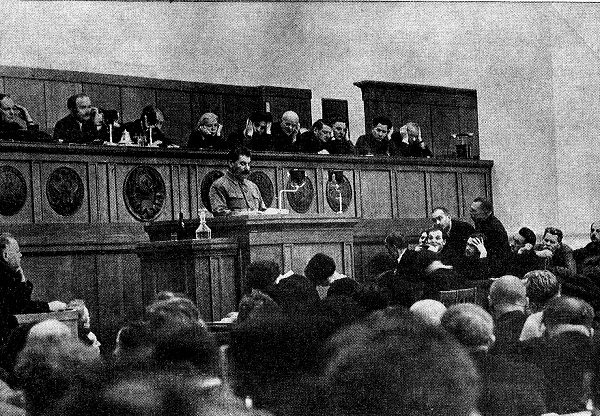
But in this case the methods could not be purely physical, because the world’s only Communist state also relied on the world: for both political legitimacy through internationalist ties with foreign peoples and international recognition from foreign governments, and for economic engagement through the import of expertise and industry and the export of grain for the hard currency with which such expertise and industry could be imported at scale. This is what sustained the Stalinist regime’s ambitious Five Year Plan to remake itself and remold its people through the agricultural collectivization of the countryside and the rapid industrialization of the cities, and it succeeded by that regime’s own estimations. “The policy of eliminating the kulaks and of complete collectivisation has triumphed,” Stalin boasted at the appropriately named 1934 Congress of Victors, “what arguments can be advanced against this fact?”
And rather than argue with the man let us instead consider the constituent parts of the plan that led to this apparently astounding triumph. The method, or heuristic, if you will. I think the method actually involves the cultivation of two distinct but symbiotic ecosystems: what I will call an ecosystem of destruction and an ecosystem of denial.
Ecosystems of destruction are what you might typically think of when you think of genocide in its original definition as coined by Raphael Lemkin in 1944: that is, broadly speaking, “a coordinated plan of different actions aiming at the destruction of essential foundations of the life of national groups.”
In the context of the Holodomor, this ecosystem featured:
- The widespread theft and destruction of agricultural goods and property to the point of mass starvation.
- The dismantling of effective food production and distribution systems in the famine-affected areas of Ukraine.
- The sealing of borders around and within the famine zones of Ukraine and prevention of escape by arrest and shooting.
- The collective punishment through blacklisting of whole communities, justified by criminalizing constructs such as “kulak”.
- The mass arrest, torture, and execution of purported nationalists, terrorists, and saboteurs on supposed national security grounds.
- The militarized occupation of rural Ukraine in response to widespread unrest, again on supposed national security grounds.
- The destruction of religious and cultural sites like the St. Michael’s Golden-Domed Monastery and the concurrent liquidation of related entities and individuals.
- The purging of national authorities and cultural institutions in Ukraine.
- And the settlement and re-settlement of Russians in depopulated regions of Ukraine, especially the Donbas.
By contrast the ecosystem of denial encompasses the non-physical realm of state power and its exercise. Broadly, this ecosystem featured:
- The denial of famine or even famine-like conditions in domestic Soviet state propaganda and by representatives of the state.
- The leveraging of affiliated and sympathetic foreign interest groups, lobbies, and individuals to engage in famine denial abroad – including by smearing and slandering critics and whistleblowers.
- The denial of media access and aid entry from interested foreign entities like the International Red Cross on the grounds that no help was needed.
- The Stalinist regime’s denial of Ukrainian self-determination and assumption of Ukraine as an integral part of the Soviet empire.
- The Western legacy media’s embrace of the occupying imperial power’s narratives and logics by downplaying the mass starvation and deflecting the blame to the victims themselves.
- The linguistic dehumanization of regime enemies as vermin, bugs, and germs and the concurrent nullification of Ukrainian personhood as a matter of Soviet state policy.
- The legitimization of the Stalinist regime by Western governments through the dismissal of protests and petitions and the proffering of diplomatic support and economic cooperation.
This ecosystem of denial as it played out in Western media and politics, and the central role of the Moscow-based Communist International (or Comintern) and its satellite parties in promoting such denialism to global audiences even as Ukrainians were still starving, rests at the heart of my own research. Indeed it forms a constitutive part of my new monograph with Bloomsbury Academic – Communist Propaganda in Pre-Cold War America– which is a history of the American Communist party’s official newspaper, the Daily Worker, and its pivotal role in spreading Bolshevik propaganda about the Holodomor and other Soviet atrocities abroad. These denialist propaganda campaigns also serve as the subject of my contribution to a Massive Open Online Course available March 23rd, 2026 through the University of Alberta on the Holodomor: which has brought together more than a dozen leading scholars on the famine to produce a first-of-its-kind, free, undergraduate-level offering. What I have found through such research is that these ecosystems of destruction and denial are not only inherently self-reinforcing – which should not be surprising, given the extensive employment of the latter by the Soviets to enable the former – but also internally self-reinforcing.
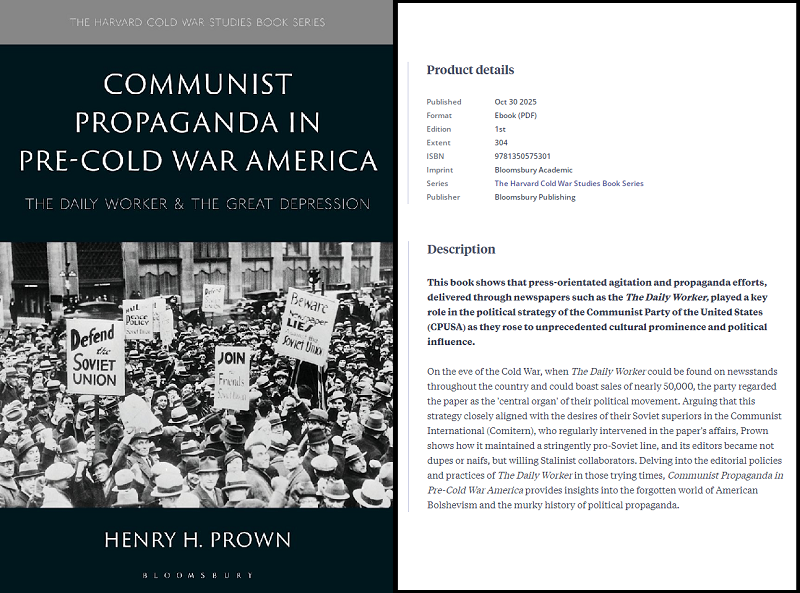
(Credit: Bloomsbury Academic and University of Alberta).
For instance the Soviets through the Comintern fed funding, articles, and orders to Communist propagandists abroad at outlets like the Daily Worker to praise agricultural collectivization and deny any and all starvation, denials which were in turn absorbed uncritically by sympathetic non-Communist Westerners – many of whom themselves took sponsored trips to the Soviet Union which they then used to publicly reject reports of famine in Ukraine in letters to the Daily Worker. The denial of media access to Ukraine and leveraging of press access in Moscow encouraged uncritical reporting of collectivization and what foreign correspondent Eugene Lyons called a “conspiracy of silence” among reporters, whose deferential coverage and victim-blaming legitimated before Western audiences the Stalinist regime’s policies in Ukraine and rejection of aid. These oppressive policies, premised on the programmatic rejection of Ukrainian statehood, enabled the labelling of any and all dissent as illegitimate nationalist terrorism. In turn the dehumanization of the kulak drove an increasingly brutal interpretation of those policies on the ground.
Collectively this effort to “confuse the issue” through sympathetic or state media – as historian Robert Conquest put it – allowed for famine to “become politicized” to quote scholar James Mace, and ultimately enabled Western governments and corporations more interested in making money than protecting human lives to ignore the Holodomor as it happened. And the legitimization of the Stalinist state through diplomatic recognition and trade ties even in the midst of forced famine allowed the dictator to accomplish his genocidal self-proclaimed triumph without external consequence. Much the opposite, actually. “There cannot be any doubt that [American recognition] is of very great significance for the whole system of international relations” Stalin quipped at the Congress of Victors in January 1934. “That anti-Soviet bulwark has been voluntarily removed,” he marveled.
Once again we must credit the man for his perspicacity. For the choice the Americans and the League of Nations made to essentially reward mass murder was just that: a choice. Much like Stalin’s decision to forcibly starve the Ukrainian people into subjugation was a choice. Much like the media’s misrepresentation of that starvation was a choice. These choices were made independently, to be sure, but they were also interconnected. Moreover, to borrow from the historian Ellen Schrecker’s perceptive analysis of the Cold War Anti-Communist movement, “the interconnections are crucial…each of its components reinforced the others, even when, as was sometimes the case, it looked as if they were operating independently.”
In drawing some more general conclusions I would like to recall the words of noted famine scholar Alex De Waal – who has observed that “the history of famine denialism is as old as the concept itself.” I do think it is worth expanding on that a bit. Because in the context of the modern world, which since the middle of the 19th century has possessed the means and the methods to save the starving and feed the famished, the question of how to cause a famine is how to hide one. Let me repeat: the question of how to cause a famine is how to hide one. The same parallel questions might be asked of genocide, incidentally enough. This is all to say…
Famine and denialism are one in the same. Genocide and denialism are one in the same. Famine is denial. Genocide is denial – physical and metaphysical. Denial not merely of life’s foundations, but also denial of their absence. Denial of assistance; denial of escape; denial of humanity; denial of witnessing; denial of victimhood; denial of justice. The mass and prolonged torture and extermination, of women and men, of young and old, by denial. The problem is power not knowledge or the lack thereof. The problem is that the denial was loaded from the start.