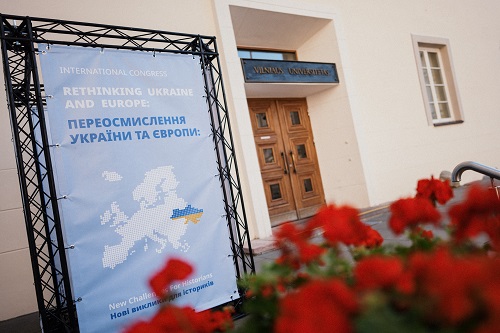
The Congress was organized by 17 institutions and associations from Lithuania, Poland, Ukraine and Germany. Among the organizers were Belarusian scholars who had fled the Lukashenko regime (Institute of political studies “Political sphere”).
According to the organizers’ estimates, the Congress was attended by around 200 scholars (some of them only as listeners) from Ukraine, Lithuania, Poland, Germany, Great Britain, Sweden, Norway, Italy, Japan and other countries. The most numerous group was Ukrainians, both those currently working in Ukraine and those with temporary or permanent affiliations in Western Europe. The Congress has been opened by a keynote lecture delivered by a prominent British historian and expert in the early modern European history, Professor Robert I. Frost from the University of Aberdeen.
The Congress had more than one objective. First of all, organizers invited representatives of various science and culture foundations from Germany, Poland, Lithuania and Ukraine. They not only provided general information about the foundations, but also gave detailed information about the specific programs that could be used by researchers from Ukraine and other countries in the region. The Ukrainian historians were particularly vocal about the need for a new German Historical Institute or a similar institution in Kyiv, and nowhere else. Congress participants also asked representatives of some German foundations why they were still cooperating with Russian research institutions. Writing this immediately after the congress, it is difficult to say how useful this part of the congress was. Especially since the best way to answer this question is to ask the congress participants, in particular those who came from Ukraine.
The second aim of the congress was to create a platform where scholars researching specific issues in the history of the region could meet. A total of 18 thematic sections were held during the congress. At the beginning of 2022, the organizing committee invited specific scholars who were responsible for the work of the panels. These panel leaders were asked to invite specific scholars, but at the same time a Call for Papers was launched and scholars from different countries were able to apply for specific thematic panels. This way, the list of speakers for the panels was established in two ways. These panels were organized in the usual way for scientific conferences: presentations by scientists, roundtables, etc. The topics of the sessions ranged from the Middle Ages to the impact of today’s Russian aggression against Ukraine on the development of historiography, the situation of scholars, and new challenges. Some of the sessions did not have a strict chronological framework, but focused on certain themes that went beyond a specific historical period (urban history; military history).
One of the aims of organizing the sections was to help researchers from different countries to get to know each other and start thinking about joint research or other projects. There were many such conversations during the congress, but we will see the results later.
No participant in the congress could write a summarizing text on the discussions in the panels, as six of them were running at the same time, so it would probably be incorrect to describe in any detail the panels in which the author of these lines participated.
While the main parts of the congress were conducted in English and Ukrainian, the panels were also conducted in Polish and Belarusian. The organizers have tried to ensure that the Ukrainian academicians do not feel uncomfortable.
Another aim of the Congress was to rethink the situation of Ukrainian studies. There was a lot of reflection in the different panels on the situation of historiography in Ukraine, but the author of these lines has only heard a fraction of such discussions and therefore cannot make any broader generalizations. The situation was different for the final discussion, which will be discussed in more detail here.
Final discussion “Do Ukraine and East Central Europe have a history?” was the paraphrase of the title of late Mark von Hagen article. Both in that article (published in Slavic Review in 1995) and in the discussion at the congress, the main focus was on the history of Ukraine, Lithuania, Poland or the region usually called East Central Europe as a legitimate field of research and teaching in academia outside of this region. It was clear even from the start of the discussion that it will be difficult to ask a question in that has not been asked in the last year and a half. Moreover, some of the participants in this distinguished group of scholars (Anke Hilbrenner, Andrii Portnov, Jan Malicki, Olena Palko, Irena Vaišvilaitė) have already been involved in not one, but probably dozens of similar debates, so it is inevitable that discussants had to repeat themselves. On the other hand, these issues are so important that they will need to be raised again and again in the future.
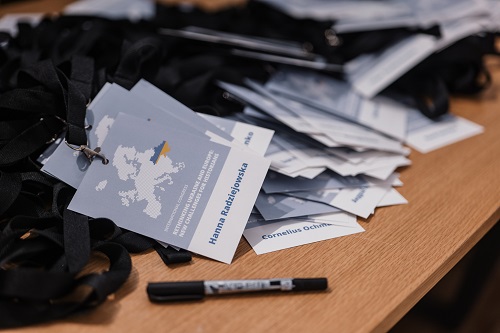
First question discussed at that panel was related to the need to rethink how the history of Ukraine and the region has been written? First of all, the issue of decolonization was addressed. In previous debates some scholars argued that all attention should be focused on institutional changes, while others argued that our scientific vocabulary needs to be rethought first. Yet other colleagues argue that we have to change the perspective. While not everyone at the panel liked the term decolonization, because it implies the existence of a center and a colony, all agreed that change (whatever we call it) is necessary. Some talked about the need for decentralization of research on the region (abandoning Russo-centrism in the choice of research perspective, learning not only Russian but also other languages of the region, paying more attention to the different actors), others pointed to the hierarchy of the knowledge production (i.e. that the voice of Ukrainian, Lithuanian or Polish historians should be heard not only when “their” history is being discussed, but also when, for example, the history of Russia is being analyzed).
Next question in the discussion has also been discussed many times in different panels since the start of the full Russian aggression against Ukraine or even since 2015. For example, in the workshops organized by Ukraina Moderna in 2021 scholars dealing with the history of East Central Europe were asked what to do with historically disadvantageous status of Ukraine as a borderland? Now this topic was addressed to the panelists asking where calling Ukraine (Poland, Lithuania, etc.) a borderland is not an unconscious adoption of the imperial point of view? An additional question here was how to make it so that that apparent “weakness” of Ukrainian history would be turned into “strengths” for a new historiography? Maybe it is worth trying to rethink the region as a space of transfer and exchange and not as simply peripheral to imperial centers? To complicate matters even more, the moderator reminded the take of the prominent Ukrainian historian, Serhii Yekelchyk, who argued that portraying Ukraine or any other region as a transfer region also deprives that country of its subjectivity. Robert I. Frost talked about similar dangers in his key-note talk on the first day of the congress. The reactions from the panelists to this set of questions were varied, with individual voices suggesting that Ukraine’s history should be divided into historical epochs when Ukraine was indeed a periphery and other periods when it had subjectivity. However, most suggested looking critically at widespread geographical imagery and rethinking our own mental maps. Discussants reminded us that concepts such as the Balkans, Central Europe, Eastern Europe are ideological constructs and instruments of power. There was also support for Yakelchyk’s remark that the positioning of Ukraine as a transfer or contact zone deprives it of its subjectivity, when Ukraine should be seen as a complex society with actors of its own. At the same time, Olena Palko pointed out another problem: at a time when the cultural turn and other new paradigms in Western academic discourse are increasingly shifting away from political history, political history is very important in Ukraine, and this can be justified, especially in the face of Russian aggression.
The hierarchy of the knowledge production was raised again in the discussion when Andrii Portnov remarked that Ukrainian historian have to prove that he/she is not a nationalist. Guilty until proven otherwise. Discussants noted that the same assessments apply to Lithuanians, Poles etc. who are labelled as promoters of methodological nationalism. The panelists tried to draw the attention of their colleagues in Western academic institutions to this problem.
Later in the discussion, we talked about whether, in the year and a half since the start of Russia’s full-scale war of aggression, there has been any change in the Western academy’s approach to Ukrainian history. All the speakers agreed that changes (in vocabulary or in the hierarchy of knowledge production) are taking place, although they are rather slow and no one knows if they will be sustainable.
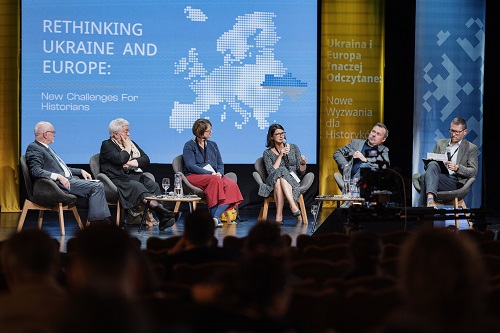
There is no doubt that changes are needed not only in the Western universities but also in Ukraine, and in this context, an important question is what is happening to young historians. In one of the sessions at the congress, Yaroslav Hrytsak pointed out that in the last decade there have been very positive developments in Jewish studies, but now a number of young professionals are in the army, and it is unclear whether these positive trends will be maintained. On the other hand, a number of Ukrainian scholars have found themselves abroad and, as the panelists noted, were immediately integrated into Western academic structures. It is hoped that the knowledge accumulated there will later influence historical research in Ukraine. At the same time, it was pointed out that there is a great need to support those historians who remain in Ukraine and to help them integrate into the international academic discourse.
On another issue – the role of historians in the face of war – the opinions of the panelists were not identical either. Some pointed to the need to be as active as possible in telling the public outside of Ukraine about the war, its origins, the history of Ukraine, etc. Others said that it is always necessary to think about whether we are succumbing to an imposed narrative. Constantly commenting on Putin’s texts on history can already be seen as a defeat, because we are succumbing to the questions asked by the aggressor.
Due to time constraints, the panelists did not have time to discuss a whole range of issues (e.g. whether war helps to come to terms with difficult past or not, etc.). You can watch that discussion on the YouTube.
The publication uses illustrations from the website of Congress.
Більше про Конгрес читайте тут