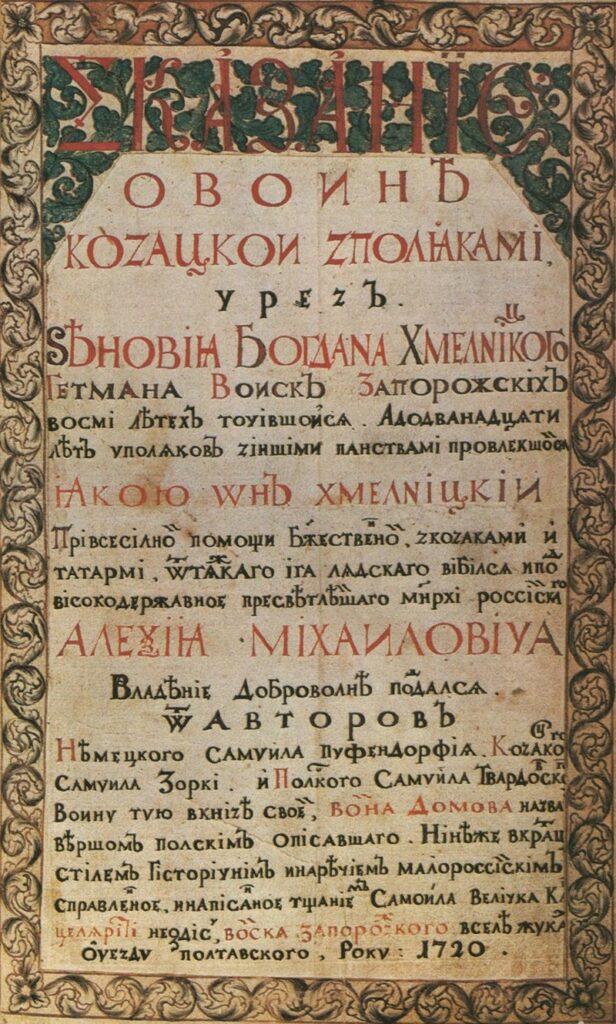
“Gentlemen Poles, it seems to me that from now on we part from you forever – we will not be yours and you will not be ours.”[1] The early eighteenth-century Ukrainian historian Samiilo Velychko quotes this statement as coming from the Cossack Hetman Bohdan Khmelnytsky when he freed the prisoners from the Battle of Batih (1652). While we may question whether Khmelnytsky ever made this declaration, we can be sure that it represented a momentous break from the traditions of Poland/Lithuania that was to be the cornerstone of modern Ukrainian history. Indeed elsewhere in the text Velychko cites Khmelnytsky’s purported Bila Tserkva universal of the spring of 1648 that describes the relationship of the Poles and the Ruthenians as that between Cain and Abel.[2] The exact dating of the documents is not of cardinal importance. What is significant is their portrayal of the Poles as the “other” that had roots much earlier in the early modern period and served as the focus for generations of Ukrainian historiography that shaped visions of Poland and the Polish-Lithuanian Commonwealth. Yet Velychko was to turn to the mid-seventeenth century Polish author Samuel Twardowski as a major source of his work. [3] Ukraine and Ukrainians might base their early modern identity as rejecting Poland and the Commonwealth, but they would be deeply influenced by its institutions, political thought, and culture, with the entities not so easy to divide as Khmelnytsky appeared to declare.
If the Cossack chronicles set the tone for Ukrainian visions of Poland and the Commonwealth, modern Ukrainian historiography with few exceptions such as Panteleimon Kulish followed along. [4] Yet it was the seemingly founders of opposite schools of modern Ukrainian historiography, Mykhailo Hrushevsky and Viacheslav Lypynsky, who encoded negative views of the Polish-Lithuanian Commonwealth in Ukrainian historical writing. [5] Hrushevsky’s vision was the clearer one, seeing the period of the fall of Old Rus’ and the middle Lithuanian-Polish period as one of decline that was hastened by the Union of Lublin and only halted by the rise of the Cossacks and the national revival of the late sixteenth century. Unlike Belarusian historians who saw the Grand Duchy of Lithuania as a joint Lithuanian-Belarusian state, he did not even see the Grand Duchy as a type of Ukrainian state, though he saw it as far preferable to Poland. Deeply imbued with populist thought Hrushevsky saw Polish institutions and social structures as deeply regressive and exploitative. Although Lypynsky was much more favorable to elites and the role of states, his roots in Polish culture did not stop him from seeing sixteenth and seventeenth-century Poland and the Commonwealth as deformed entities that repressed the rejuvenating influences of the Cossacks and the state-building tendencies, including among nobles, that emerged in the Ukrainian lands during the Khmelnytsky uprising.
The primitive Marxist models that dominated in Ukraine after the 1930s inherited negative attitudes toward the Commonwealth and combined them with concepts of an anti-feudal struggle. Cut off from the international historical community and even to a considerable degree from research in Poland, which often avoided Ukrainian issues and at times carried on Polish traditions glorifying the Commonwealth and Poland’s civilizing mission in the East, Ukrainian historiography remained isolated from major international discussions, including the General Crisis of the Seventeenth Century. [6] The witch hunt against Ukrainian nationalism and Cossack historiography of the 1970s, which even stopped source publications, lowered the level of research that had been continued in Kyiv, Lviv, and Dnipro. Fortunately figures such as Ivan Krypiakevych, Ivan Butych, Yaroslav Dashkevych, Yaroslav Isaievych, Mykola Kovalsky and others carried on Ukrainian traditions. When perestroika and glasnost arose they could be joined by specialists such as Natalia Yakovenko, who examined Polish historiography anew, as well as the Institute of Archaeography and historians such as Yurii Mytsyk that dealt with sources and new publications. [7] As the shibboleths of Soviet historiography were abandoned (“The Theses on the Tercentenary of Ukraine’s Reunification with Russia” [8]) and earlier works could be discussed, Ukrainian historiography could begin to look at the Commonwealth in new ways and strike out for new topics divorced from the Polish-Ukrainian polemics that had long dominated the field.
The first stage of rethinking can be characterized by issuing an uncensored copy of Ivan Krypiakevych’s Bohdan Khmelnytsky and opening up the discussion of how to characterize the Khmelnytsky uprising, especially in relation to questions of nation-building, state-building, and revolution. [9] Here research conducted in Poland such as Teresa Chynczewska’s discussion of national consciousness or in western-diaspora historiography such as my discussion of revolution could play a role. [10] In addition diplomatic history could be examined on the basis of sources as Ukrainian historians went abroad and had access to Polish sources (Yaroslav Fedoruk). [11] The next stage was a ground-breaking work by Natalia Yakovenko on the nobility. [12] To those outside of Ukraine who had been strongly under the influence of the Lypynsky school, the nobility seemed a tired topic. In Ukraine it was not, and above all it was not when based on wide new archival research. It was also written in a way that was divorced from the questions of betrayal by the upper strata or Polish discrimination. The third topic to blossom was new study of religious history, above all in discussions of the Union of Brest, but also of Orthodox institutions and texts. Once again publications abroad opened the way (especially the monograph of Borys Gudziak) but much was based simply on opening up sources long known and abandoning religious polemics. [13] Here Ihor Skochylas’s project on Kyivan Christianity was key. [14]
As research mounted on numerous topics and accepted assumptions, the role of Poland and the Commonwealth could be reconsidered. This had been undertaken in the emigration by figures such as Ihor Ševčenko who could address Poland’s westernizing role from the perspective of a scholar grounded in the study of Byzantium and Eastern Christianity. [15] Now however colleagues in Ukraine could both consider the role of the Ukrainian lands in the Commonwealth sine ira et studio. Sometimes this would lead to unexpected reaffirmations of earlier suppositions of Ukrainian historiography such as the presumed unity of the Ukrainian-Rus’ lands even before the Union of Lublin of 1569 (Natalia Starchenko). [16] At other times it would lead to rectifications of the meaning of conversions and role of toleration in the Commonwealth. Schools emerged in Ukraine that varied in emphasis and views such as how to portray the Khmelnytsky revolt, with some scholars closer to traditional Polish views than Ukrainian. [17] Still one might say that if the silos between homeland and diaspora historiography had been broken down, the process of Ukrainian historiography reshaping Polish visions of the Commonwealth was slower. Somehow examination of the territories in which the Commonwealth failed came slowly to Polish scholars. The eighteenth century continued to be a problem with Ukrainian emphasis on the Hetmanate and Sloboda Ukraine and lack of full attention to the Right-bank and even Galicia, except for studies of the Uniate/Greek Catholic Church. That chasm was still greatest for the late eighteenth century despite the work of western scholars Larry Wolff and Richard Butterwick. [18]
In general Ukraine has had good fortune in the development of early modern studies because of the ability to carry on archival research, deal with new concepts, and intellectual exchange with scholars in Poland. The depth of Polish-Ukrainian relations could be pointed out by those who saw the 600 years of Poland’s presence in western Ukraine as far longer than the contacts of Ukrainian lands with Russia. The Polish-Lithuanian Commonwealth, which had witnessed attempts to reform as a triune state (the Union of Hadiach, 1658), can now be examined as an entity in which long term Ruthenian/Ukrainian cultural patterns were formed and developed that underlie fundamental differences between Muscovy/Russia and Ukraine. Even the great Cossack revolt against the Commonwealth underscored how deeply Ukrainians had been affected by their experiences within the Polish cultural sphere, especially when Khmelnytsky sought an agreement with the Muscovite tsar, following models of relations with the Polish king. Russian imperial and nationalist historiography and politics have seen the link with Poland and the experience within the Commonwealth as deforming Ukrainians from their “Russian” roots. Instead their influences both negative and positive should be seen as part of a process through which the territories and groups of the Ukrainian lands of the early middle ages continued on a course of development quite different from the Russian territories and the diverse groups that inhabited them. Fortunately Ukrainian historiography has reached the point at which the Commonwealth and its inheritance can be fully integrated into the national narrative while at the same time being studied within their own right.
References
1 Samiilo Velychko, Litopys, comp. Hennadii Boriak and Tetiana Taïrova-Iakovleva (Kyiv: Klio, 2020), 193.
2 For a discussion of the text and its authorship, see Serhii Bahro, “Bilotserkivs’kyi universal Bohdana Khmel’nyts’koho: Pokhodzhennia ta obih tekstu,” Zapysky Naukovoho tovarystva im. Shevchenka 214 (2012):474–92. The text attributed to Hetman Khmelnytsky was long thought to be the call explaining why Ukrainians should take up arms but is now usually dated to the early eighteenth century.
3 Samuel Twardowski, Woyna domowa z Kozaki i Tatary, Moskwe: Potym Szwedami, i z Węgry (Kraków, 1660).
4 See Panteleimon Kulish, Otpadenie Malorossii ot Pol’shi (1340–1654), 3 vols. (Moscow: Universitetskaia tipografiia, 1888–89).
5 On the two historians’ views, see Frank E. Sysyn, “Hrushevsky Confronts Lypynsky: The Historian’s Final Assessment of Hetman Bohdan Khmelnytsky and the Khmelnytsky Era,” in Mykhailo Hrushevsky, History of Ukraine-Rus’, vol. 9, book 2, part 2, trans. Marta Daria Olynyk, ed. Yaroslav Fedoruk and Frank E. Sysyn with the assistance of Myroslav Yurkevich (Edmonton: CIUS Press, 2010), lX–lXXVIII.
6 For a discussion of the General Crisis with reference to the Commonwealth and Ukraine, see Frank E. Sysyn, “Ukraine and the General Crisis of the Seventeenth Century: The Khmelnytsky Uprising among the Early Modern ‘Revolutions,’” in Ukraine and Europe: Cultural Encounters and Negotiations, ed. Giovanna Brogi Bercoff, Marko Pavlyshyn, and Serhii Plokhy (Toronto: University of Toronto Press, 2017), 136–57.
7 See Natalia Iakovenko, Paralel’nyi svit: Doslidzhennia z istoriï uiavlen’ ta idei v Ukraïni XVI–XVII st. (Kyiv: Krytyka, 2010); Natalia Iakovenko, Ukraïns’ka shliakhta z kintsia XIV do seredyny XVII st. (Volyn’; i Tsentral’na Ukraïna) (Kyiv: Naukova dumka, 1993); Iu. A. Mytsyk, ed. “Perestoroha,” Ukraïns’kyi istorychnyi zhurnal, no. 5 (1991): 133–8; Iu. A. Mytsyk and M. V. Kravets’;, eds. Lysty Ivana Sirka: materialy do ukraïns’koho dyplomatariiu (Kyiv: Instytut istoriï Ukraïny NANU, 1995); Feodosii Sofonovych, Khronika z litopystsiv starodavnikh, ed. Iu. A. Mytsyk and V. M. Kravchenko (Kyiv: Naukova Dumka, 1992).
8 For a discussion of the historiography with the text of the theses, see John Basarab, Pereiaslav 1654: A Historiographical Study (Edmonton: CIUS Press, 1982).
9 Ivan Kryp’iakevych, Bohdan Khmel’nyts’kyi, 2nd rev. ed. (Lviv: Svitlo, 1990); V. A. Smolii and V. S. Stepankov, Bohdan Khmel’nyts’kyi: Sotsial’no-politychnyi portret (Kyiv: Lybid’, 1993).
10 Teresa Chynczewska-Hennel, Świadomość narodowa szlachty ukraińskiej i kozaczyzny od schyłku XVI do połowy XVII w. (Warsaw: Państwowe Wydawnictwo Nauk., 1985); Frank E. Sysyn, “The Changing Image of the Hetman: On the 350th Anniversary of the Khmel’nyts’kyi Uprising,” Jahrbücher für Geschichte Osteuropas 46, no. 4 (1998): 531–45; Frank E. Sysyn, “A Contemporary’s Account of the Causes of the Khmel’nyts’kyi Uprising,” Harvard Ukrainian Studies 5, no. 2 (June 1981): 254–67; Sysyn, “Seventeenth-Century Views on the Causes of the Khmel’nyts’kyi Uprising: An Examination of the ‘Discourse on the Present Cossack or Peasant War,’ Harvard Ukrainian Studies 5, no. 4 (December 1981): 430–66. See the preface to the third part of Hrushevsky, History of Ukraine-Rus’, 8:416–17; and the introduction by Frank E. Sysyn, “Assessing the ‘Crucial Epoch’: From the Cossack Revolts to the Khmelnytsky Uprising at its Height,” XXXI–lXIX; Frank E. Sysyn, “Ukrainian Nation-building in the Early Modern Period: New Research Finding,” in Theatrum Humanae Vitae. Studiï na poshanu Natali Iakovenko, ed. V. Aleksandrovych (Kyiv: Laurus, 2012), 358–70.
11 Iaroslav Fedoruk, Vilens’kyi dohovir 1656 roku: skhidnoievropeis’ka kryza i Ukraïna u seredyni XVII stolittia (Kyiv: Vydavnychyi dim “Kyievo-Mohylians’ka Akademiia,” 2011).
12 Iakovenko, Ukraïns’ka shliakhta.
13 On the Union of Brest, see Borys A. Gudziak, Crisis and Reform: The Kyivan Metropolitanate, the Patriarchate of Constantinople, and the Genesis of the Union of Brest (Cambridge, MA: Ukrainian Research Institute, Harvard University, 1998); Ukrainian translation, Borys Gudziak, Kryza i reforma: Kyïvsʹka mytropoliia, Tsarhorodsʹkyi patriarkhat i heneza Beresteisʹkoï uniï (Lviv: Instytut Istoriï Tserkvy Lʹvivsʹkoï Bohoslovsʹkoï Akademiï, 2000).
14 See Zamisʹkyi provintsiinyi sobor Rusʹkoï Uniinoï Tserkvy 1720 roku. Book. 1: Diiannia ta postanovy, ed. R. Paranʹko, I. Skochylias, I. Skochylias (Lviv: UKU, 2021); Sobory Kyïvsʹkoï arkhyieparkhiï XV–XVIII stolitʹ: dokumenty i materialy, ed. I. Skochylias (Lviv: UKU, 2022).
15 Ihor Ševčenko, “Poland in Ukrainian History,” in his Ukraine between East and West: Essays on Cultural History to the Early Eighteenth Century, 2nd ed. (Edmonton: CIUS Press, 2009), 131–86; Ukrainian translation, Ihor Shevchenko, “Pol’shcha v ukraïns’kii istoriï,” Ukraïna mizh Skhodom i Zakhodom. Narysy z istoriï kul’tury do pochatku XVIII st. (Lviv: Instytut istoriï tserkvy Lvivs’koï bohoslovs’koï akademiï, 2001), 121–39.
16 Natalia Starchenko, Ukraïns’ki svity Rechi Pospolytoï (Kyiv: Laurus, 2021).
17 On conversions, see Iakovenko, Paralel’nyi svit; Starchenko, Ukraïns’ki svity Rechi Pospolytoï; and Henryk Litwin, “Struktura wyznaniowej szlachty kijowskiej,” Odrodzenie i Reformacja w Polsce 48 (2004): 199–220; Serhii Plokhy, The Cossacks and Religion in Early Modern Ukraine (Oxford: Oxford University Press, 2001); Ukrainian translation, Serhii Plokhii, Nalyvaikova vira: kozatstvo ta relihiia v rann’omodernii Ukraïni (Kyiv: Krytyka, 2001); Yaroslav Isaievych, Voluntary Brotherhood: Confraternities of Laymen in Early Modern Ukraine (Edmonton: CIUS Press, 2009). On the Khmelnytsky revolt, see Natalia Iakovenko, “U kol’olorakh proletars’koï revoliutsiï,” Ukraïns’kyi humanitarnyi ohliad 3 (2000): 58–78; Natalia Iakovenko, “Viina iak remeslo, abo shche raz pro kozats’ki viiny seredyny XVII stolittia,” Kwartalnik Historyczny 109, no. 3 (2002): 120–33; Frank Sysyn, “War der Chmel’nyc’kyj-Aufstand eine Revolution? Eine Charakteristik der ‘großen ukrainischen Revolte’ und der Bildung des kosakischen Het’manstaates,” Jahrbücher für Geschichte Osteuropas 43, no. 1(1995): 1–18; Frank Sysyn, “Chy bulo povstannia Bohdana Khmel’nytskoho revoliutsiieiu? Zauvahy do typolohiï Khmelnychchyny,” in ПРОΣФΩNHMA: Istorychni ta filohichni rozvidky, prysviacheni 60-richchiu akademika Iaroslava Isaievycha. Ukraïna: Kulturna spadshchyna, natsionalna svidomist, derzhavnist’ 5, ed. Bohdan Yakymovych et al. (Lviv: Instytut ukraïnoznavstva im. I. Kryp’iakevycha NAN Ukrainy, 1998), 571–8.
18 Larry Wolff, The Idea of Galicia: History and Fantasy in Habsburg Political Culture (Stanford: Stanford University Press, 2010); Larry Wolff, Disunion within the Union: The Uniate Church and the Partitions of Poland (Cambridge, MA: Harvard University Press, 2020); Richard Butterwick-Pawlikowski, The Polish-Lithuanian Commonwealth 1733-1795: Light and Flame (New Haven: Yale University Press, 2020).