

Peter J. Potichnyj and Peter J. Yakob
The Ukrainian Village of Pavlokoma
A Demographic Study
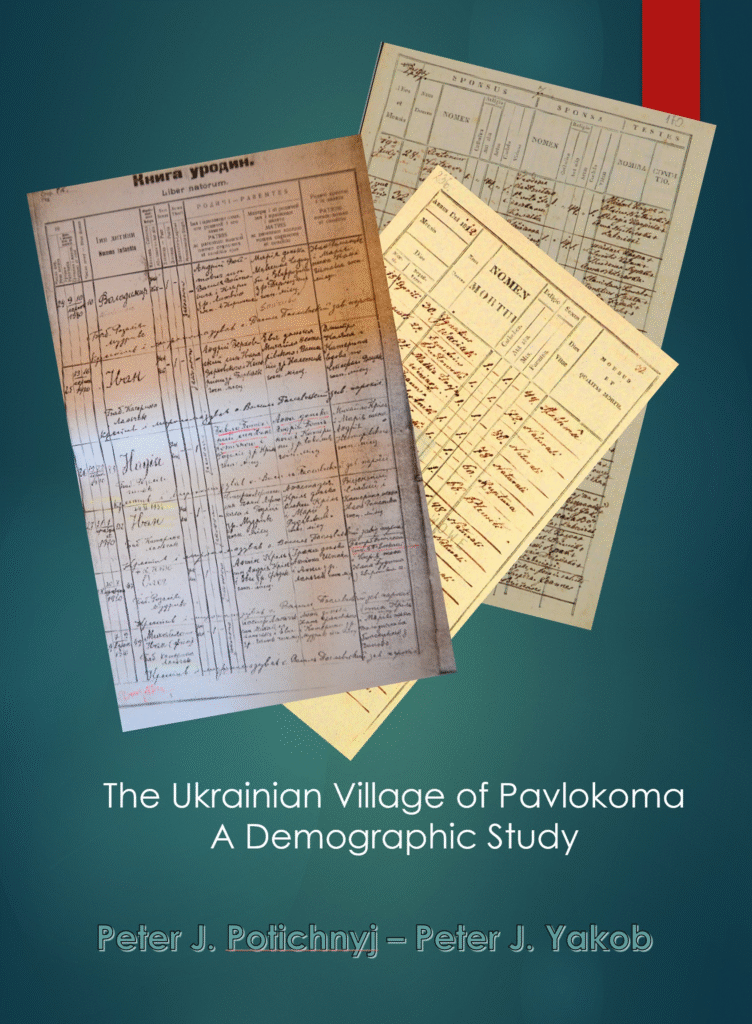
The village of Pavlokoma (Polish name: Pawłokoma) is widely known as the site of a massacre of its native Ukrainian population by the Polish Home Army in March 1945. But its history, like that of the other formerly Ukrainian villages in contemporary Poland’s San/Sian region, stretches back centuries. During Communist Poland’s “Operation Vistula” of 1947, nearly 150,000 of the region’s indigenous Ukrainian inhabitants were forcibly deported and resettled in Poland’s western and northern territories or in Soviet Ukraine. In May 2006, as part of a process of reconciliation between Ukrainians and Poles, President Viktor Yushchenko of Ukraine and President Lech Kaczyński of Poland unveiled a monument to the victims of the Pavlokoma massacre. Professor Peter Potichnyj, who was born in Pavlokoma, and Peter Yakob, a descendant of immigrants to America from Pavlokoma, have assembled a massive body of centuries-old records about the village’s inhabitants. Their monograph and its accompanying tables will be of interest to scholars and students of the region as well as to persons pursuing genealogical research.

This book is available in pdf format.
For Tamara and Janet
And in memory of the 366 Ukrainian villagers of Pavlokoma murdered during March 1945
ABOUT THIS BOOK
The Ukrainian Village of Pavlokoma: A Demographic Study by Peter J. Potichnyj and Peter J. Yakob has been published online by the Canadian Institute of Ukrainian Studies (CIUS) and the Ukraina Moderna website (https://uamoderna.com/; operated by the CIUS’s Petro Jacyk Program for the Study of Modern Ukrainian History and Society), in cooperation with the Institute of Historical Research at Lviv National University and the Manuskrypt Publishers.
This book is intended for private use by individuals interest-ed in their family history as well as by researchers and scholars in pursuit of historical, demographic, societal, family-structural, and similar research.
The Ukrainian Village of Pavlokoma may be downloaded at no cost by individuals and/or academic organizations. However, this book shall not be reproduced in full or in part and/or translated without written consent from the publisher. All rights are reserved.
Readers are encouraged to use the Search function to locate specific information such as surnames, PPINs, locations, biographical or historical information etc.
Several or the appendices were generated using Excel© spreadsheet technology prior to conversion to PDFs. Individuals interested in file linkage or in further analysis and data manipulation should convert the appendixes back to a spreadsheet format. Once converted, users can reinsert formulas to generate American Soundex Numbers, generate PPINs, and use pivot table functions.
Linkage tools can also be developed.
The authors included all available birth, marriage, death and immigration records at the time of publication. Additional records continuously become available through online genealogy sites as well as through family sites. Users are encouraged to share new information with other readers.
Readers interested in furthering research should consider the growing technology of DNA analysis. Previously unknown family relationships can be developed when DNA samples are developed.
ACKNOWLEDGEMENTS
We thank the many individuals who supported or collaborated with us to bring this project to completion, including Zenon Potichnyj and the Pavlokoma Foundation. We are grateful to Robert Parsons, Adriana Potichnyj, John A. Yakob, and Paul J. Yakob for their technical support. We also extend our thanks to Gordon Beck, director and map specialist, and Christine Homuth, spatial information specialist, at the Lloyd Reeds Map Collection at McMaster University’s Mills Memorial Library in Hamilton, Ontario.
Ol’ha Koshtovs’ka-Chervins’ka shared with us her unique knowledge of Pavlokoma’s neighbourhoods and their residents; and Olena Fedak-Potichnyj, Oleksandra Fedak-Potichnyj, Ivan Fedak, and many others provided us with assistance.
We are grateful to the staff of the Canadian Institute of Ukrainian Studies (CIUS), particularly to Roman Senkus, senior editor; Professor Frank E. Sysyn, director of the Peter Jacyk Centre for Ukrainian Historical Research; and Dr. Marko Robert Stech, director of CIUS Press and scholarly publications. We also extend our thanks to the members of the CIUS Lviv Office, Professor Yaroslav Hrytsak, Oksana Dmyterko, and Ihor Stakhiv. Our work was generously supported by the Dr. Demitrius and Maria Todosijczuk Memorial Fund at the CIUS.
Finally, we are indebted to our wives, Tamara and Janet, for their patience and dedication.
Peter J. Potichnyj and Peter J. Yakob
CONTENTS
About this book
Acknowledgements
Introduction
Вступ
Chapter 1 Pavlokoma, a Ukrainian Village
Chapter 2 Historical Demography
Chapter 3 Collecting the Records
Chapter 4 Everyone is Unique
Chapter 5 Birth Records
Chapter 6 Marriage Records
Chapter 7 Death Records
Chapter 8 Pavlokoma’s Neighbourhoods
Chapter 9 Migration Records
Chapter 10 Observations and Analyses
Appendix 1 Birth Records
Appendix 2 Marriage Records
Appendix 3 Death Records
Appendix 4 Ship-Manifest Records
Appendix 5 Pavlokoma’s Neighbourhoods
Appendix 6 Villagers’ Surnames
Appendix 7 List of Maps
Appendix 8 Landmark Co-ordinates
Appendix 9 Inheritance Case Files
Appendix 10 Villagers’ Estate and Probate Case Files
Appendix 11 Birth-Records Analysis Summary
Appendix 12 Marriage-Records Analysis Summary
Appendix 13 Death-Records Analysis Summary
Appendix 14 Migration-Records Analysis Summary
Appendix 15 Neighbourhood-Records Analysis Summary
Appendix 16 Villagers Sent as Forced Labourers to the Third Reich
Appendix 17 Villagers Who Joined the Ukrainian Insurgent Army
Appendix 18 Villagers Who Enlisted in the Galicia Division
Appendix 19 Villagers Conscripted by the Red Army in 1940 and 1944
Appendix 20 Villagers Mobilized during the 1939 German-Polish War
Appendix 21 Villagers Arrested by the NKVD, 1939–41
Appendix 22 Villagers Arrested by the Germans, 1941–42
Appendix 23 1953 List of Poles Born in Pavlokoma
Appendix 24 The 3 March 1945 Massacre in Pavlokoma
Bibliography
INTRODUCTION
Demographers, historians, archaeologists, sociologists, anthropologists, statisticians, genealogists, and even poets who wish to know more about their heritage or past populations typically have one thing in common: a profound interest in preserving the history and memories of their forefathers, families, and the towns and villages where they lived. Without these individuals’ curiosity, passion, and hard work, details about the past would be lost to future generations. It is almost a part of human nature to preserve in writing or orally the record of our existence. One can only imagine how much more of human history would enlighten us today had all the records in libraries and archives survived. Hundreds of towns and villages in Eastern Europe suffered devastation during and immediately after World War II. Since then, – historical demographers have since joined the ranks of scholars and academics to ensure that the histories of past populations are not lost. Louis Henry (1911–91), the founder of historical demography, developed tools and procedures for researchers to create advanced studies of past populations.
The Ukrainian Village of Pavlokoma: A Demographic Study was written to further historical-demography research on Pavlokoma (Polish name: Pawłokoma), the formerly predominantly ethnic Ukrainian village where our forebears were born. The village was located near the San River on territory that has belonged to Poland since 1918. Written records date back to 1441. For generations Pavlokoma’s Ukrainian and Polish inhabitants intermarried and lived in harmony despite their different faiths and customs. The Ruthenian/Ukrainian Greek Catholic and Polish Roman Catholic Churches kept records of the births, marriages, and deaths of their respective parishioners in the village from the sixteenth century on.
Pavlokoma’s records were destroyed or became otherwise lost to scholars and researchers. On 3 March 1945, 366 of the village’s Ukrainian inhabitants were brutally murdered by soldiers of the Polish Armia Krajowa (Home Army) with the collaboration of the villagers’ Polish neighbours. This Ukrainian village’s march to oblivion continued for several more years, especially once the Soviet-backed Polish government implemented so-called Akcja Wisła (Operation Vistula) from April through July 1947. During these early postwar years, several thousand Galician Ukrainian and Lemko villagers were expelled from their ancestral homes. Many of the villages they had inhabited were completely destroyed or resettled by ethnic Poles, and Ukrainian civil and church records were destroyed or removed from public access. Consequently, the ethnic Ukrainian village of Pavlokoma no longer exists. Instead, for over seventy-five years it has been supplanted by the Polish village of Pawłokoma.
The Ukrainian Village of Pavlokoma is an attempt at recovering the demographic records of individuals who called Pavlokoma their home so that they can serve the needs of the various scholarly disciplines listed above. The village’s birth, marriage, and death records exist in various Polish, Ukrainian, German, Austrian, Hungarian, Russian, and perhaps other archives. Their access and collections constitute the foundation for studying families and individuals who lived in Pavlokoma. Several sources with information about Pavlokoma’s diaspora—primarily U.S. and Canadian immigration, census, and naturalization records—were also collated. However, the authors did not have an opportunity to examine similar sources in other countries to which persons from Pavlokoma also immigrated, such as Argentina, Brazil, and Australia.
The primary method of capturing data was to develop spreadsheets of the births of all former residents of Pavlokoma, be they Ukrainian, Polish, or Jewish. Some metrical records are available, most of them Greek Catholic ones preserved in the State Archive in Przemyśl, Poland, and Lviv, Ukraine. They cover the 1784–1843 and mid-1886–1945 periods respectively. Further estimates of births were gathered from the ages of persons listed in migration records. Every attempt was made to treat each entry as a unique individual, and a Pavlokoma Personal Identification Number (PPIN) system was created for each villager, consisting of a unique variable string with an individual’s American Soundex code, the initial of their first name, their gender, and the last three digits of their birth year. The PPIN permits data from various spreadsheets to be linked, searched, and combined, thus providing rigorous documentation for a given individual. We believe the PPINs will provide historical demographers and other researchers with a tool for in-depth longitudinal and cross-sectional studies about individuals, families, and various population cohorts. We also believe that the historical-demographic data in this study will serve as a model for researching other Galician Ukrainian villages; and that demographers will be able to use the results to draw in-depth and valid conclusions regarding demographic topics of interest to them.
We did not attempt to undertake extensive analyses of fertility or mortality. However, we present an overview of these and other demographic topics and make relevant observations. It is hoped that future researchers will benefit from the information presented in this study.
This book is available in pdf format.


