Globalization and Infrastructure
In the early 16th-century, the successful circumnavigation of the world enabled the West (Europe) to develop regularly plied sea lanes that since then have tightly spanned the entire globe. Trade and conquest – hand in hand – followed swiftly, yielding Europe’s maritime empires. By the early 20th century, Russia had no choice but to avail itself of the established sailing lines to kickstart the mass colonization of the Asian part of its land empire. The Trans-Siberian railway became available for this purpose only in the decade prior to World War I.
The seas and oceans already traversable in a predictable fashion, the problem remained how to ensure similar access inland for goods, people and information. Slow, dangerous and inefficient traditional dirt tracks and caravan-style routes of times immemorial remained the standard of cross-continental travel until the development of viable railways in the 1830s. Subsequently, railway networks internally connected the landmasses of Europe, the United States, southern Canada, alongside the westernizing Japan. The rest of the world saw no comparable rail-enabled connectivity on a continental scale.
Railways in colonies and other non-Western areas were constructed not for the benefit of the inhabitants but with an eye to extracting mineral wealth and other produce for imperial metropoles in the faraway West. Rail lines did not span Africa, Southern America or Asia but rather extended from a mine or a plantation to the nearest seaport, from where produce would be shipped to the imperial metropole.
The fanning out of railways, since the mid-19th century, was accompanied by the unrolling of telegraph lines, typically in parallel to train tracks. While trains and ships transported goods and people on the global scale, telegraphy ensured the same for information. The difference was that the transport of passengers and merchandise took days, weeks and even months, whereas sending a telegraphic message was almost instantaneous.
During the 1920s, telegraphy was replaced with telephones, while automobiles usurped the domination of trains in transport. What was still missing were networks of motorways for widespread automotive use. Fascist Italy built one in the interwar period. Nazi Germany shortly followed with its own. Both countries introduced the terms autostrada and Autobahn, which to this day often are used in preference to the English word ‘motorway.’ Across the West, motorways became an addition to railways, apart from the United States, where the latter were largely superseded. Between 1920 and 2022, the US railroad network shrank from 400,000 to 140,000 kilometers.
Instead, postwar America emulated Germany’s Autobahnen and, beginning during the 1950s, started constructing an Interstate Highway System, whose total length today reached almost 80,000 kilometers. Similar motorway networks were developed in postwar Western Europe, and after the fall of communism throughout Central Europe. Also in the 1990s, China joined this construction race. The totalitarian power’s network is dubbed the National Trunk Highway System. By 2004, its length had reached the mark of 34,000 kilometers and now, in 2025, it is the most extensive in the world, standing at the mindboggling 184,000 kilometers.
During the 1950s and 1960s, the construction of networks of high-speed railways commenced in France and Japan. Italy joined this competition in the 1970s, Germany during the 1990s, while Spain at the turn of the 21st century. Notably, outside the West, China began building high-speed rails in the early 2000s. A quarter of a century later, at 50,000 kilometers, Beijing now boasts the longest network of this kind in the world. In comparison, France’s and Spain’s high-speed networks amount to a mere 3,000 kilometers each, while Germany’s is well below 2,000 kilometres. The facts are a clear indicator of China’s global leadership in this area.
To the growing mix of means of transportation, commercial (passenger) aviation was added in the US during the 1930s. After World War II, commercial aviation developed across Western Europe in the mid-20th century. After the fall of communism, at the turn of the 21st century, this trend reached the rest of the continent and also became a new norm of travel in China.
New Continental Blocs
In 2025 Washington abandoned America’s postwar commitment to global leadership. The entailed ditching of the rule-based order that underpins international relations plays into the Kremlin’s and Beijing’s hands. Both non-Western powers envision a multipolar world with their own political-cum-economic blocs the size of continents. Each of these blocs should be run in accordance with its own suitable set of principles (values). On top of that, China aspires to take from the US the mantle of the world’s political and economic leader, or rather, hegemon.
Where are then these blocs? What are their strengths and weaknesses from the perspective of infrastructure? Let us then distinguish and rank these blocs by the size of their economies. Extant political maps of the world are not (yet?) helpful in this regard.
The United States, with its annual GDP of $30 trillion, thus far, remains the world’s largest economy. The country’s area amounts to 9 million square kilometers, where 340 million people reside. The European Union with the GDP of $20 trillion boasts the population of 450 million who live on the territory of 4 million square kilometers. Until recently, Britain with 68 million inhabitants and its GDP of $3.6 trillion used to be a member of the European Union and still retains close ties with Brussels. In communist China where the GDP reaches $19 trillion, 1.4 billion people live in the country whose area is 9.5 million square kilometers.
Other important players of international economy and politics include Canada and Russia on account of territory, which totals, respectively to 10 million in the former case and 17 million square kilometers in the latter. While Canada’s population at 40 million is three and a half times smaller than Russia’s 140 million inhabitants, both countries’ GDP is almost the same at $2.2 trillion. India’s populace numbering 1.43 billion is slightly bigger than China’s. However, the country’s GDP of $4.2 is equal to Japan’s with the population more than ten times smaller, standing at 123 million. The same ratio applies to both countries’ area, or 3.3 million square miles in the case of India and 370,000 square miles, regarding Japan. What is more, Brazil ($2.3 trillion, 210 million inhabitants, 8.5 million square kilometres) seems to have thrown its lot with China. Meanwhile, Indonesia ($1.5 trillion, 285 million inhabitants, 1.9 million square kilometers) vacillates between its political tradition of nonalignment and closer links with China, given Washington’s erratic behavior.
Thanks to its nuclear arsenal on a par with Washington’s, Russia aspires to be reckoned with as a separate bloc and civilization in its own right. However, in reality, it is China that supports the country’s economy ravaged by the sanctions, imposed due to the Kremlin’s unjustified neoimperial war of recolonization on Ukraine. The Russian army is now (2024-2025) in such a weak position that the Kremlin has been forced to seek ammunition and soldiers in North Korea. It could not happen without Beijing’s consent because Pyongyang is fully dependent on China.
Should Washington express such a desire, the US could easily retain its role as the globe’s sole arbiter with the willing support of the European Union, Canada, Japan and, perhaps, Indonesia. However, America’s renewed isolationism and abandonment of its allies and international obligations leave the aforementioned players to fend for themselves. The incumbent US president’s openly stated his personal desire to annex Canada, which pushes Ottawa to cooperate more closely with the EU. Likewise, most Japanese doubt whether the US would come to their defence if China attacked. Despite Jakarta’s close defence and economic cooperation with America, Indonesia may not be sure of Washington’s commitment to containing aggressive China, either. Especially so that the US seems to be inching toward the abandonment of Taiwan, which was unthinkable just a year ago.
Instead, the present (2025) US administration pursues closer business and security links with Saudi Arabia ($1.1 trillion, 32 million inhabitants, 2.1 million square kilometers) and the Gulf countries (combined GDP of UAE, Qatar and Bahrain: $0.8 trillion). Washington’s decision to build in the United Arab Emirates a largest AI campus outside America seems to be an attempt at achieving an alliance with the region in the latest infrastructural race. Curiously, the strong presence of Chinese IT giants the UAE does not worry Washington, though may result in Beijing’s swift capture of state-of-the-art chips that officially are strictly banned from export to China.
Blocs and Infrastructure
From the domestic perspective, infrastructure decides on the quality, intensity and ease of transport and communication within a polity or economic zone (bloc). Otherwise, the level of connectivity with the outside world ensures the appropriate functioning of economy, balancing its needs with those of security.
With the world’s longest networks of motorways and high-speed railways, China is clearly winning the infrastructural race in the compartment of transportation. The US has rested on the laurels in this regard and appears to have resigned from constructing high-speed railways altogether. As a result, America’s system of motorways is congested and not maintained to a high standard. In contrast, the EU pushes for integrating the individual motorway networks of its member states and constructs new, often transcontinental, ones with quite a success. The combining and expansion of the member states’ extant high-speed railways has proved more difficult. In a nutshell, the problem is of decision-making because the EU is not a single state but a kind of a loose confederation whose member states tend to bicker over divergent interests.
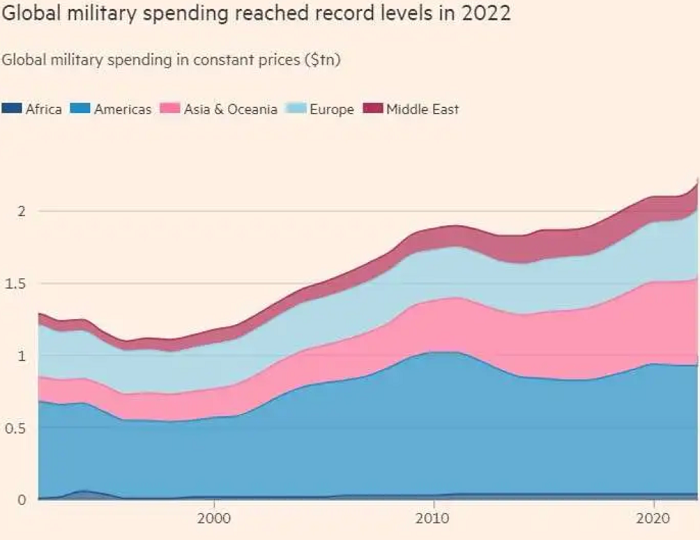
The American economy being still the world’s largest, it makes up for the country’s aforementioned infrastructural and other deficiencies. On this basis, Washington can afford to remain the world’s biggest military spender. The US defence budget is as much as three times greater than China’s. Russia is the globe’s third largest military spender. Currently, the aggregated defence budgets of the EU states amount to slightly more than China’s. However, the uncoordinated disbursement makes the use of these separate budgets inefficient. In the context of restive Russia, this may change soon and the overall EU’s military spending may as much as double for the sake of containing any onslaught that the Kremlin may be planning.
Neither China nor the US offers a social democratic system of universal health care that is free at the point of delivery. This is the shining hallmark of the EU and its pro-social policies. Furthermore, most EU countries boast accompanying universal systems of social welfare provisions for EU citizens. As a result, in Europe the average quality of life is the highest in the world and the average length of life the longest. Europe takes much better care of its human capital than the globe’s other two blocs. The facts are especially galling for the Americans who shoulder the highest level of spending per capita on healthcare.
The dilemma is that China’s infrastructural achievements and America’s military spending do not make up for the lack of equitable healthcare for all. However, the European Union can find itself being worse off, missing out on effective military defence, if Washington withdraws its assistance in this regard, thus far extended through NATO. On top of that, the weaponization of the internet (including its infrastructure) added yet another variable to this game of aggressive competition among the world’s coalescing three blocs.
Cyber Gap
Only China and the US boast big tech (IT) companies of worldwide importance. For instance, Google (Alphabet), Amazon, Meta (Facebook), Microsoft, Apple in America, whereas Baidu, Alibaba, Tencent and Xiaomi in China. Collectively, these companies dominate cyberspace and internet-based services across the world. The EU threw its lot with the US companies after it turned out that Huawei’s telecommunication equipment could make Europe susceptible to Chinese surveillance and influence. But overdependence on American companies is not a sustainable solution, either, given tax avoidance and mishandling of users’ private data.
America and Europe subscribe to the open internet, which is both their strength and vulnerability. In the West, social and political mass protests (or flash mobs) cannot be mitigated by limiting access to the internet or even switching it off in a certain area. This is the norm in China and among its allies, alongside a host of authoritarian and totalitarian regimes across the globe. China and Iran pioneered the censorship of the domestic internet access and its censorship through active separation from unwanted ideological influences that arrive from abroad. Afterward, Russia joined this totalitarian e-club with the Kremlin’s idea of ‘sovereign internet.’ Obviously, it was nothing original, but an emulation of North Korea’s internet, whose very infrastructure is physically isolated from its global counterpart.
After the end of the pandemic, in 2022, the world was stunned by the launch of the first widely available AI solution, namely, ChatGPT. Already hundreds of millions find it of much use in their everyday life. ChatGPT is a product of the US company OpenAI. In a quick succession, big tech companies released similar online AI solutions. Google (Alphabet) offers Gemini, Meta (Facebook) – Llama, Anthropic – Claude, or xAI – Grok.
Tellingly, all these companies are from the US. In addition to its largest economy and military budget, America got a head start in this new LLM arms race. LLMs, or large language models, underpin what is seen as AI (artificial intelligence). LLMs constitute the core of the aforementioned ChatGPT and similar online AI solutions. Besides making the everyday use of computers and the internet easier and quicker, those solutions enable laymen to create their own software, alongside sorting and searching ever larger stores of data faster and more efficiently.
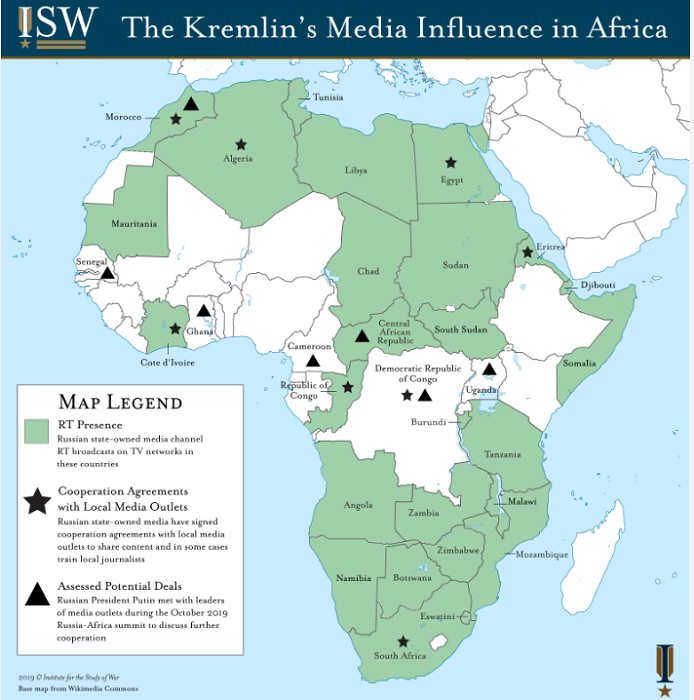
With the Russian war on Ukraine raging on, the dual – or military – use of LLMs became immediately obvious. Due to the Western sanctions on AI-level chips, China joined the LLM arms race only with a substandard chat bot Ernie, released by the tech giant Baidu. Yet, to America’s surprise, in 2025, China offered to the entire world the open-source DeepSeek chat bot that is equal to American solutions in this regard. Whereas, the compilation of LLMs and the training of AI solutions on this basis cost hundreds of millions of dollars in the US, seemingly the total outlays on creating the DeepSeek bot amounted to a mere $6 million. This achievement – or cyberwarfare-style disinformation – overnight wiped out a trillion dollars in value from the US big tech companies’ shares. In turn, the exponential uptake of DeepSeek by hundreds of millions of users, exposes them to Beijing’s propaganda and surreptitious surveillance.
The LLM race is now in full swing. Europe lags behind, though the French company Mistral valiantly joined this race. The EU’s traditional reliance on America in technology and defence makes European companies reluctant to move into the field on their own. What is more, Brussels’ approach to limiting adverse effects of AI and the internet through regulation irks the current American administration and further curbs grassroots AI initiatives in Europe. Perhaps, etatism – or state support and investment – may constitute a good reply to this dilemma. Washington’s gradual withdrawal from Europe and the incumbent American president’s attempts to derail the EU mean that Europe must fend for itself. The other option is disintegration that would entail the loss of agency and a division of Europe between the American bloc and China’s Eurasian bloc.
New Scramble for Africa
Curiously, the three coalescing blocs of a future multipolar world seem to be emulating the dystopian vision of the globe split among the three totalitarian blocs, which, in 1948, the British writer George Orwell presented in his prescient novel 1984. As in this book, the current geopolitical configuration leaves Africa for grabs. After the 1880s imperial scramble for Africa, which led to the wholesale colonization of this continent, a new AI-enabled infrastructure-based scramble for Africa seems to be brewing rapidly.
In the wake of the political decolonization mostly achieved in the mid-20th century, African countries aspired to emulate the former colonial masters, when it came to economy and politics. The West replied with haughty-style advice and offered some developmental aid, instead of due reparations. Furthermore, any grants and loans from the West were made conditional on achieving certain benchmarks in the compartments of democratization, transparency and economic regulations. These impositions angered both rulers and populaces in the postcolonial countries, recently leading to the expulsion of advisors and military contingents from the former colonial metropoles.
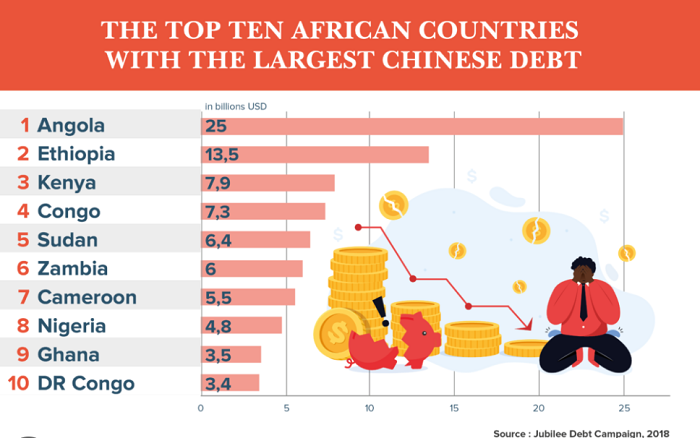
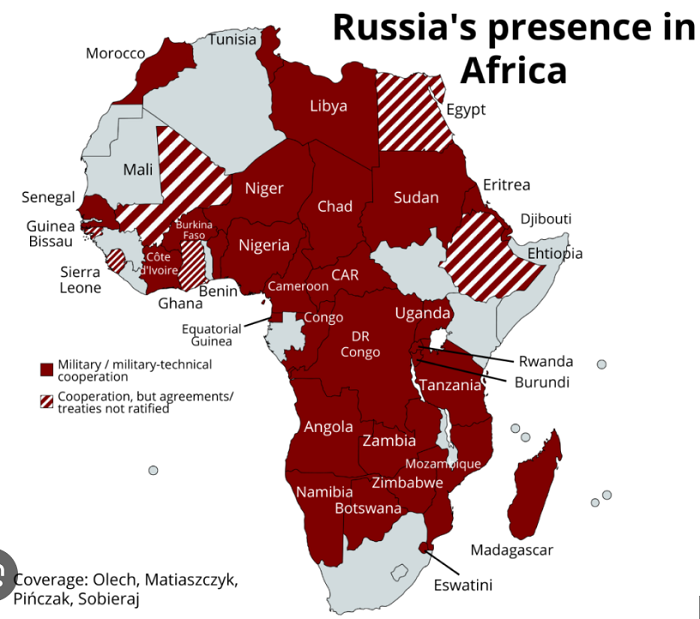
In their stead, China and its politically-blind loans are readily welcomed across Africa. In 2025, quite thoughtlessly, Washington facilitated Beijing’s plans in this regard by dissolving USAid. Meanwhile, much to many Africans’ liking, Russia offers discount oil, weaponry and mercenaries, alongside polyglot anti-Western rhetoric and ideology. Both America and Europe largely lost their pervious sway over Africa. As such the continent is now wide open to Sino-Russian neocolonization, branded as win-win development and modernization. Infrastructural projects and debt trap make subsequent African countries financially and politically dependent on China, while many of the continent’s dictators look to the Kremlin for keeping them in power with Russian boots on the ground.
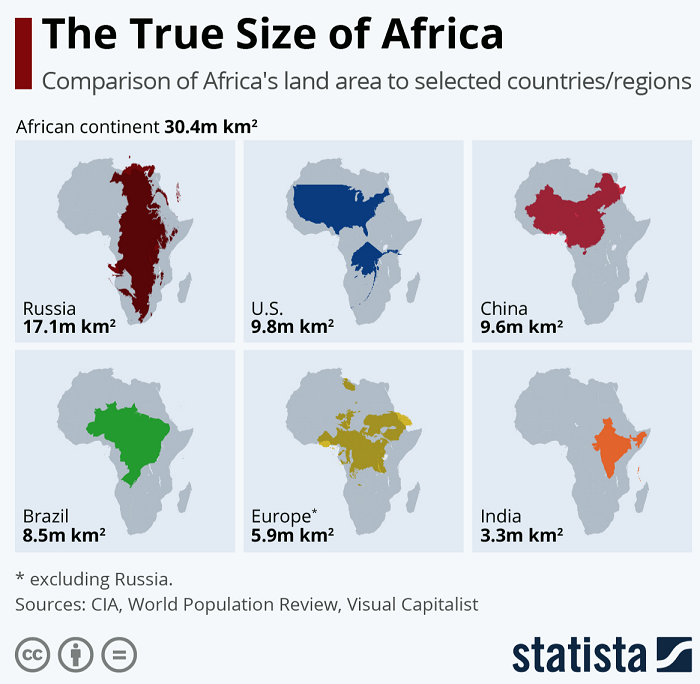
Like in the past, also today, the construction and control of infrastructure is the colonizing powers’ indispensable tool of domination and extracting wealth. Infrastructure that foreign powers offer, gift or impose deprives the recipient of agency and makes it pliable in the hands of new colonizers. China’s Belt and Road Initiative (BRI) commenced in 2013. The presumably benevolent plan was to span Eurasia, Africa and Latin America, making China into the economic and political hub for most of the world, to the marginalization of the ‘decadent West’. BRI stalled in Europe due to Russia’s war on Ukraine and Brussels’ recognition that China is an economic competitor and systemic rival. Moreover, in compliance with the Monroe doctrine, Washinton removed China’s grip over the geopolitical chokepoint in the Panama Canal.
Transport of goods and people across Africa is difficult because no viable railway networks were ever put in place there. Some freight trainlines for extracting mineral wealth inherited from the colonial times remain but most declined or were abandoned. Neither were motorways constructed for spanning the continent except for southern Africa. Many roads inherited from the colonial period fell into disrepair. What is more, outside the southern tip of Africa, the vast majority of roads remain unpaved. The tiny rich elite, fluent in the European languages of the former colonial masters, avail themselves of passenger aviation, which grew rapidly during the past two decades. Emirates and the Turkish Airlines secure dense networks of air routes that cover the entire continent of Africa.
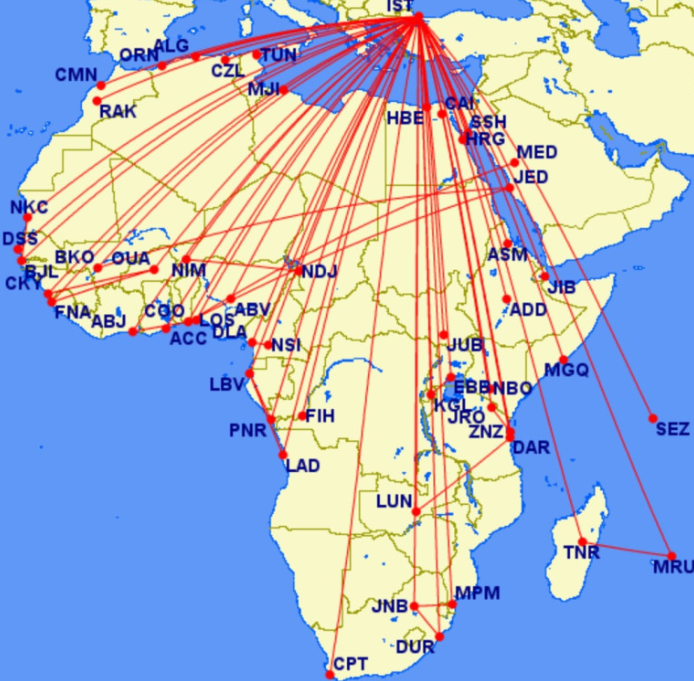
In turn, African masses are compelled to journeying on foot, by riding donkeys and camels, or to availing themselves of minibuses. Travel on dirt tracks takes days and weeks, like in premodern Europe or prior to the construction of transcontinental railway lines in North America. More well-to-do Africans who happen to reside in port cities may resort to hitching rides on oceanic ferries and freight ships to other coastal cities.
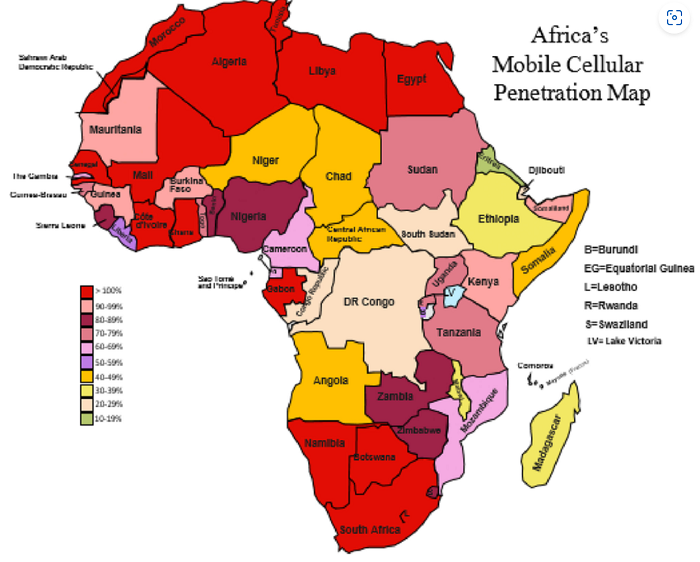
A similar situation can be observed in the compartment of information transfer. Although fixed-line telephony became the standard across the world during the 20th century, it never took off in Africa, apart from the continent’s southern end. As in the case of aviation routes that replaced never built railways and motorways, mobile telephony allowed to scale the problem with the dearth of stationary telephones. During the past two decades, almost two-thirds of Africans gained mobiles and corresponding connectivity coverage. Thanks to wind-up and solar devices, this development took place without any commensurate electrification of the continent’s towns and villages.
Neocolonial Frontier
The skipping of the construction of capita-intensive infrastructure – like railways, motorways or fixed-line telephony – to some may appear a sign of accelerated progress. In reality, it is a sure result of colonial exploitation that continues to deprive inhabitants of Africa of transport and communication services that are the golden standard elsewhere in the world. Practically, one encounters no fixed-line internet connectivity in Africa. But during the past decade internet usage doubled across the continent, reaching over 40 percent. This was possible, thanks to the spread of cheap smartphones that let internet connectivity to piggyback on mobile telephony networks.
Hence, most young and middle-aged Africans now enjoy access to the global sources of information. Yet, the lack of broadband connectivity, offered through optical cables, restricts their access to online solutions. This limited or otherwise stunted infrastructure limits the agency of Africans to excel in entrepreneurship or research. But on the other hand, it opens their countries to the global economy and entailed exploitation at the hands of Chinese and Western big tech companies.
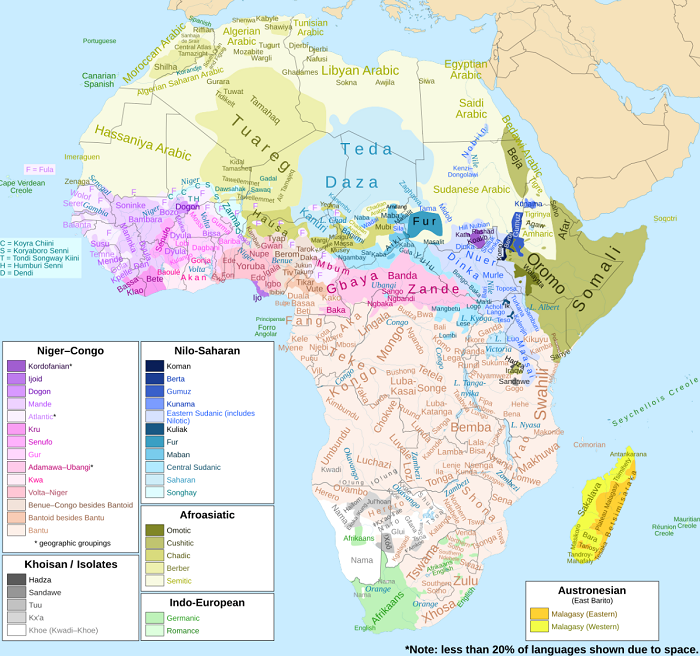
What else can be taken away from Africans in the age of the weaponized LLM race? Since the moment of their inception, LLMs have been trained on the multilingual digitized printed material (books and periodicals) and on the equally polyglot internet content generated during the past quarter of a century. However, out of around one hundred languages in which ChatGPT is available, two-thirds are of European provenance, while the rest stem from Asia. Just a single African language, Swahili, features in this repertory, due to the commercially attractive number of 80 million speakers. At its 70 million speakers the language of Hausa displays a similar international and economic appeal, like Amharic with its 60 million speakers, Oromo and Yoruba with 45 million speakers each, or Igbo and Zulu with 40 and 30 million speakers, respectively.
LLMs are not available for even big African languages, due to widespread illiteracy and the sheer dearth of publications or internet content on which viable models could be trained. As in the past, most day-to-day traffic in African languages takes place orally, through speaking, be it face to face, on mobiles or with the use of online communicators. Another problem is the lack of Western-style standardization that would be imposed and maintained through compulsory and free elementary education for all. As in premodern Europe, African languages still tend to vary gradually from village to village, city to city, region to region and state to state.
But this is not an insurmountable hurdle for the existing technology. With the competition heating up among the three global blocs, the LLM race is sure to be taken soon also to Africa. After all, data necessary for training LLMs can be harvested in the oral form through mobile networks and thanks to China’s surveillance CCTV cameras that excel at harvesting multimodal (face, audiovisual, electronic or written) data. The multi-variety English available on ChatGPT shows the way.
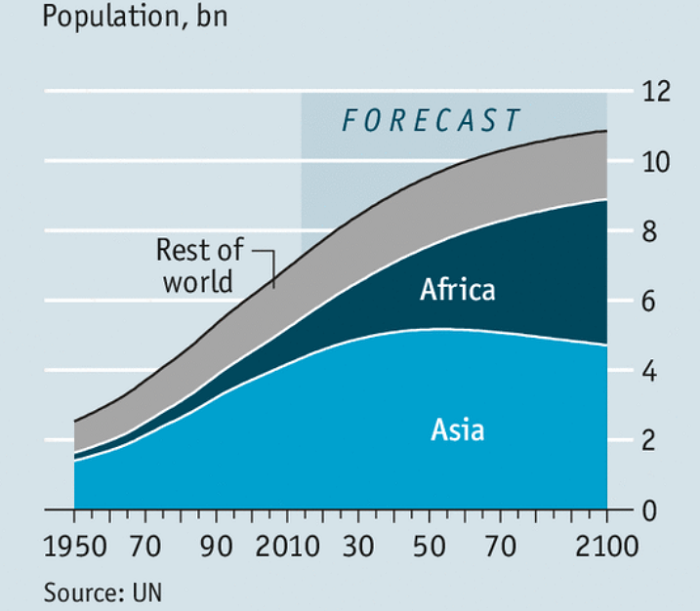
AI solutions that communicate verbally are increasingly attuned, as a matter of course, to American, British, Indian or Australian English. The same can be done for Swahili, which is spoken (and more rarely written) differently in Burundi, Kenya, Mozambique, Rwanda, Tanzania or Uganda. Similarly, the varieties of Hausa – spoken in Benin, Cameroon, Chad, Ghana, Niger, Nigeria or Togo – could be harnessed for online use and commercialization. In the wake of such a success, global companies could directly target African consumers and tap the educated African workforce without investing into education, healthcare or book publishing. Skipping such, one would think, essential investment would again leave Africans stuck deeper in the situation of chronic underdevelopment, which they have suffered since the 19th century. But on the other hand, the world’s three geopolitical blocs could profit richly, preying on the youngest and fastest growing population in the world. The number of Africa’s inhabitants topped 1 billion in 2008 and is predicted to grow almost two and a half time, that is, to 2.4 billion by 2050.
Soberingly, the point in time is only a quarter of a century away. Meanwhile, 36 years have already elapsed since the fall of communism and the end of the Cold War in 1989.
Ukraine: The Decisive Moment
Not only are the world’s three emerging blocs of America, China and Europe at loggerheads in politics, economy and war, but they also engage – tacitly or not – in a neocolonial scramble for Africa. At present, Russia’s war on Ukraine lies squarely at the crux of this multivectoral competition-cum-conflict among these blocs. Aspiring for some sort of agency on the global stage, the Kremlin strains to reverse Ukraine’s democratic choice to pursue integration with Europe and the West. Totalitarian China stands by and helps Moscow on the sly. If Russia wins, China’s Eurasian bloc of unfreedom will receive a significant boost. In the case of defeat, Beijing will save Russia from collapse and retain China’s face as a ‘neutral arbiter’ of worldwide importance. Whatever the outcome, Russia as a de facto colony will become more deeply entangled with and dependent on hegemonic China.
Ukrainian grain exports are essential for supplying most of Africa with food staples and for keeping their prices affordable. Famine and hunger brought about by increasing food insecurity would considerably lower expected profits from the neocolonial exploitation of Africa. Both Kyiv and Moscow continue to export grain to the continent’s multiple countries. The Russians are looting it on an unprecedented scale from Ukrainian depots and fields under the Kremlin’s occupation. Grain exports are yet another instrument for making Africa dependent, be it on Europe or China’s Eurasian bloc.
Under Joseph Stalin’s totalitarian rule, the interwar Soviet Union perfected the use of man-made famine for political ends during the Holodomor in Ukraine. Today, Kremlin once again utilizes hunger as a weapon on a global scale. Following the 2025 shutdown of USAid, America withdrew humanitarian support from Africa. The move has greatly facilitated Moscow’s weaponization of food supplies, making the continent gradually even more dependent on China’s Eurasian bloc.
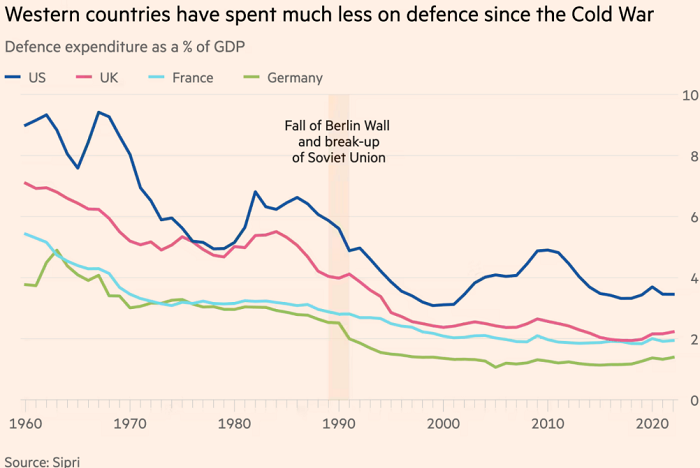
In the emerging tripartite division of the world, the postwar certainties of the rule-based international order are gone. Washington vacated the post of global arbiter-cum-policeman. Likewise, the halcyon decades of the postcommunist period are over. During the time, spending on defence was drastically cut in Europe, whereas the resultant bonus of peace dividend turbocharged the unprecedented rise in the standard of living across the Old Continent.
The long post-1945 period of peace in Europe – deepened thanks to the East-West rapprochement that followed the fall communism and the breakup of the Soviet Union – is sadly over. Russia’s hot war on Ukraine, the West’s response with cold war-style sanctions, alongside the Kremlin’s and China’s cyber and hybrid attacks on Europe and America increasingly destabilize the world. The – thus far – absence of any direct military confrontation in the EU or across the NATO area does not mean that Europe remains at peace. That was true prior to Russia’s 2014 and 2022 attacks on Ukraine. Nowadays, the situation in Europe amounts to the absence of both hot war and peace.
Can finding ourselves caught in the state of hybrid war be described as peace? Maybe, it is a kind of ‘hot peace’ or some ‘heating-up cold war.’ For sure, it is a new norm for decades to come. The globe’s three blocs that are engaged in the neocolonial scramble for Africa created and abide by this norm. What is more, these blocs appear to accept this norm, irrespective of whatever sufferings it may visit on us all soon.
The future does not look bright, even without mentioning the climate crisis.
Published for the first time. The publication uses illustrations from open sources provided by the Author.