Great Russian Literature and History
Nowadays, following Moscow’s full-scale onslaught on Ukraine, any discussion on Russian literature, culture and history sooner or later hits a moral or logical dilemma.
Isn’t the plot line of Alexander Pushkin’s narrative poem The Prisoner of the Caucasus curious? It depicts a Circassian beauty moved so much by her love to a Russian officer-cum-conquistador in Circassian captivity that she helps him flee. Does it mean that unmarried womenfolk of the nations under Moscow’s ongoing conquest would or should sympathize more with Russian conquerors than her own menfolk? Why did Fyodor Dostoyevsky devote Crime and Punishment to a failed student-turned-murderer, who believes himself destined for greatness, rather than to the old woman whom this ex-student killed for money? Leo Tolstoy condemned private property and excessive wealth. So, why did he cheat Bashkir owners of their land and mislead Russian peasants who wanted to acquire it in order to purchase a vast estate equal in size to Manhattan at a discount price? Wasn’t the writer motivated by avarice when in 1900 he sold this land at a huge profit to establish his youngest children as suitably rich and upcoming aristocrats?
Mikhail Bulgakov’s sprawling and inventive novel The Master and Margarita is unequivocally admired and lauded in the West. Who would remember that the author wanted to please with this book none other than Soviet dictator Joseph Stalin himself? That is why in a shootout presented in the novel devils and KGB agents do not hurt one another. Most lovers of belles lettres heard about Nobel prize winner Aleksandr Solzhenitsyn. In his renowned trilogy Gulag Archipelago he brough the Soviet system of concentration and death camps to the world’s attention. As an inmate himself, the writer knew that a plurality of gulag prisoners were Ukrainians, while the rest stemmed from all Soviet Union’s ethnic groups. Why then does the trilogy feature exclusively ethnic Russians?
The canon of classical Russian literature portrays characters drawn only from among the ethnically Russian nobility. At half a million, in 1900, the group accounted for a quarter of the empire’s nobles and a mere 0.3 percent of the entire population. Does it really support the claim of Russian literature to universality and unqualified greatness? Soviet literature recalibrated and broadened this social pool described, but just a bit. Characters of all ethnicities could feature in socialist realist literature, as long as they were good communists speaking and writing the language of global socialism, that is, Russian.
Tsarist, Soviet and Russian historians and writers have consistently shied away from probing into their country’s wars of imperial conquest and the fate of the subjected peoples in Moscow’s numerous colonies. Operating from the privileged colonial metropole of Moscow and St Petersburg (Leningrad), Russian authors and researchers have carefully avoided dubbing their country an empire and striven to deny the existence of its colonies. On top of that, in the Soviet and post-Soviet periods, the Kremlin’s propaganda has excelled at casting Russia in the role of the sole leader of anticolonial struggle, the postcolonial world and, at present, of the Global South. Russia with its population of 140 million proposes to be the sole representative of the Global South’s 7 billion inhabitants, which Moscow pitches against the ‘rotten West’s ‘golden billion.’

Imperialist Soul
All the aforementioned Russian and Soviet writers turned out to be loyal subjects and patriots, that is, staunch imperialists. They were unabashed bards of the Russian empire, careful never to mention Russian imperialism by its name. This unsaid imperialism trumps tyranny, which is the essence of Russian governance. Despite suffering imprisonment and exile for their timid liberal leanings, afterward mature Pushkin, Dostoyevsky and Solzhenitsyn proved their mettle as reliable Russian imperialists. Tolstoy and Bulgakov, separated by eight decades, both participated as obedient and brave soldiers in the Russian intermittent conquest and suppression of the Caucasus.
In the mid-1980s, a notorious spat took place in the American press between Milan Kundera, a Czechoslovak émigré writer living in France and Joseph Brodsky, a Soviet expellee writer domiciled in the United States. The former criticized Russian literature, as epitomized by Dostoyevsky’s oeuvre for inherent irrationality and immorality. The latter took umbrage, pointing to the belief that literature is and should be about emotions. Hence, the acme of the world’s literary pantheon is occupied by Dostoyevsky’s works, which focus on ‘the struggle for man’s soul.’
Donning the cloak of a convinced Eurasianist, Brodsky also took a jibe at Kundera, belittling the latter’s Central Europe by dubbing the region then under Soviet control as ‘Western Asia.’ In the patriotic – or rather imperialist – poem ‘To the Slanderers of Russia,’ Pushkin criticized France and Western Europe for their criticism of Russia’s bloody suppression of the Polish-Lithuanian nobility’s uprising in 1830-1831. These noble insurrectionists failed at the attempt to decolonize their homeland that a generation earlier Russia had conquered. To Pushkin this anticolonial and anti-imperialist struggle appeared to be just a ‘quarrel within the Slavic family.’ According to the poet the West had no stake or an understanding of the events. Thus, Western Europeans should stay clear of this ‘Polish war’ and let the tsar do as he willed in the vast ‘Slavic’ space from Prague to China and from Finland to Crimea.
Like Pushkin about Poland-Lithuania, like Brodsky proved his patriotic – that is, imperialist – credentials in the notorious diatribe ‘On the Independence of Ukraine,’ written in the wake of the breakup of the Soviet Union. In the poem the poet violently rejects independent Ukraine and embraces the Russian imperial idea. As a sufficient ‘proof’ of his position Brodsky belittles the Ukrainian national poet Taras Shevchenko, contrasting his verses with the presumed greatness of Pushkin’s poetry. Nowadays both imperialist poems are a fixture of Russia’s anti-Ukrainian propaganda. In turn, when Russia’s unjustified war on Ukraine continues, any Ukrainian decisions to stop or prevent commemorations of such anti-Ukrainian poems and figures are seen as amounting to ‘unjustified Russophobia.’
Mysterious Russian Soul
This fog of emotions, patriotic imperialism and delusions about some undefined greatness, as espoused by Dostoyevsky and Brodsky, alongside a host of other Russian writers, became encapsulated in the versatile expression and concept of ‘Russian soul.’ It is Русская душа Russkaia dusha in Russian or more rarely Русский дух Russkii dukh, that is, ‘Russian spirit.’
The collocation Russian soul first appeared in 1842 in the context of serfs who were popularly referred to as ‘souls’ in deeds of sale done by landowners. This then novel Russian expression drew on the German-language term Volksgeist. The latter was coined at the turn of the 19th century. It was a translation of the French expression esprit des nations, which in turn coalesced in the mid-18th century. Interestingly, though at the same time the English version of this collocation was proposed (‘spirit of nations’), it never caught on.
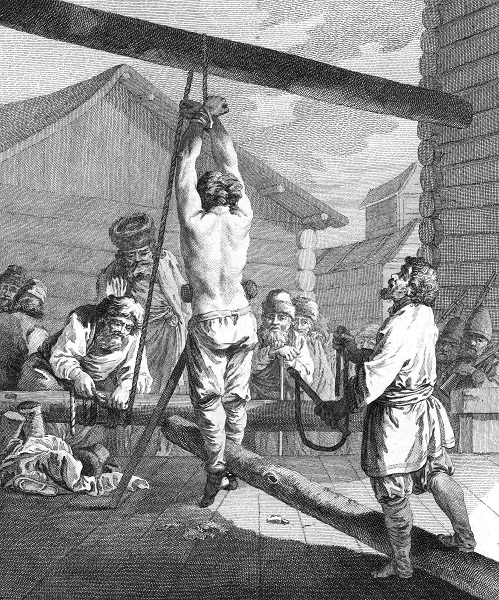
(Jean-Baptiste Le Prince, Supplice du grand knout)
In French and English this 18th-century term referred to the peculiarities of customs and culture as typical of a given people or a country’s inhabitants. Refracted through German, Volksgeist came to mean some never attested metaphysical (‘psychological’) essence of the ethnolinguistically defined nation, equating it with a given language’s speakers. In Russian, this sense connected to ethnolinguistic nationalism is denoted with the term национальный дух (natsional’nyi dukh ‘national spirit’) or народная душа (narodnaia dusha ‘people’s soul’).
In tsarist Russia itself, the ongoing irrationalization of the meaning of the concept Volksgeist went on one step further. In 1868, the convinced imperialist, proponent of panslavism, minor poet and diplomat Fyodor Tyutchev published a brief four-verse poem. Subsequently, its opening line Умом — Россию не понять Umom — Rossiiu ne poniat’ (‘You can’t understand Russia with your mind’) attained the status of a common saying in Russian.
This saying is often paired with the term Russian soul as a koan-like explanation of the latter. I interpret the Russian president’s 2016 enigmatic proposal that ‘Russia is borderless’ as a variation on Tyutchev’s opening verse. After all, the poet concluded his piece by saying that ‘Russia is so boundless that you can only believe in it.’ It is nothing less than Tyutchev’s passionate confession of love and faith to the Russian Empire. I am sure that the Russian president subscribes to it when opining that ‘Ukraine is not just a neighbouring country for us. It is an inalienable part of [Russia].’
In 1861, commenting on the uniqueness of Russian literature, Dostoyevsky wrote ‘It’s frightening how free a Russian man’s spirit [дух dukh] is, how strong is his will! No one has ever been so much torn away from his native soil, as he sometimes had to be; nobody ever took a turn so sharp, as he, following his own belief!’ But what does it mean? In 1873 the writer ‘explained’ that ‘the most basic, most rudimentary spiritual need of the Russian people is the need for suffering.’
By the turn of the 20th century, the collocation ‘Russian soul’ became widely accepted in culture, politics and historiography – both in Russia and abroad – as an objective term for emphasizing and explaining the uniqueness of Russia and its presumed civilizational destiny of an inscrutable character.
The use of this Russian term peaked during the Second World War, when the Soviet Union under the German attack teetered on the verge of collapse. Afterward, the employment of this collocation declined in the postwar Soviet Union before picking up in the decade preceding the demise of the USSR. Interestingly, a politically significant variation of this term Российская душа Rossiiskaia dusha peaked prior to the adoption of the Russian world (Russkii mir) ideology in the 2010s.
Although both adjectives Russkii and Rossiiskii are translated as ‘Russian’ into English, the former refers to ethnic Russians (or Orthodox Russian-speakers), while the latter to all Russia’s inhabitants, irrespective of ethnicity, religion or language. This switch from Russkii to Rossiiskii announced the abandonment of the idea of building a democratic multiethnic Russian people in favor of the ethnically homogenous Russian nation.
Imperial Triad
In a nutshell, the collocation Russian soul is a shorthand for the Russian imperial ideology last time standardized and succinctly expressed in the 1833 triad of Orthodoxy, Autocracy and Peoplehood (Nationality). Following the established imperial order (as preordained by the Orthodox God or the Russian autocrat himself), the population at large (narod), especially ethnic Russians (natsia), must unquestionably obey this autocrat’s (be it the tsar, general secretary of the communist party, or the president) orders however inscrutable these may turn out to be. The autocrat knows best, as informed by his unique access to God (or the ruling ideology).
When the autocrat’s inscrutable decisions visit multiple tribulations and sufferings upon the common folk, the troubles are readily explained away by Russia’s civilizational destiny and its imperial greatness. People are expected to suffer patiently, awaiting a just reward in the heavenly or communist paradise. Meanwhile, their partaking in the great empire must suffice.
Russian citizens in their quotidian conversations employ the term Russian soul to either to explicate or comment on their own dire circumstances. These include the obvious discrepancy in the standard of living between the rotten capitalist West and godly Russia. In turn, this collocation works both as a justification and pretext of why Russian conquistadors in Ukraine must rob, rape, torture and kill. Due to its sins, the West owes these scarce goods and pleasures to God- and power-fearing Russians.
Because of Russian soldiers’ actions innocent civilians of different ethnicities may suffer. But it is not the former’s fault, if a Russian war criminal is apprehended and put in the dock. Culprits shrug at the evidence of their crimes and point to the mysterious Russian soul that compels them to do unthinkable and inhumane things. Western pundits of Russian studies demure and continue probing into the presumably bottomless Russian soul in search for answers.
There is nothing to be found there. The collocation is a rhetorical device to pull wool over the eyes of all and sundry. As a result, neither Russians themselves nor foreigners are able to see clearly that the Russian soul is nothing else but a fancy synonym for the unrepentant imperialist’s mindset. The Kremlin’s propaganda can and does tap it for confusing the West and whitewash Russia’s colonial crimes and imperial conquests in the past, today and in the future. By definition, Moscow as the self-appointed leader of the postcolonial world cannot be guilty of the crimes of colonialism and empire building.
Mendacity is the Kremlin’s material dialectics.
December 2024