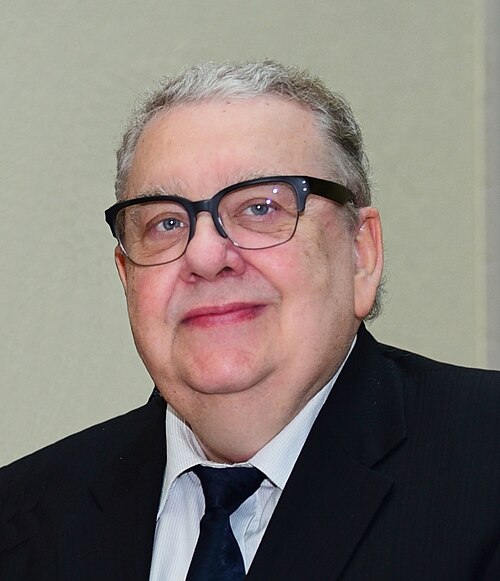
3 червня відійшов у вічність професор Петро Й. Потічний. Йому було 96 років. Його остання книга, написана у співавторстві, була присвячена його рідному селу Павлокома. Вона була опублікована на сайті “Україна Модерна “.
Пропонуємо Вашій увазі виступ (англійською мовою) п. Романа Сенькуся на презентації цієї книжки в Українсько-канадському дослідчо-документаційному центрі у Торонто 2 листопада 2025 року.
Роман Сенькусь був багаторічним старшим редактором видавництва Канадського Інституту Українських Досліджень, яке видало декілька збірників статей за редакції проф. Потічного.
Years ago, back in 2001, Peter Potichnyj asked me to say a few words at the Toronto launch of his first history of Pavlokoma, his native village. I accepted his invitation without hesitation, as it is was a great honour and pleasure for me to do so. My participation in today’s launch of Professor Potichnyj’s second history of Pavlokoma, written this time in English together with Peter Yakob, is, of course, again a great honour and pleasure. I have known Professor Potichnyj for nearly a half-century, since the latter half of the 1970s, when I began working as an editor at the Toronto branch of the Canadian Institute of Ukrainian Studies. From the very beginning of the institute’s scholarly activities, Professor Potichnyj was its great supporter and close collaborator. He helped to publish its first textbooks, on which I worked at the CIUS Toronto office, and organized three important and influential international academic conferences at McMaster University on Ukrainian-Polish, Ukrainian-Russian, and Ukrainian-Jewish relations (in 1977, 1981, and 1983 respectively). Professor Potichnyj compiled and edited the collections of papers presented at these conferences and they were published by the CIUS Press (1980, 1988, 1992). He also prepared for CIUS Press a collection of key documents of the wartime Ukrainian nationalist underground’s political thought in English translation (1996), coedited with Yevhen Shtendera.
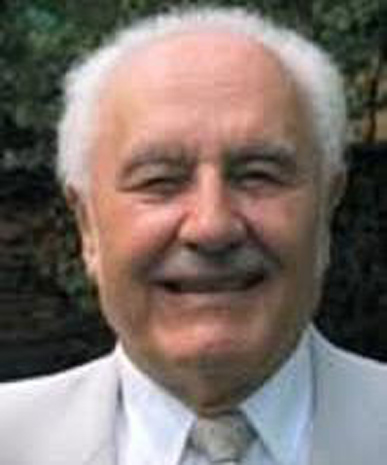
I also know and respect Professor Potichnyj for his tremendous contribution to the initiation and publication of the important, multi-volume Khronika UPA (Chronicle of the Ukrainian Insurgent Army) book series and for his painstaking work in compiling the best collection of archival documents on the Soviet state’s struggle against the OUN-UPA, which he donated to the University of Toronto library for preservation. This series has enabled contemporary and future scholars to study in detail and objectively the history of the Western Ukrainian nationalist underground during World War II and the unofficial but total war waged by the Soviet state until the first half of the 1950s. Then in 1996, I had the honour of editing and publishing a collection of 15 articles written in honour of Professor Potichnyj by his colleagues in Canada, America, Ukraine, and even China as a special issue of the CIUS Journal of Ukrainian Studies, for which I was responsible for many years.
There is another reason why I am pleased to speak to you today, namely my family background. My mother, Evheniia Karpa, and her brother and two sisters were all born in Pavlokoma, but when their parents went to France as migrant workers during the Great Depression, they were taken by their maternal grandmother and uncles to live with them in the village of Hlidno 14 km. from Pavlokoma. During the Second World War, my mother and her brother were transported to Germany as forced labourers, while their sister was evacuated from Lviv and survived the terrible siege and battle of Stalingrad while serving as a nurse in the Red Army. None of them were in Pavlokoma when the brutal massacre of 366 of the village’s Ukrainian inhabitants by a unit of the Polish Home Army in 1945 took place, forever and almost completely eradicating this rural bastion of Ukrainian identity in the Zakerzonnia region. I first heard about this war crime from my mother when I was still a child. I will always remember how sad I was when I drove to see Pavlokoma in 1984 and saw almost no trace of the once proud Ukrainian community there.
I am very grateful to Professor Potichnyj and Peter Yakob, whose maternal grandfather emigrated from Pavlokoma to Pittsburgh in 1903, for researching and writing this new history and demographic study of Pavlokoma, copublished in English online by the CIUS and the Lviv journal Ukraina Moderna. Their work forever documents the fact that Pavlokoma was a Ukrainian settlement since ancient times and that it is only because of the atrocities committed by Polish war criminals in March 1945 that it is no longer so. Over the course of several years, Professor Potichnyj devoted much effort into researching and collecting unique historical documents about Pavlokoma in the archives of Lviv and Przemyśl, as well as the memories and testimonies of former residents of the village scattered around the world. His and Peter Yakob’s authoritative work recreates the history of this Ukrainian settlement over more than five centuries. In it, we learn about the early history of the village in the Middle Ages; how its inhabitants lived, worked, rested, and celebrated during serfdom; who the local landowners were; and about individual families and their individual members. The book also depicts the history of Pavlokoma’s Ukrainian community life — that is, the history of its church, school, and branch of the Prosvita cultural organization.
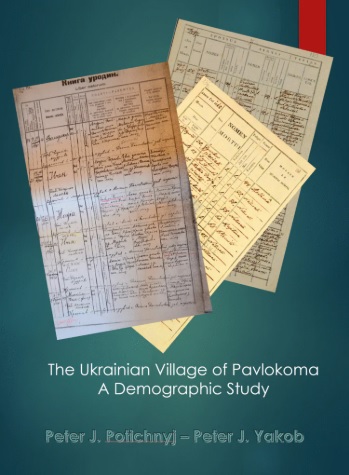
In their book, the authors alternate between a detailed examination of their sources and methodology with descriptions of the village’s history and, in some cases, broader contexts. They begin their narrative in prehistoric times. The authors trace the origins of the village itself to an ancient settlement on the outskirts of Pavlokoma, disagreeing with the thesis that the village arose in the 15th century (when the first written mention of it was recorded) “on an empty site.” They tell the story of the Pavlokoma school and of its Prosvita branch, describe peasant traditions of marriage and burial, depict a typical hut and household, and tell how emigrants who returned to the region brought with them a new “Western” type of construction. Most of these stories are taken mainly from Potichnyj’s previous book, in a slightly abridged version.
Professor Potichnyj compiled a detailed list and information about all of the villagers who were murdered in 1945, thus ensuring that their memory would be preserved. He also provides information about their killers, among whom were neighbours and even relatives of the victims. This important information proves that the myth of Polish innocence during the war remains unjustified and that there were and perhaps still are war criminals who were never punished for their criminal acts.
However, the new work focuses not on the tragedy of the village, but rather on its history prior to 1945. Professor Potichnyj was born there in 1930, and at the age of 14 or 15 he joined the Ukrainian Insurgent Army, with which he managed to break through to the West. He has spent his entire adult life on the North American continent, first as a U.S. Marine in Japan and Korea and a student at Temple and Columbia Universities, and then for many years as a professor at McMaster University in Hamilton. Professor Potichnyj has devoted his studies primarily to two topics that directly affected his life: to the Ukrainian liberation movement and to his native village, which he left forever as a teenager.
In their book, Potichnyj and Yakob have deliberately limited the focus of their research, concentrating on collecting and systematizing data on the village’s population in order to provide a basis for further research, in particular for in-depth studies of the causes and consequences of demographic processes. Their main task was to identify every resident of Pavlokoma found in various archival data — not an easy task because the names of the same person may be recorded in various archival records in different languages (Latin, German, Polish, Ukrainian) and transliterations. Consequently the authors developed their own system for assigning each person a Pavlokoma Personal Identification Number (PPIN) based on the American Soundex code.
The main sources for their study are the metrical books of births, marriages, and deaths of the Greek Catholic parish in Pavlokoma. The records preserved therein contain information beginning in 1784, when the Habsburg administration instructed parish priests of all rites to keep population records. The village’s metrical books are missing for significant periods of time after 1843 because most of them were destroyed in a fire in the parish church before their copies had been sent to the Roman Catholic diocesan archive in Przemyśl. The authors endeavoured to fill these lacunae with civil records, such as the population censuses in Austria-Hungary.
Despite their efforts, the authors were unable to gain access to the Roman Catholic and Jewish records kept by the parishes in the neighbouring village of Dylągowa and the nearby town of Dynów. Therefore, their history of the “Ukrainian village of Pavlokoma,” is the history of its Ukrainian Greek Catholic community, which, according to various sources, constituted about 70% of the village’s population.
Another important source was various migration documents, from which Potichnyj and Yakob gleaned information about villagers from Pavlokoma who immigrated to the New World, particularly to the U.S.—ships’ passenger lists, mobilization registers, naturalization data, and so on. They also obtained information through correspondence with people from Pavlokoma or their descendants.
The authors also conducted several interesting analyses. For example, they determined the average age of first marriage for men and women, the number of remarriages, and the age difference between men and women in their first and second marriages. They also created a population pyramid for Pavlokoma in the years for 1787, 1800, 1842, 1912, and 1938 and have tried to determine which trends (epidemics, emigration, etc.) influenced the structure of the village population. In general, by comparing data from various sources, the authors managed to establish the names of 3,500 people born in Pavlokoma from the late 18th to the mid-20th century.
The topographical part of the study deserves special attention. Using cadastral records and maps, the authors identified 163 different localities in the village as of the 1930s and 1940s, with a list of their inhabitants, and also localized each farm in the village as of 1945 with coordinates on the map. These results are illustrated on the map that adorns the study’s back cover.
The authors recorded all the results of their work in numerous tables, which they included as 24 appendices totalling 443 pages! These appendices make up three-quarters of the book itself and are, in fact, the main result of the authors’ work. They also contain lists of the names of those villagers who were mobilized by the Polish and Red Armies during World War II, those who joined the UPA and the Galicia Division, those who suffered Soviet and Nazi repression, and finally, 366 of the victims of the 1945 massacre.
Peter Potichnyj and Peter Jacob’s book will remain an invaluable resource for anyone interested in the past of Pavlokoma, and a solid basis for further research on the history of the village and its inhabitants. It is undoubtedly an important contribution to Ukrainian studies and a perfect example of micro-history research. In addition to its scholarly value, it also serves another function — the preservation of historical memory. I congratulate the coauthors on the publication of their important study and wish them continued inspiration and the best of health.